7
BLOWER AIR INTAKE
To minimize maintenance, supply your blower with the cleanest air possible. It is important that the air does not contain any
flammable or toxic gases, as the blower will concentrate these gases. This could result in damage to the unit and surrounding
property, lead to personal injury or death.
WARNING: Do not use air blowers on explosive or hazardous gases. Each size blower has limits on pressure
differential, running speed, and discharge temperature. These limits must not be exceeded.
If it is necessary to take air from a remote source, such as in a vacuum application, the piping should be at least the same diameter
of the blower inlet. For distances greater than 20 feet (6 m) the pipe diameter should be enlarged to reduce inlet restriction.
Excessive restriction will reduce the efficiency of the blower and elevate its discharge temperature. The piping used should also
be corrosion resistant, and free of scale and dirt. The inlet should be covered to keep out precipitation, insects, and small animals.
Vacuum kits are available.
MOTOR DRIVES
Two drive connections commonly used are direct drive and V-belt drive.
DIRECT COUPLED
When installing the motor directly to the blower, align shafts to the coupling in accordance with the coupling manufacturer’s
instructions. blowers shipped with motor directly coupled and mounted on a common base have been aligned prior to shipment
and normally no further alignment is necessary. However, alignment should be checked and adjustments made if necessary prior
to starting the unit.
V-BELTS
If the motor and blower are V-belt connected, the sheaves on both motor and blower shafts, should be as close to the shaft bearings
as possible. Blower sheave is not more than 1/4” (6.5 mm) from the blower drive end cover. The drive sheave is as close to the driver
bearing as possible. Care should be taken when installing sheaves on the blower and motor shafts. The face of the sheave should
be accurately in line to minimize belt wear.
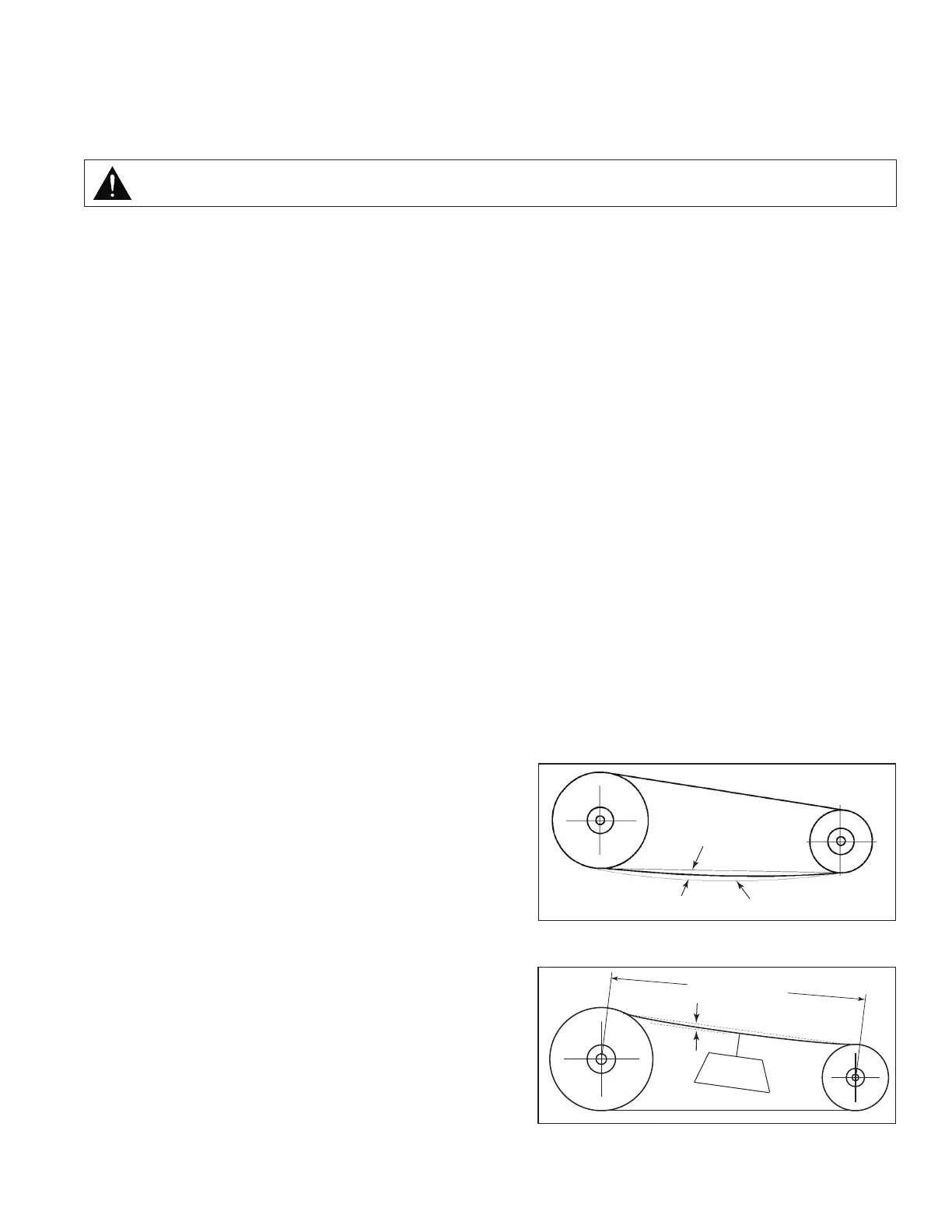
Adjust the belt tension to the manufacturer’s specifications using a belt tension tester. New belts should be checked for proper
tension after 24 hours of run time. When manufacturer data is not available industry guidelines are 1/64” deflection for each inch of
span at 8 to 10 pounds of force in the center of the belt. (Also see Figure 3).
Insufficient tensioning is often indicated by slipping (squealing) at start up. Belt dressing should not be used on V-belts. Sheaves and
V-belts should remain free of oil and grease. Tension should be removed from belts if the drive is to be inactive for an extended period
of time. For more specific information consult the drive manufacturer.
In a V-belt drive, the blower sheave must fit its shaft accurately, run
true, and be mounted as close to the bearing housing as possible to
minimize bearing loads. (Also see Figure 3)
A tight or driving fit will force the drive shaft out of its normal position
and cause internal damage. A loose fit will result in shaft damage or
breaking. The motor sheave must also fit correctly and be properly
aligned with the blower sheave.
Adjust motor position on its sliding base so that belt tension is in
accordance with drive manufacturer’s instructions. Avoid excessive
belt tension at all times. Re-check tension after the first ten hours of
operation and periodically thereafter to avoid slippage and loss of
blower speed.
Check blower after installation and before applying power by rotating the
drive shaft by hand. If it does not rotate freely, look for uneven mounting,
piping strain, excessive belt tension, or coupling misalignment. Check
blower at this time to insure oil was added to reservoirs.
Figure 3. General appearance of V-belt drive
Too Tight
Slight Bow
Too Loose
Figure 4. Proper tension for a V-belt drive
20/64” = 5/16” (8 mm)
20”
(50.8 cm)
8-10 lbs.
(3.6-4.5 kg)



 To Next Page