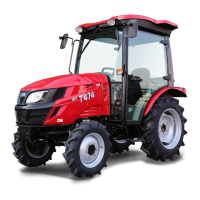
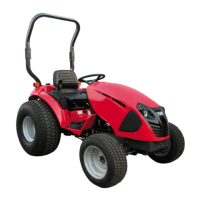
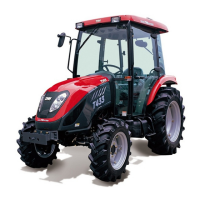
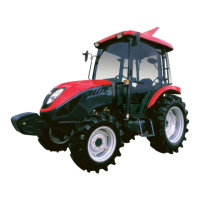
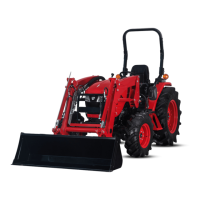
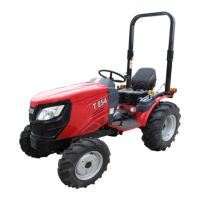
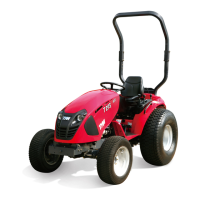
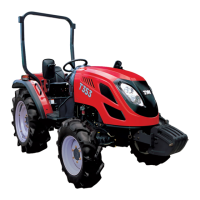
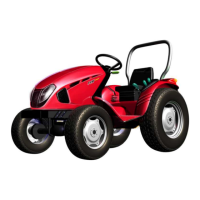
This document serves as a device manual for the TYM 2400, 2400H, 2510, 2510H, and 2610H tractors. It provides comprehensive information on general precautions, warranty, overview of the tractor, functions, operation and work, maintenance, troubleshooting, specifications, and emissions control warranty.
General Precautions
The manual emphasizes safety with various warning symbols:
- DANGER: Indicates a high risk of death or serious injury if instructions are not followed.
- WARNING: Indicates a potential risk of death or injury.
- CAUTION: Indicates a potential risk of injury or equipment damage.
- NOTE: Provides additional descriptions for effective machine operation.
- IMPORTANT: Highlights crucial information for correct and safe use, advising to keep the manual close to the tractor.
Key safety precautions include:
- Maintenance: Perform maintenance on a flat, safe, and well-lit surface. Block tires to prevent movement.
- Exhaust Gas: Do not operate the engine in enclosed spaces; ensure good ventilation to avoid intoxication.
- Clothing: Wear appropriate, non-loose clothing, anti-slip shoes, and a safety helmet.
- Implements: Use only manufacturer-recommended implements.
- Passengers: Only the driver should be on board; do not allow others, especially children, near the tractor during operation.
- Road Safety: Connect brake pedals when driving on roads to prevent one-sided braking. Reduce speed on turns and hilly roads to avoid overturning. Observe traffic regulations and wear a helmet.
- Children: Keep children away from the tractor at all times.
- Training: Ensure anyone operating the tractor reads the manual and is properly trained.
- Hazardous Materials: Properly discard hazardous materials like coolant, brake oil, engine oil, filter elements, and batteries. Do not dispose of chemicals on the ground or in waterways.
- Fueling: No smoking or open flames near the fuel tank. Fill the tank only after the engine has cooled to prevent fire or explosion.
- Electrical System: Regularly inspect electrical parts and wiring for contact insulation, shorting, or sparks.
- Tires: Do not overinflate tires beyond the maximum pressure.
- Tools: Use proper tools for maintenance.
- Hood/Covers: Secure hood and side covers before operating.
- Battery: Connect the positive (+) terminal first when installing, and disconnect the negative (-) terminal first when removing. Avoid contact with battery solution.
- Periodic Maintenance: Perform regular maintenance and replace hydraulic and brake hoses every two years.
- PTO Shaft: Cover the PTO shaft when not in use and apply grease.
- Hot Parts: Avoid touching hot parts like the muffler immediately after operation.
- High Oil Pressure: Ensure hydraulic couplings and hoses are not loose or damaged. Release high pressure before disconnecting.
- Storage: Disconnect the battery and key for prolonged storage. Place the clutch pedal in the "Disconnect" position. Confirm implements are on the ground before starting the engine.
- Slopes/Ramps: Do not shift gears on slopes or loading ramps. Use proper loading ramps with sufficient strength and width. Move the tractor backward when loading and forward when unloading.
- Modifications: Use only genuine or approved parts. Do not modify the tractor.
- Towing: Move wheels to the widest setting on slopes or when towing. Use caution when towing a trailer, linking its brake with the tractor's. Follow implement instructions.
- Balance: Balance heavy implements with front weights. Do not put hands or feet under or near implements.
- Rotary: Be careful of unexpected movement when using the rotary.
- Transport: Secure the tractor during transport by applying the parking brake and fastening it to the truck.
- Drawbar: Use the drawbar for towing; do not use the top link or lower link.
- PTO RPM: Be aware of PTO RPM requirements for implements.
- ROPS: Fasten the seat belt when ROPS is upright. Do not fold down ROPS when working. Check ROPS for damage.
Important Technical Specifications
The manual provides detailed specifications for various models:
Engine (Models 2400, 2400H, 2510, 2510H, 2610H):
- Maker: A1100N2 IDI NA
- Aspiration: Natural
- Emissions Standards: Tier 4
- Gross Power hp (kW): 24 (18.0) for all models
- PTO hp (kW): 21 (15.7) for 2400, 2510; 18 (13.5) for 2400H, 2510H, 2610H
- No. of Cylinders: 3 for all models
- Displacement cu.in (cc): 71.7 (1,175) for all models
- Rated Revolution RPM: 2,800 for all models
- Max Torque lb-ft (Nm): 47.9 (65.0) for all models
- Fuel Tank Capacity gal (L): 6.0 (23.0) for all models
- Fuel Consumption gal.hr (L/hr): 1.5 (5.8) for all models
- Air Cleaner: Dry, Element
- Alternator 12volt amp: 50 for all models
Drivetrain:
- Transmission: Sliding Mesh (2400, 2510), HST (2400H, 2510H, 2610H)
- Forward/Reverse Method: HST (2400H, 2510, 2510H, 2610H)
- 4 Wheel Drive: 2WD/4WD for all models
- No. of Traveling Speeds: 6F / 2R (2400), 2 Range (2400H), 9F / 3R (2510), 3 Range (2510H, 2610H)
- Clutch: Dry Single Plate for all models
- Brake: Wet, Multi-disc for all models
- Differential Lock: STD for all models
- Creeper: No for all models
- Cruise Control: No (2400), Standard (2400H, 2510, 2510H, 2610H)
Hydraulics:
- Power Steering: Power Assisted Hydrostatic for all models
- Total Hydraulic Flow (POWER STEERING+Implement) gpm/lpm: 7.4 (3.1+4.3) / 28.1 (11.7+16.4) for all models
- Lift Control Type: N/A (2400), Position (2400H, 2510, 2510H, 2610H)
- Joystick Valve: No for all models
- Rear Remote (Port): N/A (2400), Option (up to 2) for 2400H, 2510, 2510H, 2610H
3 Point Hitch:
- 3 Point Hitch: CAT I for all models
- Lift capacity at lift link ends lbs (kg): 1,499 (680) for all models
- 3Point Hitch Lift Capacity @24" behind lift point lbs (kg): 974 (442) for all models
PTO:
- Rear(Mid) PTO Speed RPM: 540 / 960 (2,500) for all models
- Rear PTO Type: Live for all models
Tires:
- Front: 6 - 12 (2400, 2400H, 2510, 2510H), 7-16 (2610H)
- Rear: 9.5 - 16 (2400, 2400H, 2510, 2510H), 11.2-20 (2610H)
Dimensions:
- Wheelbase in (mm): 59.1 (1,502) (2400, 2400H, 2510, 2510H), 65.7 (1670) (2610H)
- Overall Length (W/ 3PT) in (mm): 120.3 (3,055) (2400, 2400H, 2510, 2510H), 122.9 (3,122) (2610H)
- Min.Overall Width in (mm): 44.2 (1,124) (2400, 2400H, 2510, 2510H), 53.8 (1,369) (2610H)
- Overall Height (W/ ROPS) in (mm): 87.3 (2,219) (2400, 2400H, 2510, 2510H), 91.5 (2,328) (2610H)
- Ground Clearance (4WD) in (mm): 12.1 (307) (2400, 2400H, 2510, 2510H), 15.1 (382) (2610H)
- Min.Turning Radius (W/ Brake) feet (m): 9.61 (2.93) for all models
- Turning Degree: 46 for all models
- Weight (W/O Front Weights) lbs (kg): 1,792 (813) (2400, 2510), 1,829 (830) (2400H, 2510H), 2,106 (956) (2610H)
Usage Features
The manual details various functions and operations:
- Main Key Switch: Used to start the engine. "OFF" stops the engine and cuts power. "ON" powers electrical parts.
- Throttle Lever: Increases/decreases engine speed, used for constant speed work.
- Accelerator Pedal: Increases/decreases engine speed, primarily for road driving (manual transmission only).
- Turn Signal S/W: Activates left or right turn signals.
- Head Lamp & Horn S/W: Controls high/low beam headlights and the horn.
- Hazard Lamp Switch: Activates hazard lights for emergencies.
- Instrument Panel: Includes tachometer (engine RPM), hour meter, PTO position indicator, pre-heat lamp, battery charge lamp, engine oil pressure lamp, fuel gauge, water temp gauge, and high beam indicator.
- Pedals: Clutch pedal (manual transmission), brake pedal (independent for turns, connected for road), differential lock pedal (prevents slipping, release for turns), F-R HST drive pedal (forward/backward movement), cruise control unit (maintains constant speed).
- Lever Operation (R): Main gear shift lever (4 levels, depress clutch fully), position control lever (raises/lowers implement, keeps it at set position), MFWD lever (2-wheel/4-wheel drive, depress clutch or stop machine to shift).
- Lever Operation (L): Range shift lever (3 stages, depress clutch fully), PTO shift lever (2 stages, depress clutch deeply), flow control valve (regulates implement lowering speed).
- Others: Seat belt (wear with ROPS upright), tail lamp, brake lamp.
- Starting the Engine: Check fuel, put main shift lever and PTO lever in "NEUTRAL," put position control lever to "lowest," wait for pre-heat lamp to turn off, depress clutch, turn ignition to START, release key once engine starts, warm up engine at 1,500 rpm for 5 minutes.
- Stopping the Engine: Put throttle lever to LOW, turn main switch to "OFF," put shuttle, main gearshift, and PTO shift levers to "N," put PTO ON/OFF switch to "OFF," front wheel lever to "OFF," and position control lever to "DOWN."
- Raising/Lowering Implement: Move position control lever forward/backward. Adjust lowering speed with the flow control valve.
- Driving on Road/Slope: Connect brake pedals on roads. Reduce speed on turns/hilly roads. Do not depress clutch on slopes. Start slowly in low gear on uphill slopes. Shift gears only on flat ground. Park on flat ground.
- Pavement: Enter/leave pavement perpendicularly. Lower implement for lower center of gravity.
- Differential Lock: Depress pedal to engage, release to unlock. Do not lock on roads.
- Tractor Loading/Unloading: Use loading ramps on flat, safe ground. Move backward when loading, forward when unloading. Fasten tractor securely.
- 3 Point Link: Attach lower link, connect check chain, and adjust length.
- Aux. Hydraulics: Use hydraulic block type outlet for hydraulically operated equipment.
- Adjusting Wheel Tread: Adjust based on work type and condition.
- Power Steering: Lightly manipulated when engine is running. Avoid unnecessary steering when stationary.
- Towing: Short distances only. Use strong, checked chain. Tow from rear.
- Loader Operation: Do not lift or carry people. Be aware of falling objects. Maintain balance with weights. Keep bucket low when transporting.
- ROPS Folding: Pull pins, turn to release lock, raise ROPS, replace pins, fold down, lock pins.
Maintenance Features
The manual outlines detailed maintenance procedures:
Periodic Maintenance Schedule:
- Every Work: Check engine oil level, fuel hose & band, air cleaner hose & band, inlet hose & band, coolant, coolant level, radiator & radiator net, radiator hose & band, electrical cables, greasing.
- 50 Hours: Replace engine oil & filter (first time only), check air cleaner element, fan belt & A/C belt, battery, transmission oil, transmission oil filter, front axle oil, hydraulic oil hose, tightening handles, tightening bolts & nuts, clutch, brake, engine breed pipe, generator motor, hydraulic system.
- 100 Hours: Check air cleaner element.
- 200 Hours: Check air cleaner element.
- 250 Hours: Check air cleaner element.
- 300 Hours: Replace engine oil & filter, fuel filter, transmission oil, transmission oil filter, front axle oil. Check air cleaner element.
- 400 Hours: Check air cleaner element.
- 500 Hours: Replace engine oil & filter, fuel filter, transmission oil, transmission oil filter, front axle oil. Check air cleaner element.
- 600 Hours: Check air cleaner element.
- 700 Hours: Replace engine oil & filter, fuel filter, transmission oil, transmission oil filter, front axle oil. Check air cleaner element.
- 1 Year: Replace fuel hose & band, steering wheel hose, hydraulic oil hose, tightening handles, tightening bolts & nuts, clutch, brake, engine breed pipe, generator motor, hydraulic system.
- 2 Years: Replace fuel pipe & connection, steering wheel hose.
Oil, Grease, and Anti-Freeze Chart:
- Fuel: Diesel (Summer: S, Winter: W). Use winter diesel below 50°F.
- Engine oil: SAE 10W-40, CG Above.
- Grease: Arctic Grease Below 14°F (-10°C), SAE (NLGI) #0, #1 32~-22°F (0~-30°C), SAE (NLGI) #2 32~122°F (0~50°C).
- Coolant Anti - Freeze: ASTM D4985 Extended Lift antifreeze.
- Transmission / Steering/Front axle oil: TYM Origin Oil, Texaco TDH oil, 1893.
- Front axle oil: SAE 80W-90.
Fuel, Oil, and Coolant Chart (Capacity in gal (L)):
- Fuel: 6.08 (23.00)
- Engine oil: 0.79 (3.00)
- Coolant: 1.21 (4.60)
- Transmission / Hyd oil: 2.90 (11.00) (2400, 2510, 2510H, 2610H), 2.64 (10.00) (2400H)
- Front axle: 0.79 (3.00)
Specific Maintenance Procedures:
- Engine Oil: Check level with dipstick, add if low. Drain oil when warm, replace filter every 300 hours or with oil change (first 50 hours).
- Transmission Oil: Check fluid level in inspection window. Drain oil when warm, replace filter every 50 hours.
- Front Axle Fluid: Check fluid level with gauge, refill as needed. Drain fluid through drain holes.
- Fuel Filter: Clean and replace element. Drain air from fuel lines if necessary.
- Coolant: Check level in reservoir, refill. Drain and replace every year. Use anti-freeze mixture ratio table.
- Radiator Screen & Air Cleaner Element: Clean regularly, more often in dusty environments.
- Battery: Check solution level. Connect (+) first, disconnect (-) first.
- Pipes and Hoses: Check for damage, leakage, or loose bolts. Replace every two years.
- Electrical Cables: Check for contact, insulation damage, or loose connections. Repair by authorized dealer.
- Greasing: Apply grease every 50 hours.
- Clutch: Adjust pedal free play (0.1~1.4 in).
- Steering Wheel: Check free play (0.8~2.0 in).
- Brake: Check free play (1.2~1.5 in). Adjust both pedals evenly.
- Fan Belt: Check tension (0.4~0.6 in sag). Adjust or replace.
- Toe-in: Check (0.16~0.3 in difference between front wheels). Adjust tie rod nuts.
- Fuse & Fusible Links: Check and replace burnt fuses with same capacity.
- Color of Exhaust Gas: Normally clear. Black indicates incomplete combustion, white indicates misfiring/cold, blue indicates burning oil.
Maintenance for Prolonged Storage:
- Store in a dry, well-drained place.
- Remove weights and implements.
- Apply anti-corrosion oil/grease.
- Fill fuel tank completely.
- Disconnect and store battery.
- Drain coolant.
- Cover air cleaner, muffler, engine oil inlet.
- Keep clutch pedal depressed.
- Maintain tire air pressure.
Troubleshooting
The manual includes a troubleshooting section for common issues:
- Engine: Problems with starting, irregular revolution, overheating, or weak power. Solutions involve checking clutch, battery, fuel, air cleaner, cooling system, and electrical components.
- Clutch and Brake: Issues with slipping clutch, ineffective brake, or squeaking pedals. Solutions involve adjusting free play, replacing springs, and greasing parts.
- Hydraulic System: Problems with lifting or lowering the work unit. Solutions involve checking hydraulic stop/slow return valve, fluid level, oil filter, pump, control valve, and cylinder.
- Electrical System: Issues with head lamp, turn signal, other lamps, or horn not working. Solutions involve checking bulbs, fuses, cables, contacts, flasher unit, grounding, and battery.
Emissions Control Warranty
The manual includes a U.S. EPA Emissions Control Warranty Statement:
- Warranty Rights and Obligations: TYM warrants emission control systems to conform to EPA standards. TYM will repair warrantable conditions at no cost.
- Manufacturer’s Warranty Coverage: Covers defects in material and workmanship for the emission control system.
- Variable speed engines < 19 kW (25 HP): 2 years or 1,500 hours.
- Constant speed engines < 37 kW (50 HP): 5 years or 3,000 hours.
- Engines ≥ 19 kW (25 HP): 5 years or 3,000 hours.
- Owner’s Warranty Responsibilities: Operate on diesel fuel only. Initiate warranty process by presenting the engine to a TYM dealer.
- Emissions Warranty Exclusions: Malfunctions due to misuse, abuse, improper adjustments, modifications, tampering, inadequate maintenance, or use of unrecommended fuels. Damage from accidents or events beyond TYM's control. Loss of time or inconvenience.
- Emission Parts Covered: Fuel injection pump, fuel injectors, ignition system, intake manifold, electronic control units, sensors, exhaust manifold, positive crankcase ventilation system parts, turbocharger, charge air cooling system, smoke puff limiter, EGR, air-induction system, aftertreatment devices (DPF, DOC), and related hoses, clamps, and gaskets.

 Need help?

 To Next Page
 General