
 Need help?
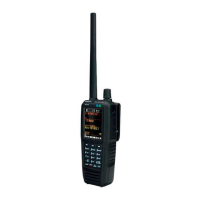
Do you have a question about the Uniden Bearcat SDS100 and is the answer not in the manual?
Options for initiating the Waterfall function with current or predefined settings.
Overview of the scanner's display division into FFT and Waterfall panes.
Real-time graph of signal strength and RF noise with frequency on horizontal axis.
Vertical line indicating current frequency; can be adjusted or fixed.
Continuous display showing rolling 10-second window of activity with color-coded signal strengths.
Exits Waterfall feature and resumes scanning.
Changes the frequency Span of the band being observed.
Freezes the display to allow tuning to a frequency before transmission disappears.
Changes the frequency step size or selects Auto mode.
Keeps displayed signals visible after transmission stops for observation.
Moves the Marker and current frequency to the Center Frequency.
Restarts the last waterfall session used.
Selects and starts a waterfall session for a pre-defined band.
Selects and starts a waterfall session for a user-defined band.
Defines custom bands, up to 10 can be defined.
Edits parameters of the current FFT Display.
Changes screen space dedicated to FFT and Waterfall displays.
Chooses method to represent signals in FFT Display (Line or Bar).
Turns Max Hold on or off.
Sets the duration display is held when Hold is pressed.
Adjusts marker position and width.
Customizes colors for signal strength ranges and marker color.
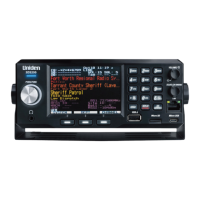
The Uniden Bearcat Waterfall Feature is an advanced function available for the SDS100 and SDS200 scanners, designed to provide a comprehensive visual representation of radio transmissions across a user-selectable span of the radio spectrum. This feature graphically displays active radio signals, allowing users to quickly assess the activity within a given frequency range and navigate to specific transmissions for listening.
The core function of the Waterfall Feature is to visualize radio activity. It operates by continuously scanning a defined frequency span and presenting the received signals in two primary display panes: the FFT Display and the Waterfall Display.
The FFT Display (Fast Fourier Transform Display) provides a real-time graphical representation of radio signal strength and background RF noise. It plots signals and noise in white against a grid, where the horizontal axis represents frequencies and the vertical axis depicts signal strength levels. A central vertical line, known as the Marker, indicates the frequency to which the scanner is currently tuned. This marker, defaulting to green, can be adjusted to move across the span or remain fixed in the center, depending on user settings. The FFT Display also shows additional information such as data about the transmission being received (e.g., "P25"), the current date and time, the name of the band being received, the current frequency in large numbers, the step size, and the modulation type.
The Waterfall Display is a continuous, time-based visual record of transmissions and noise levels. It presents a rolling 10-second window of activity, with the most recent observations at the top and older observations moving downward, creating a "waterfall" effect. This display color-codes the strength of signals or noise received, with different colors representing distinct ranges of signal strength. There are five predefined signal ranges and corresponding colors, which can be customized by the user. Transmissions appear as lines, with their lengths reflecting the duration of the transmissions. This visual history allows users to observe patterns, such as simultaneous repeater transmissions on multiple frequencies or the relationship between repeater input and output frequencies. The strength of signals, indicated by color, provides clues about the nature of the transmissions and the proximity of the transmitters. The Waterfall Display also shows the span size, the current gain setting, the current frequency the scanner is tuned to, the current volume setting, and the current squelch setting.
The Waterfall Feature offers a variety of settings and controls to enhance its utility:
While the manual primarily focuses on operational features, it outlines key steps for initial setup and ongoing software maintenance:
By providing a visual, real-time, and historical view of radio activity, the Uniden Bearcat Waterfall Feature significantly enhances the user's ability to monitor, analyze, and understand the radio spectrum, making it a powerful tool for both casual listening and more in-depth radio exploration.
 General
| Model | SDS100 |
|---|---|
| Category | Scanner |
| Frequency Coverage | 25-512 MHz, 758-824 MHz, 849-869 MHz, 894-960 MHz, 1240-1300 MHz |
| Weather Alert | YES |
| Channels | Unlimited |
| Connectivity | USB |
| Dynamic Memory | Yes |
| Display | Full-color LCD |
| Digital Modes | DMR, NXDN |
| Memory | Unlimited |
| Power Source | Li-Ion battery |
| TrunkTracker | TrunkTracker X |
| Modulation Types | AM, FM, NFM, P25 |
| Audio Output | Headphone Jack, Internal Speaker |



 To Next Page