4
2. Installation (cont’d)
2.6 Exterior Hoods
It is important that the fresh air intake hood be positioned well away
from any source of contamination. The exterior supply and exhaust
hoods must be separated enough to prevent cross-contamination
and at an elevation that will prevent blockage by snow, dirt and
leaves.
NOTE:
Consult local building code for restrictions in your area.
A rodent screen with 1/4” (6 mm) mesh must be installed to prevent
the intake of large debris and animals. A backdraft damper may
need to be installed in the exhaust duct to prevent cold air entering
the building if the unit is to be shut off for a long period of time.
To maintain optimum airflow performance, exterior hood selection
must be such that the minimum free area of opening is as follows:
140 inches (0.09 m).
2.7 Drains
The drain fittings provided with the unit will accept a 3/4” (19 mm) NPT
coupler (supplied by others). The drain line for the unit must be
fabricated on-site and connected to the building main. A loop in
the hose or trap in the copper or plastic pipe must be provided to
prevent sewer gases from entering the unit when connecting to a
drain as illustrated in Appendix D.
NOTE:
Consult local building code for plumbing requirements in your area.
If copper pipe is to be used, ensure not to solder to the 3/4” (19 mm)
coupler while it is attached to the plastic drain fitting as deformation
may occur. Ensure adequate slope is present to allow good drainage
(minimum 1/4” per foot or 6 mm per 305 mm).
2.8 Electrical Connections
POWER
A terminal block and strain relief bushing or a junction box is
provided for line voltage to make the necessary power connections.
The electrical requirements are as follows:
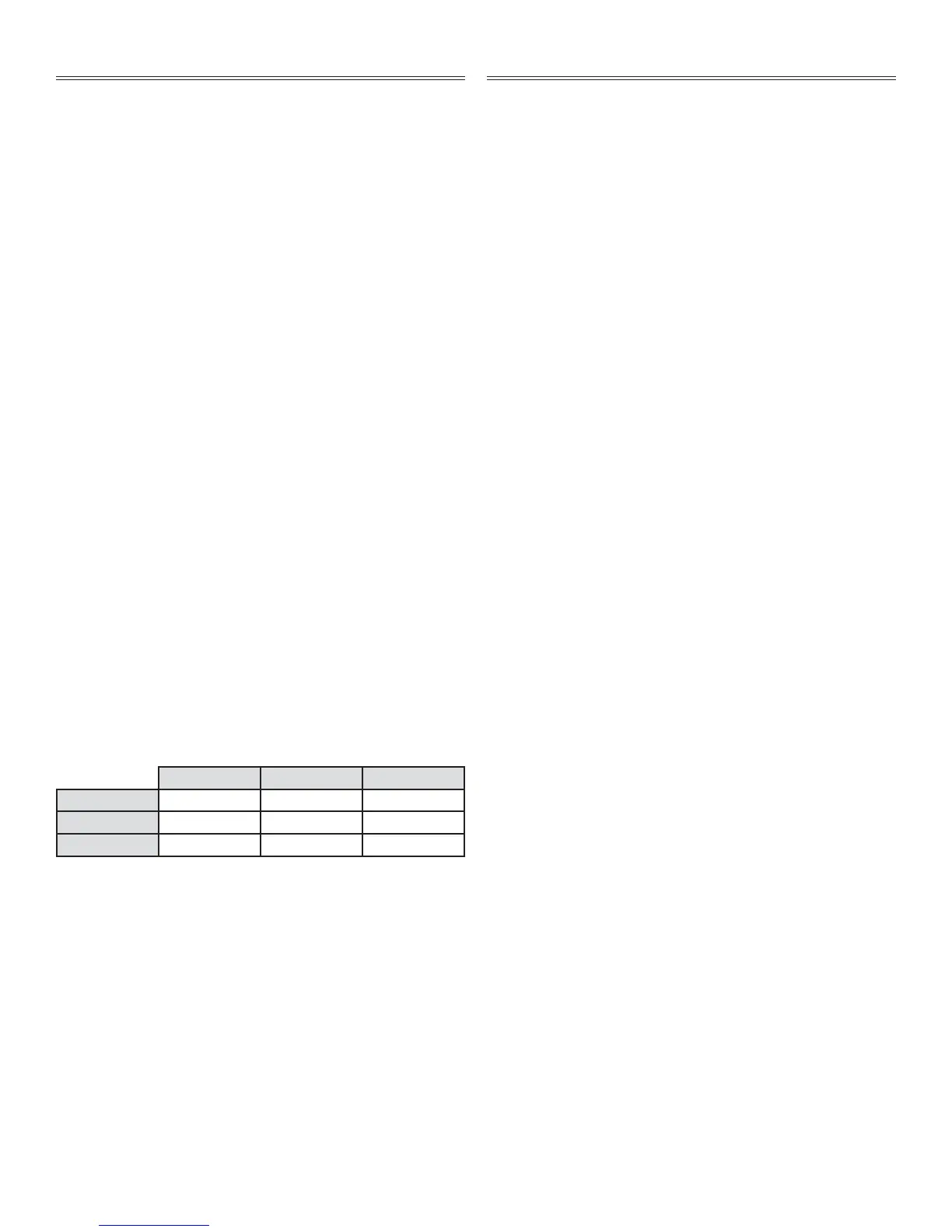
6LC, V6LC 7000 12LC, V12LC
VOLTAGE 115 V115 V115 V
MCA 8.65 6.63 13.4
MOP 12.5 9.13 20
3. Controls
3.1 General Information
FAN INTERLOCK RELAY OUTPUT (FF)
External fan control can be achieved by connecting an external
24 volts fan control through dry contacts (FF). These contacts are
closed on a call for ventilation or defrost. See wiring diagram shown
in Appendix E.
S
PEED SELECTION (6LC, V6LC /12LC, V12LC UNITS ONLY)
There are three speed settings available with the controls, only two
of which can be functional at any one time. The units are factory
set to use the low and high speed taps on the blower motors. If
necessary, the medium speed tap can be used instead of the low
speed tap. See wiring diagrams for instructions on how to make this
change. Units without the remote wall control option can be shut off
by opening the contact between LOW - COM or HIGH - COM as
shown in Appendix E-2.
3.2 Sequence of Operation
Before start-up, check the unit for obstructive packaging, objects
near or in blowers, dampers, heat exchangers, etc. Once installation
is complete, check all modes of operation to ensure that the unit is
working properly. Close the doors and check for operation on LOW,
COM and HIGH. Use a wall control or the dry contact switching to
run fan speeds as shown in Appendix E-2.
The 7000 unit is two speed. Low speed can be initiated by creating
a closure across LOW - COM or high speed can be initiated by
creating a closure across HIGH - COM.
UNIT CHECK POINTS (ALL UNITS):
• Power connected, no ventilation call - Both fans are off, defrost
damper (if equipped) closes off fresh air from outdoors.
• Power connected, low speed call - Both fans on low speed
internal defrost damper (if equipped) opens fresh air from
outdoors. For 6LC, V6LC, 12LC and V12LC units only, if
equipped with recirculation module, the internal defrost damper
closes recirculation opening.
• Power connected, high speed call - Both fans on high speed,
defrost damper opens fresh air from outside. For 6LC, V6LC,
12LC and V12LC units only, if equipped with recirculation
module, the internal defrost damper closes recirculation opening.
• Power connected, occupied timer/sensor connection open
(unoccupied mode) - Both fans are off, defrost damper closes
fresh air from outdoors. For 6LC, V6LC, 12LC and V12LC units
only, if equipped with recirculation module, the internal defrost
damper opens recirculation opening.
• Power connected, FF control contacts close during unit ventilation
or defrost cycle.


 To Next Page