SERVICE
Service - 43
Changing The Propane Cylinder(s)
1.
DANGER
Propane is fl ammable and/or explosive. Follow all
safety instructions in the Propane Safety section of
this manual and in the engine operator’s manual.
WARNING
Do not breathe propane vapors.
Contact with escaping vapors or liquid may cause
freezing of tissue or frostbite. Seek immediate
medical attention if contact occurs with propane
vapors or liquid.
Park the power unit on a level surface in a well
ventilated area.
2. Engage the parking brake.
3. Close the liquid withdrawal valve on both of the
propane cylinders.
4. Purge the propane from the hoses by allowing the
engine to run until it stops.
5.
A
Turn the ignition key to the Off position and
remove the key
from the ignition
switch.
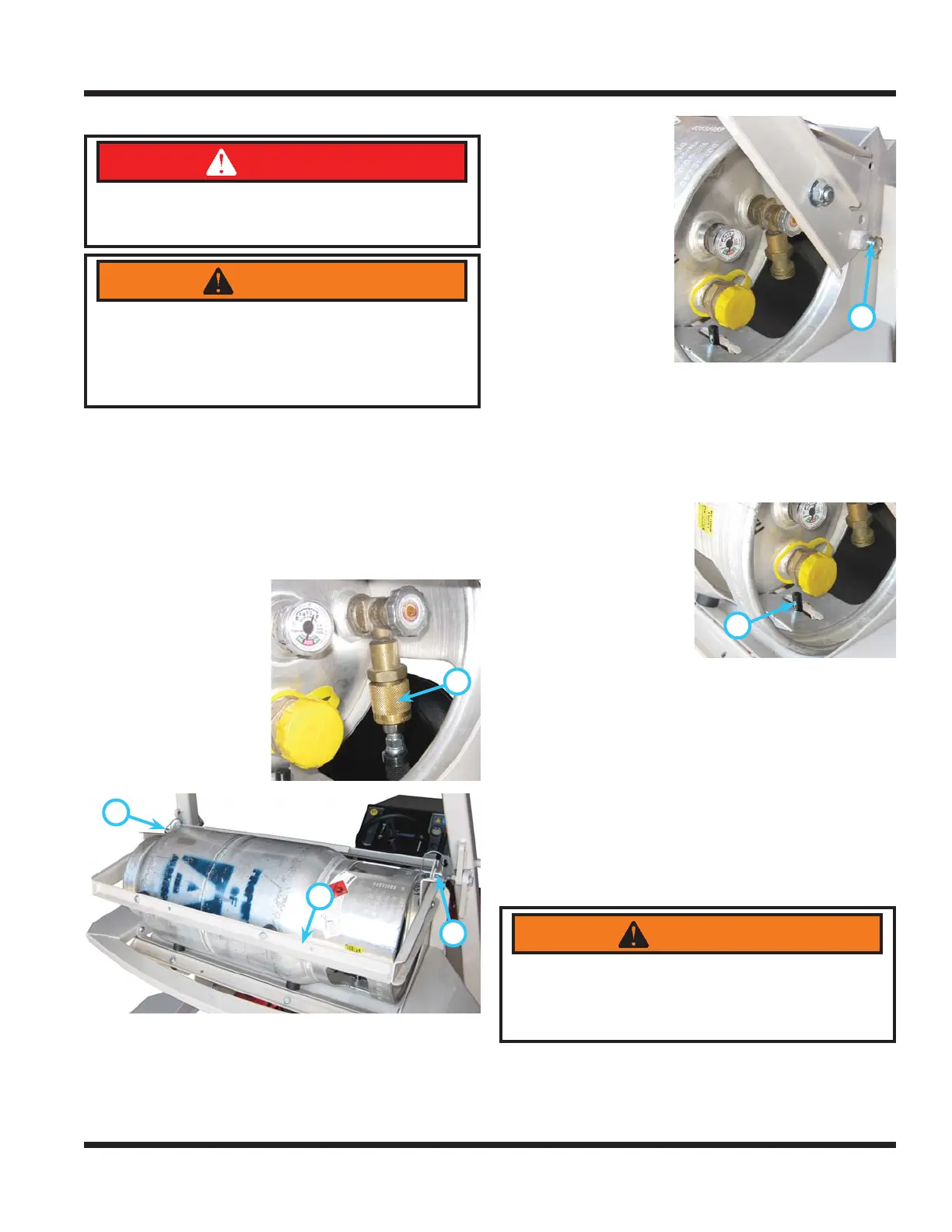
6. Carefully disconnect
the LPG hose con-
nector (A) from the
propane cylinder.
7. Remove the 2)
safety snap pins (B)
B
B
C
that secure the
cylinder retainer (C).
8.
D
Pull out on the
spring plunger pin
(D) to release the
cylinder retainer
and raise the
retainer until the
spring pin snaps
into the latch hole.
9. Remove the empty
cylinder from the
tank support.
10. Inspect the fi lled
propane cylinder.
If the cylinder is
dented, gouged, bulging, or corroded, it must be
removed from service and replaced.
11. Inspect the fi lled cylinder valve and the LPG
hose connector for dirt, debris, or damage.
12. Inspect the LPG hose connector to ensure the
o-ring is not damaged or missing.
E
13. Place the fi lled pro-
pane cylinder onto
the tank support, with
the valve on the right
side of the power
unit and the locating
pin (E) on the tank
support through the
locating slot on the
propane cylinder.
14. Pull out on the spring plunger pin to release the
cylinder retainer and lower the retainer until the
spring pin snaps into the latch hole.
15. Install safety snap pins into the lock holes on
each side of the cylinder retainer.
16. Thread the LPG hose connector onto the propane
cylinder and hand tighten.
17. Open the liquid withdrawal valve on the propane
cylinder.
Checking The LPG System For Leaks
1.
WARNING
Never check for leaks using an open fl ame.
Never use bare hands when checking fi ttings and
valves. Escaping propane vapor or liquid freezes
skin on contact.
With the engine running at low idle, use a soap
solution to check for leaks at all connections
between the propane tanks and the dual fuel car-
buretor. Bubbles will indicate a loose connection.


 To Next Page