To Table of Content
MIX controls the balance between the noisy component part and the detuned multiple
oscillator section. Turned fully counterclockwise, only the noise component will be
audible; turned fully clockwise, only the multiple oscillator section will be audible,
allowing more “authentic” cymbal sounds, thanks to its metallic-sounding charac-
ter.
PITCH denes the pitch/frequency of the oscillator mix as well as of the ATTACK transient
spike at the same time.
☛
HI HAT 1 and HI HAT 2 can be triggered in two ways, using the TRIG button
q
-
either as cymbal/open hi-hat or as closed hi-hat. The closed hi-hat has a xed
short decay time, independent of the DECAY control setting. After turning on the
DRM1 MKIV, the default setting of the TRIG button
q
is triggering the cymbal/
open hi-hat, with the duration of the sound being governed by the DECAY
control. To toggle between the trigger-modes, keep TRIG
q
depressed for approx.
one second. The corresponding LED will light up briey to conrm the mode of
operation.
When using MIDI, both sounds of these instrument channels – i. e. cymbal/open
hi-hat and closed hi-hat – can be played by two different MIDI notes which also
lets you alternate between open and closed hi-hat (see “MIDI Functions” on
page 19).
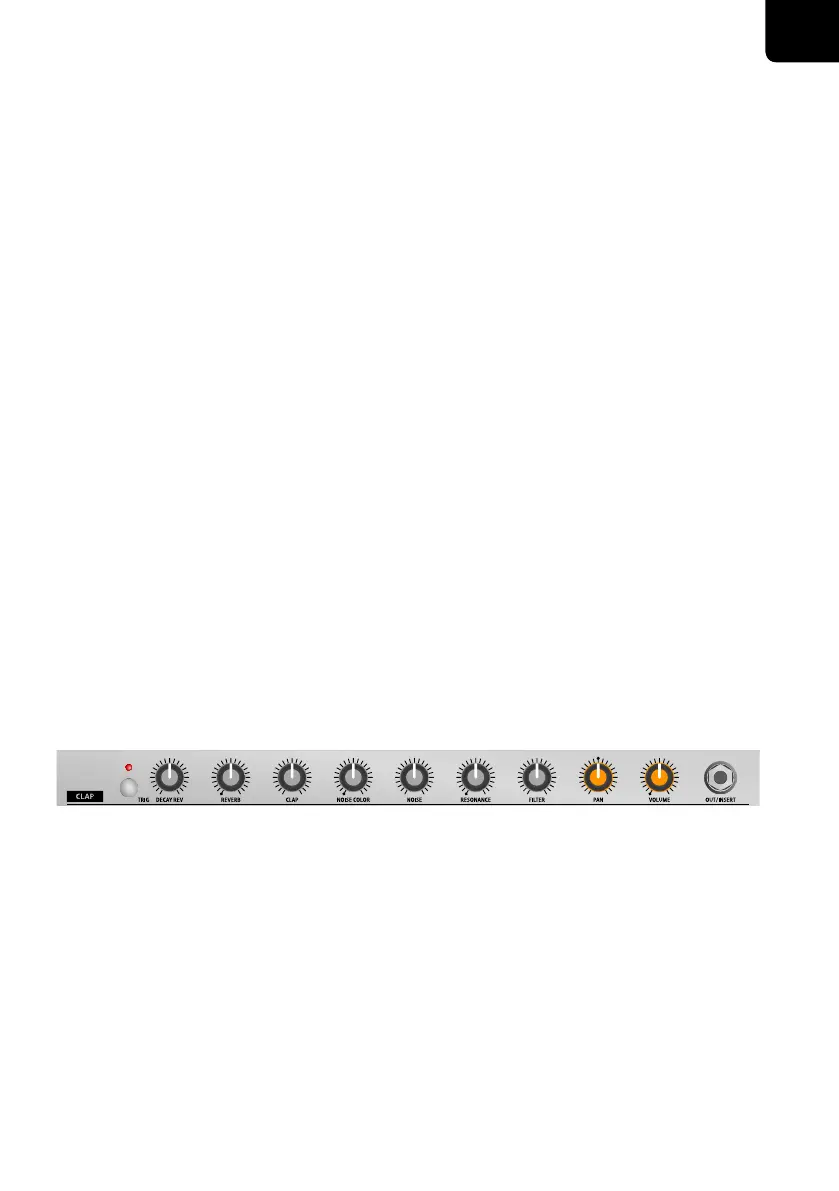
CLAP
Figure 8: CLAP instrument channel of the DRM1 MKIV
CLAP serves a clearly dened task – it simulates the clapping of several hands (but not necessarily
applause). Like SNARE, it also sports some sort of an electronic pseudo-reverb which, in this case,
is an integral part of the sound since it makes the claps sound a lot more authentic and natural. The
CLAP instrument channel also features a resonating lter component.
DECAY REV sets the duration of the reverb effect. The effect of this parameter will only be au-
dible with REVERB being active.
User Manual DRM1 MKIV
EN
17


 To Next Page