Page 11VX-1700 OPERATING MANUAL
Base Station Antenna Considerations
As with mobile or maritime installations, antenna perfor-
mance is critical to base station communications system
effectiveness. Every effort must be made to ensure that
the impedance of the antenna system utilized with the VX-
1700 is as close as practicable to the specified 50-Ohm
impedance value, and that mechanical and electrical com-
ponent integrity are maintained at all times.
For wide frequency range applications, Vertex Standard’s
Model YA-30 Broadband Dipole Antenna may be ideal
for your communication requirements. Covering an oper-
ating frequency range of 1.6-30 MHz, the YA-30 elimi-
nates the need for multiple antennas which might other-
wise be required for equivalent frequency coverage.
The type of antenna required for a particular communica-
tions distance will vary. A complete discussion of this topic
is beyond the range of this manual; however, a few gen-
eral guidelines will be offered herewith.
Any antenna to be installed should be free of nearby ob-
structions which might interfere with its radiation pattern.
The antenna, its support structure, and its cables must never
be installed in such a manner that would allow them to
contact with power or telephone lines in the event of a
catastrophic windstorm or other cause of major failure.
An adequate safety is usually provided by keeping the
antenna and its support structure 1.5 times the height of
the support plus the length of any antenna or guy wires
attached to the support.
When installing a balanced antenna such as a dipole, re-
member that the VX-1700 transceiver is designed for use
with an (unbalanced) coaxial feedline. Always use a balun
or other balancing device so as to ensure proper antenna
system performance.
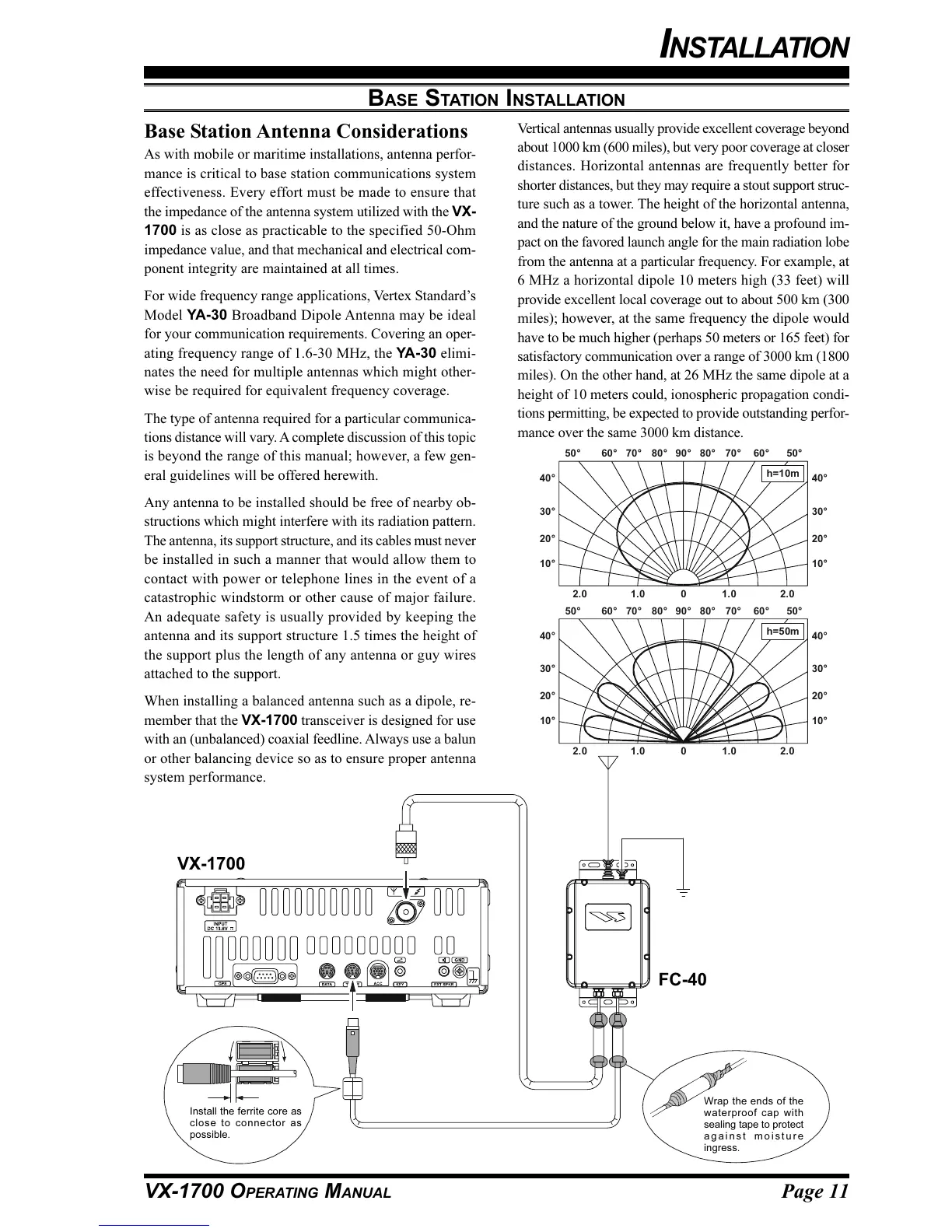
Vertical antennas usually provide excellent coverage beyond
about 1000 km (600 miles), but very poor coverage at closer
distances. Horizontal antennas are frequently better for
shorter distances, but they may require a stout support struc-
ture such as a tower. The height of the horizontal antenna,
and the nature of the ground below it, have a profound im-
pact on the favored launch angle for the main radiation lobe
from the antenna at a particular frequency. For example, at
6 MHz a horizontal dipole 10 meters high (33 feet) will
provide excellent local coverage out to about 500 km (300
miles); however, at the same frequency the dipole would
have to be much higher (perhaps 50 meters or 165 feet) for
satisfactory communication over a range of 3000 km (1800
miles). On the other hand, at 26 MHz the same dipole at a
height of 10 meters could, ionospheric propagation condi-
tions permitting, be expected to provide outstanding perfor-
mance over the same 3000 km distance.
BASE STATION INSTALLATION
VX-1700
FC-40
Install the ferrite core as
close to connector as
possible.
Wrap the ends of the
waterproof cap with
sealing tape to protect
against moisture
ingress.


 To Next Page