23
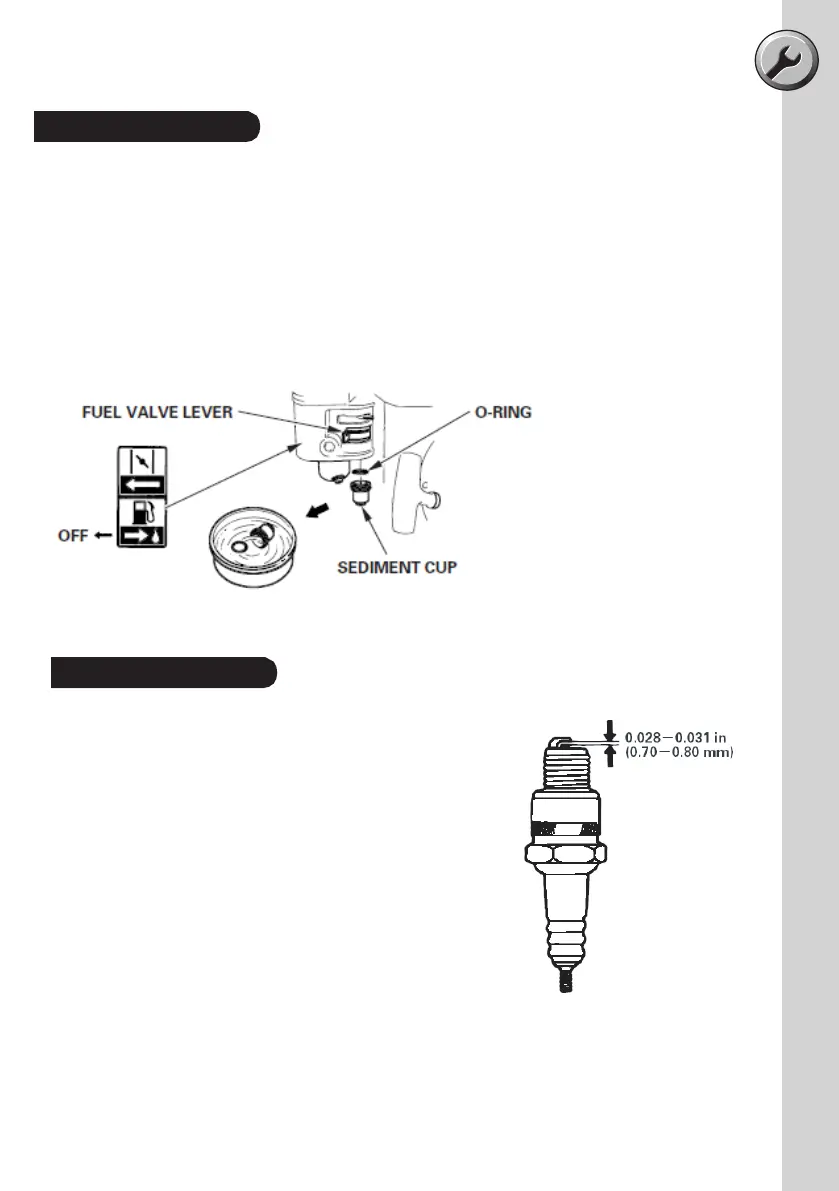
Sediment cup
The sediment cup prevents dirt and water that may be in the fuel tank from entering the
carburettor.
a) Put the pressure washer on a at, level surface.
b) Move the fuel tap lever to the OFF position.
c) Remove the sediment cup.
d) Clean the cup and screen thoroughly with soap and water.
e) Use a clean cloth and wipe all pieces dry.
f) Reinstall the sediment cup, make sure the o-ring is in place.
g) Move the fuel tap lever to the ON position.
h) Check for fuel leaks.
i) Return the fuel tap lever to the OFF position.
Fig. 20
Spark plug
To ensure proper engine operation, the spark plug must be
properly gapped and free of deposits. Refer to the Maintenance
Schedule for regular service intervals.
a) Put the pressure washer on a at, level surface.
b) Remove the spark plug cap. Clean any dirt or debris from
around the spark plug base.
c) Use a 13/16" spark plug wrench to loosen and remove the
spark plug.
d) Inspect the spark plug. If the insulator is cracked or
chipped, discard the spark plug and replace it with a new
one. If the spark plug is in good condition, clean the spark
plug with a wire brush.
e) Measure the plug gap with a feeler gauge. The correct
gap should be 0.028-0.031 in. (0.70-0.80 mm). If the gap
is incorrect, bend the side electrode carefully.
f) Make sure the spark plug washer is in good condition.
g) Reinstall the spark plug by hand. This will prevent cross
threading.
h) After the spark plug is seated, tighten a 1/4 turn with the
spark plug wrench to compress the washer.
Fig. 21
MAINTENANCE & CARE



 To Next Page