Page No. 28-GB 8.5.2 We reserve the right to make technical changes!
Additional defrosting will be initiated when the cold-
room door is open for longer than 4 min.:
P30 = 1y
Defrosting will be initiated in addition to the opera-
ting mode entered in value Y when the Fault report
“Coldroom door open” occurs.
Air circulation defrosting:
If the nominal temperature lies above the value set
into P37, defrosting will take place via air circulation. In
this case, the evaporator fan is switched on during the
defrosting process and the defroster heating is off.
Hysteresis
The hysteresis between switch-on and switch-off tempe-
rature can be set via P33.
If the value of P33 is negative, the unit switches off
when the coldroom temperature has reached the value
of the nominal temperature minus the absolute hystere-
sis value. It switches on when the coldroom temperature
reaches the nominal temperature again.
Example: Nominal temperature -20°C,
Hysteresis -2K
Unit off at -22°C,
Unit on at -20°C.
If the value of P33 is positive, the unit switches off when
the coldroom temperature reaches the nominal tempe-
rature. It switches on when the coldroom temperature
reaches the nominal temperature + hysteresis value.
Example: Nominal temperature +5°C,
Hysteresis +2K
Unit off at +5°C,
Unit on at +7°C.
Condenser fan (on units with air cooled condenser
and turning speed regulator):
The condenser fan is outfitted with a turning speed
regulator on some unit models. In this case, the conden-
ser temperature is detected by means of a temperature
sensor located at the condenser outlet pipe. If the sen-
sor has not been installed for economical reasons, the
turning speed regulator function is bridged via a relay
and the fan will run at full turning speed.
The condenser temperature can be displayed in P09. If
turning speed regulator is not active or if a temperature
sensor is not connected to the condenser, “OFF” will be
displayed in P09.
If the turning speed regulator fails, the high-pressure
Pressostat will activate any fans, which are not running.
As this is recognised as a fault situation, the fan will be
switched on via the relay. As an activation of the high-
pressure switch is possible under other circumstances,
as well, the turning speed regulator will be reactivated
after a one-hour run time of the unit. If the high-pressu-
re switch is activated again within the next hour, then
the turning speed regulator will be bridged and a Fault
report will be generated. The Fault report can be ack-
nowledged by a short actuation of the keys [ ] or
[ ]. The turning speed regulator remains bridged so as
long as the unit power supply voltage is switched of and
back on.
Parameterisation of the turning speed regulator:
Parameters P46 to P49 are decisive for turning speed
regulation. The condensation temperature, which
should be maintained via the turning speed regulator is
established in P46.
Minimum turning speed in % is established in P48. P49
establishes the regulator slew-rate. The lower the value
is, the slower the turning speed regulator will react to a
change in temperature; it reacts quicker with a higher
value.
Resetting the parameter to factory setting:
The unit model is selected in P50
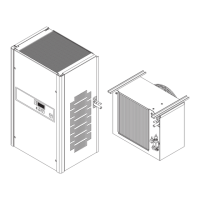
CS = Normal refrigeration wall-hanging unit
FS = Deep-freezer wall-hanging unit
CT = Normal refrigeration ceiling unit
FT = Deep-freezer ceiling unit
If the value 78 is selected in P51, then parameters P29 to
P49 will be set to the respective factory settings for the
unit model.



 To Next Page