11
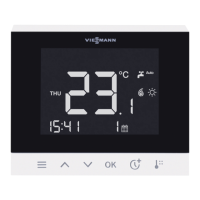
Install your remote control on a wall.
■
Installation only in enclosed buildings
■
The installation location must be dry and free of frost.
■
Ensure ambient temperatures between +5 and
+40 °C.
■
Never seal off the vent apertures of the
Vitotrol 100-E.
■
Distance to floor min. 1.5 m
■
Not next to windows or doors
■
Not above radiators
■
Not between shelves, in recesses, etc.
■
Not near heat sources (direct insolation, fireplace,
TV set, etc.)
■
Away from vents
Note
To ensure a good wireless connection, keep the dis-
tance between the Vitotrol 100-E and the Viessmann
appliance as short as possible.
Check the reception quality at the intended installation
site: See the following chapter.
Checking the reception quality at the installation location
In order to check the reception quality at the intended
installation location, first start the Vitotrol 100-E: See
page 14 15.
Tap the following buttons:
1.
2. / for "DEV INFO"
3. OK
4. / for "RF RANGE"
5. OK
The signal strength "RF RANGE" for this mounting
position is displayed. For an explanation of the dis-
plays, see the following table.
Note
■
The poorer the reception quality, the longer it takes
for the Vitotrol 100-E to establish a connection to the
Viessmann appliance. It can take up to 6 minutes to
establish the connection.
■
A poor connection can result in the batteries running
out sooner.
■
To ensure a stable wireless connection, we recom-
mend a signal strength of at least –75 dBm: See the
following table.
Meaning of display
Value in dBm Reception quality
0 to –50 Very good
–51 to –65 Good
–66 to –75 Adequate
–76 to –85 Inadequate
–86 to –... No reception
The values given in the table are meant as guide val-
ues. The connection may vary depending on local con-
ditions.
Range of the wireless signal
The range of wireless signals may be reduced by
walls, ceilings and interior fixtures. These weaken the
wireless signal, causing poor reception due to the fol-
lowing circumstances.
■
On their way between transmitter and receiver, wire-
less signals are damped, e.g. by air or when pene-
trating walls.
■
Wireless signals are reflected by metallic objects
e.g. reinforcements embedded in walls, metal foil of
thermal insulation and thermal glazing with metal-
lised thermal vapour deposit.
■
Wireless signals are isolated by service ducts and
lift shafts.
■
Wireless signals are disrupted by devices that also
operate with high frequency signals. Maintain a dis-
tance of at least 2 m from these devices:
–
Computers
–
Audio and video systems
–
Devices with active WiFi connection
–
Electronic transformers
–
Pre-ballasts
Preparing for installation
Installation location
6192459
Installation


 To Next Page