Need help?
Do you have a question about the Vivotek FE8180 and is the answer not in the manual?
Details steps for connecting the camera through a router, including port forwarding.
Explains connecting via a DSL line using PPPoE for internet access.
Instructions on accessing the camera using web browsers and installing necessary plugins.
Details the four transmission protocol options for H.264 streaming.
Section for configuring basic system settings like host name and system time.
Guides on upgrading the network camera's firmware.
Explains how to reboot the network camera.
Configures video title, information display, mount type, and video orientation.
Adjusts the value for the best color temperature, with auto and manual options.
Adjusts image brightness, contrast, and saturation levels.
Allows setting measurement windows for low light compensation.
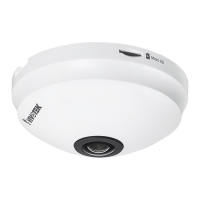
Allows selection between Fisheye mode and 1080P Full HD mode for the camera's view.
Selects the network connection type (LAN, PPPoE) for the camera.
Details HTTP streaming, authentication methods, and ports.
Utilizes VIVOTEK's free service for domain name registration and router port forwarding.
Explains CoS (Class of Service) and DSCP models for traffic classification and prioritization.
Sets the permanent administrator account password.
Creates, modifies, and deletes user accounts with specific access rights.
Outlines methods for creating and installing security certificates.
Sets maximum concurrent streaming connections and manages connection status.
Configures motion detection windows, including name, coordinates, and sensitivity.
Enables and configures dynamic DNS services for fixed host and domain names.
Configures ePTZ settings like tilt speed, pan speed, zoom speed, and patrol sequences.
Configures seamless recording settings, including disk mode and maximum connections.
Manages VADP settings, including version, memory, storage, module order, and saving to SD card.
Configures fisheye local dewarp settings per channel, including pan, tilt, and zoom speeds.
Upgrades camera firmware using POST requests with file names and return pages.
Controls fisheye local dewarp camera functions like move, zoom, and speeds using CGI commands.
 General
| Maximum Resolution | 1920x1080 |
|---|---|
| Aperture | F2.0 |
| Day/Night | Yes |
| WDR | Yes |
| Video Compression | H.264, MJPEG |
| Audio Compression | G.711, G.726 |
| Ingress Protection | IP66 |
| Lens | Fixed |
| Minimum Illumination | 0.5 Lux @ F2.0 |
| Maximum Frame Rate | 30 fps |
| Audio Capability | Yes |
| Network Interface | 10/100Base-TX Ethernet |
| Protocols | IPv4, IPv6, HTTP, HTTPS, TCP, UDP, RTSP, RTP, SMTP, FTP, DHCP, DNS, DDNS, PPPoE, NTP, UPnP, SNMP, IGMP |
| Local Storage | MicroSD/SDHC/SDXC |
| Power Supply | 12V DC |
| Power over Ethernet | Yes (IEEE 802.3af) |
| Power Consumption | 4.5W (max) |

 To Next Page