Exhaust system
71
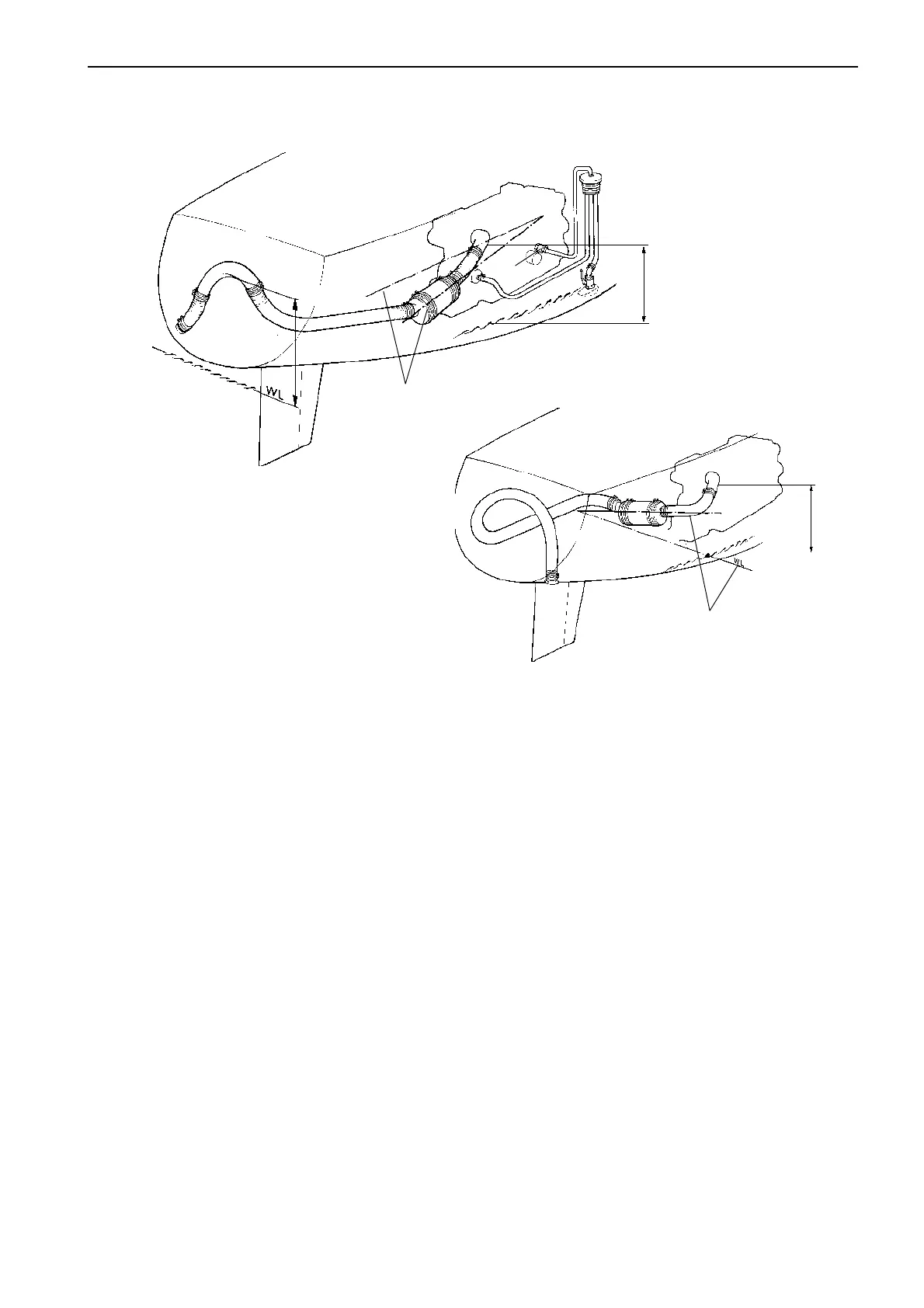
Principal system, fig D
To prevent water from entering from the rear, the last
part of the exhaust line should be arranged in a bend
(swan neck) reaching up to at least 350 mm (14")
above the water surface when the boat is loaded.
Always use stainless hose clamps. If the hose pass-
es through bulkheads or similar it must be protected
against chafing.
The inclination of the Volvo Penta silencer (A) should
be 5°–75° with the inlet facing upwards.
The exhaust hose must be routed in a riser (goose
neck). The minimum height (B) above the water sur-
face should be at least 350 mm (14") or as high as
possible.
It is recommended to position the exhaust outlet at
the side of the hull and close to the transom to reduce
the "wagon-back effect".
NOTE! If the Volvo Penta silencer is installed athwart-
ships the boat it should be inclined between 25°–45°
(C) with the silencer inlet facing upwards. This inclina-
tion is important to prevent water ingress in the engine
when the boat heels over (particularly with sailing
boats).
Anti-siphon valve
The height of exhaust elbow above water line (E min),
see fig. D, should be 200 mm (8"). If less an anti-si-
phon valve (1) is needed in the cooling system to
avoid siphon action that could result in water ingress
through the exhaust system.
Installation of anti-siphon valve see page 60.
Principal system for sailing yachts
C
E min
Fig. D
A
B
E min
1



 To Next Page