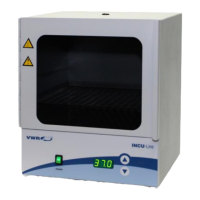
The VWR Incubating/Cooling Shaker for PCR is a versatile laboratory instrument designed to provide precise temperature control and shaking capabilities for PCR plates. This device offers three distinct operating modes: Standard/Manual, User Programmable, and Predefined Profile, allowing for a wide range of experimental setups and applications. Its primary function is to heat, cool, and shake PCR plates, ensuring optimal conditions for various molecular biology protocols.
Function Description
The core function of the Incubating/Cooling Shaker is to maintain a stable and controlled environment for PCR plates. It achieves this through independent temperature, speed, and time functions. This independence means that users can adjust the temperature or speed settings without interrupting a running timer, and vice versa, offering significant flexibility in experimental design.
In Standard/Manual Mode, users have direct control over the temperature, speed, and time settings. This mode is ideal for quick, on-the-fly adjustments and for applications that do not require complex multi-step protocols. The temperature function allows for both heating and cooling, enabling precise thermal cycling or incubation at a constant temperature. The shaking function provides orbital motion at a user-defined speed, ensuring thorough mixing of samples. The timer can be set for a specific duration or run in a continuous accumulation mode, providing flexibility for short-term or long-term experiments.
The User Programmable Mode allows for the creation and storage of up to four custom programs, each consisting of multiple sequential steps. This mode is particularly useful for automating complex protocols that involve changes in temperature, shaking speed, and duration over time. Each program step can be configured with specific temperature, speed, and time settings, along with various status options such as shaker on/off, timer on/off, temperature control on/off, preheat on/off, ramp rate selection, beep on/off, and end of program. This level of customization enables users to design intricate protocols tailored to their specific research needs. The system stores these programs in memory, making them readily available for repeated use without manual re-entry.
The Predefined Profile Mode offers a pre-set, non-editable program (Pr1) designed for common PCR-related applications. This mode simplifies operation for standard protocols, providing a ready-to-use sequence of temperature and shaking steps. The predefined program includes a pre-heat cycle, followed by several incubation and shaking steps at different temperatures and durations, culminating in a cooling phase. This mode is beneficial for users who need to run a standard protocol without the need for custom programming.
The device incorporates a microprocessor-controlled ramping feature for speed adjustments, which slowly increases the shaking speed until the set-point is reached. This gentle ramp-up helps to prevent splashing and ensures excellent control at lower speeds. Similarly, for temperature changes from higher to lower temperatures in Standard mode, users can select from various cooling ramp rates, allowing for controlled cooling of samples.
Usage Features
The Incubating/Cooling Shaker is designed for ease of use with a clear and intuitive control panel. The front panel features dedicated displays for temperature, program (speed), and time, along with corresponding control buttons.
Upon plugging in the unit, it enters standby mode, indicated by an illuminated standby light. Pressing the standby button activates the unit, illuminating the displays with previously used settings.
Setting Temperature: Users can adjust the desired temperature using up/down arrows. The display blinks to confirm the new setting. An on/off button initiates or stops the heating/cooling function, with an indicator light showing its active status. A "Caution Hot" indicator light illuminates when the plate temperature exceeds 40°C (104°F), providing a visual safety warning.
Setting Speed: The desired shaking speed is set using up/down arrows below the program display. The "Start" button initiates the shaking function, and an indicator light flashes until the set speed is reached, then remains solid. The microprocessor-controlled ramping ensures a smooth increase to the target speed, minimizing sample disturbance.
Setting Time: The timer can be set to zero for continuous accumulation mode or programmed for a specific duration using "Program" and "Abort" buttons. In timed mode, the unit runs for the selected duration and stops automatically, indicated by audible beeps. The "Pause" button can temporarily halt the timer without stopping the shaking function.
Mode Selection: Switching between Standard/Manual, User Programmable, and Predefined Profile modes is achieved by holding specific buttons in standby mode and using the "Select" button to cycle through options. The display indicates the currently selected mode (e.g., "STD" for standard, "Pr1" for predefined, "Pr2-Pr5" for user-defined programs).
Program Entry and Editing: For user-defined programs, the system guides the operator through entering temperature, time, speed, and various status options for each step. The "Program" button is used to advance through steps, and up/down arrows adjust settings. Program (Pr) 1 is predefined and cannot be edited, only viewed.
Running a Program: Once a program is selected, the "Start" button initiates its execution. The system displays the current program step and toggles between actual and set temperatures. If a step requires preheating, the display shows "hEAt" until the target temperature is reached and stabilized, after which the user must press "Start" again to continue. The "Pause" button can temporarily stop a program step, halting the shaker and flashing the time display while maintaining temperature. The "Abort" button stops the program entirely, returning the unit to standby mode.
Beeper Preference: The device includes an audible alarm for various events, such as program completion or error codes. Users can silence the general beeper operation (except for error codes) by following a specific button sequence in standby mode.
Power Interruption Recovery: The shaker is equipped with built-in memory that retains the last used temperature, speed, and time settings, allowing it to automatically restart with the previous settings after a power interruption.
Maintenance Features
The Incubating/Cooling Shaker is designed for long-term, trouble-free operation with minimal user maintenance.
Cleaning: Routine cleaning involves keeping the surfaces clean. It is crucial to disconnect the power from the unit before any cleaning. Users are advised not to use abrasive, flammable, or plastic-harming cleaning agents or solvents on the front panel or lid. Cleaning in direct sunlight should be avoided to prevent streaking on the polycarbonate lid. The unit should not be immersed in liquid for cleaning.
Servicing: No lubrication or other technical user maintenance is required. If the unit ever requires service beyond simple cleaning, users are instructed to contact their VWR representative. This ensures that any repairs are performed by qualified personnel, maintaining the integrity and safety of the device.
Troubleshooting: The manual provides a comprehensive troubleshooting guide for common error codes (E01 to E06). These codes indicate issues such as temperature measurement errors, drive system failures, unit overload, or power loss during program mode. For most errors, the guide provides specific instructions on how to address the issue, ranging from checking for obstructions and securing the unit to contacting a VWR representative for more complex problems. For instance, an E04 error (unit overloaded/walking) can often be resolved by ensuring the load is within specifications and the unit is stable on the bench.
Calibration: The device supports calibration for both speed and temperature.
For speed calibration, users enter "Standard" mode, set a desired speed, and then use a tachometer to measure the actual speed. The measured value is then entered using the program speed selection arrows, and the setting is saved.
For temperature calibration (single point), a fine wire thermocouple is placed in a specific well of the PCR block. After setting the desired temperature and allowing it to stabilize for at least an hour with the lid closed, the measured external temperature value is entered using the temperature arrows. The unit can store up to three single-point calibrations, which apply a biased offset for specific temperature settings. A flashing decimal point in the temperature display indicates that a single-point calibration is in use. Instructions are also provided for deleting a stored single-point calibration.
Environmental Conditions: The device is designed for indoor use only, within specified temperature (5 to 40°C), humidity (80% relative humidity, non-condensing), and altitude (0 to 6,562 ft) ranges. Non-operating storage conditions are also specified, ensuring proper handling when the unit is not in use.
Safety Instructions: The manual emphasizes critical safety warnings, including not using the shaker in hazardous atmospheres or with unsuitable materials, avoiding lifting by the tray or lid, operating on a level surface, and ensuring the power cord is disconnected before maintenance to prevent electrical shock. Prompt removal of spills and not operating a damaged unit are also highlighted.
In summary, the VWR Incubating/Cooling Shaker for PCR is a robust and user-friendly instrument offering precise control over temperature and shaking for PCR plates. Its multiple operating modes, intuitive controls, and clear maintenance guidelines make it a valuable tool for various laboratory applications, while ensuring safety and reliability.



 To Next Page
 General