Need help?
Do you have a question about the Wali TVS001-W and is the answer not in the manual?
Guides on safely opening the carton, laying out parts on a protective surface, and checking contents against the supplied parts list.
Provides crucial safety precautions and advice for careful installation and operation, recommending professional help if needed.
Details the process of connecting the base plates and junction plates using provided hardware.
Explains how to connect the vertical monitor brackets to the assembled base structure.
Describes connecting the TV brackets to junction plates and subsequently installing the plastic covers.
Guides on selecting correct bolts and washers for attaching the TV brackets to the back of the television.
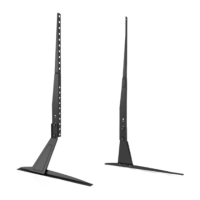
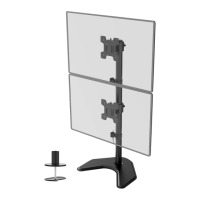
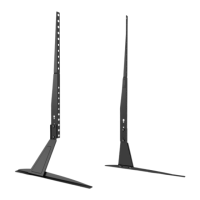
This document outlines the installation and features of a universal table-top TV stand, designed to provide a stable and adjustable mounting solution for televisions. The stand is intended for indoor use and offers a robust structure to support various TV sizes and weights within its specified limits.
The primary function of this device is to securely hold a television on a flat surface, such as a table or cabinet, without the need for wall mounting. It comprises a base assembly that provides stability, vertical monitor brackets that attach to the TV, and junction plates that connect these components, allowing for a flexible and adaptable setup. The stand is designed to replace or augment the original TV stand, offering potentially greater stability or a different aesthetic.
The installation process is divided into several clear steps, starting with the assembly of the base plates and junction plates, which form the foundational support structure. These components are designed to interlock and be secured with bolts, ensuring a rigid and stable base for the television. The base plates (A1, B1) are the primary contact points with the table surface, while the junction plates (A2, B2) extend upwards to connect with the vertical monitor brackets.
Next, the vertical monitor brackets (B5, A5) are connected. These brackets are crucial as they will directly attach to the back of the television. Their design allows for adjustability, accommodating different VESA patterns and TV sizes. The connection of these brackets to the junction plates is a critical step in establishing the vertical support for the TV.
Following this, the TV brackets (A4, B4) are connected to the junction plates. These brackets are the final interface between the stand and the television. Once connected, plastic covers (A3, B3) are installed to conceal the connection points, providing a clean and finished appearance. This step not only secures the TV brackets but also enhances the aesthetic integration of the stand with the TV.
The final step involves attaching the TV brackets to the back of the TV. This is a crucial stage that requires careful selection of the appropriate bolts (H to M) and washers (N to P) based on the TV's specific mounting requirements. The manual emphasizes the importance of matching the bolt diameter and length to avoid damaging the TV. Spacers (Q, R) are provided for situations where the bolts are too long, ensuring a snug and secure fit without over-tightening or causing stress to the TV's mounting points. This adaptability ensures compatibility with a wide range of television models.
The universal table-top TV stand is engineered for ease of use and adaptability. Its modular design allows for straightforward assembly, guided by the provided instructions and a comprehensive list of parts. The inclusion of an Allen key (F) and a wrench (G) as part of the supplied hardware means that most users will not need additional tools for assembly, simplifying the setup process.
One of the key usage features is its universal compatibility. By providing a variety of bolts, washers, and spacers, the stand can accommodate different VESA mounting patterns commonly found on televisions. This ensures that the stand can be used with a broad spectrum of TV brands and models, making it a versatile choice for consumers. The ability to adjust the vertical monitor brackets further enhances this compatibility, allowing for optimal positioning of the TV.
The stand is designed to be placed on any sturdy, flat surface, offering flexibility in TV placement within a room. This eliminates the need for drilling into walls, which is particularly beneficial for renters or those who prefer not to make permanent alterations to their living space. The robust construction of the base plates and junction plates ensures that the TV remains stable and secure, minimizing the risk of tipping.
The aesthetic design, with the inclusion of plastic covers, contributes to a clean and organized look. Once assembled, the stand integrates seamlessly with the TV, providing a sleek and modern appearance that can complement various interior designs. The stand's design also aims to keep cables organized, although specific cable management features are not explicitly detailed, the structure allows for discreet routing of power and AV cables.
The maintenance of this universal table-top TV stand is straightforward, primarily focusing on ensuring its continued stability and appearance. The materials used in its construction are likely durable metals and plastics, designed for longevity under normal indoor conditions.
Regular inspection of all bolted connections is recommended to ensure they remain tight and secure. Over time, vibrations or minor shifts in the TV's position could potentially loosen bolts. A quick check with the supplied Allen key and wrench can prevent any instability. This preventive maintenance is crucial for the safety and longevity of both the stand and the television.
Cleaning the stand is simple and can be done with a soft, dry cloth to remove dust. For more stubborn marks, a slightly damp cloth can be used, followed by immediate drying to prevent any potential moisture damage to metal components. Abrasive cleaners or harsh chemicals should be avoided as they could damage the finish of the stand or the plastic covers.
The manual emphasizes the importance of not using damaged or defective parts during assembly. This highlights a key aspect of maintenance: if any component of the stand becomes damaged, it should be replaced rather than attempting to use it, which could compromise the stand's integrity and safety. The design, being modular, suggests that individual components could potentially be replaced if necessary, though this would depend on the availability of spare parts from the manufacturer.
Furthermore, the "Important Safety Information" section serves as a guide for ongoing safe operation. It advises against using the product for purposes or configurations not explicitly specified in the instructions. This implies that any modifications or improper use could lead to injury or damage, underscoring the importance of adhering to the original design and assembly for optimal performance and safety. If any doubts arise regarding the safety of the installation or the stand's condition, consulting a qualified installation contractor is recommended, ensuring professional assessment and maintenance.
 General
| Type | TV Stand |
|---|---|
| Weight Capacity | 110 lbs |
| Number of Shelves | 2 |
| Color | Black |
| Adjustable Shelf | No |
| Cable Management | Yes |
| Assembly Required | Yes |
| Product Type | TV Stand |
| Material | Steel |
| TV Size | Up to 65 inches |

 To Next Page