Operating Instructions
40
ENGAGING THE BLADE DRIVE
1. Set the engine throttle at about 1/3 speed. Do
not attempt to engage the blade clutch at
high engine speeds. This will drastically short
en drive belt life. Use only moderate engine
speed when engaging the blade clutch.
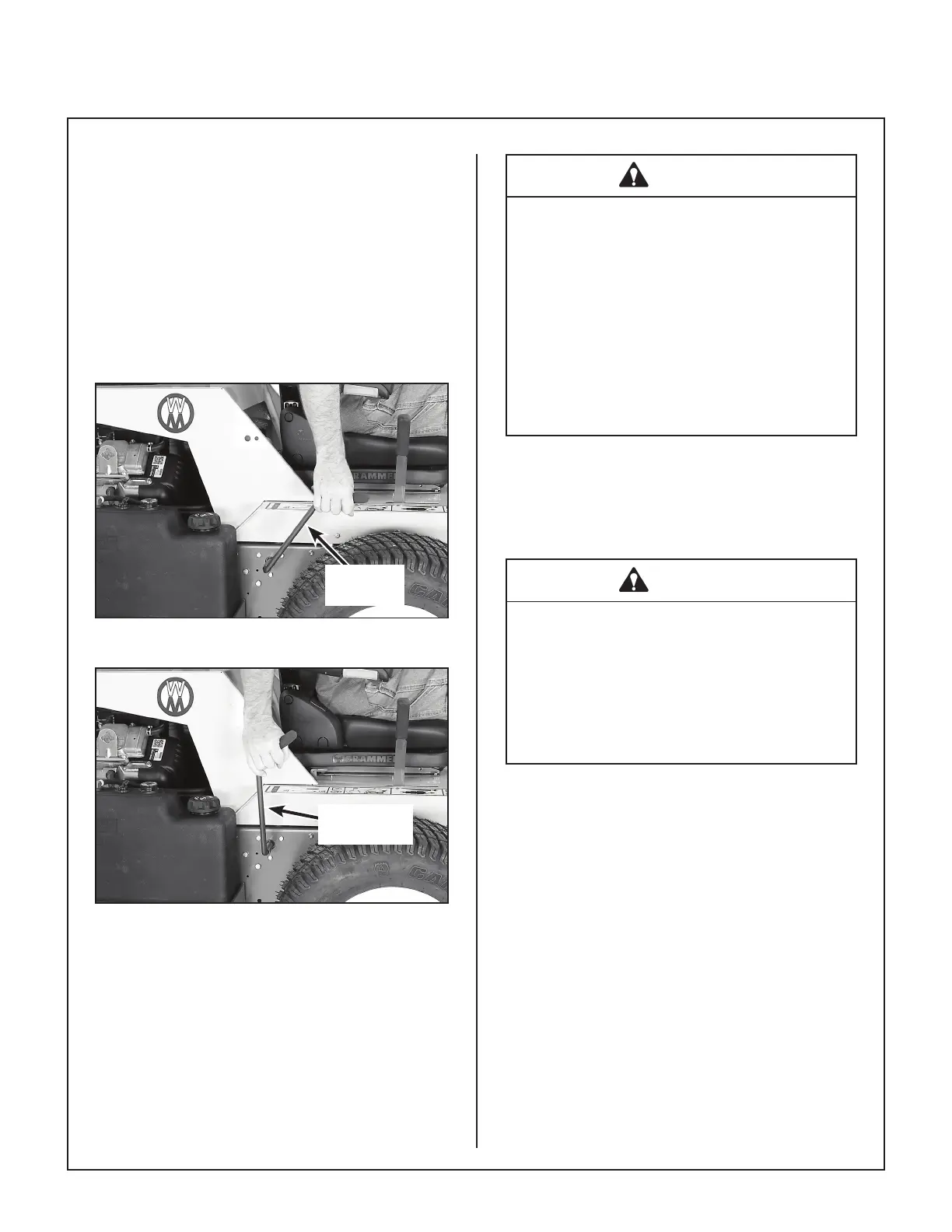
2. Engage the blade clutch by moving the blade
clutch lever forward SLOWLY. For disengage
ment, move the blade clutch lever backward
SLOWLY.
Engaged
Position
Blade Clutch Engaged
Disengaged
Position
Blade Clutch Disengaged
CAUTION
An operator presence switch (seat switch)
will cause the engine to stop if the blade
clutch is engaged and the operator is not in
the seat. The function of this switch should
be checked by the op erator raising o the
seat and engaging the blade clutch; the en-
gine should stop. If the switch is not work-
ing, it should be repaired or replaced be-
fore operating the mower. DO NOT
disconnect the safety switches; they are
for the operator’s protection.
IMPORTANT: DO NOT engage the blade clutch
when transporting the mower across drives, side
walks, loose materials, etc. DO NOT engage the
blade clutch with the PTO shaft disconnected
(the mower deck removed from tractor).
CAUTION
If the cutting blades strike a stationary ob-
ject while mowing, stop the mower imme-
diately, disconnect the spark plug wires,
lift the deck, and inspect the deck and
blades thoroughly for damage. Also, make
sure the blade retaining bolts are torqued
to 70 lb·ft (95 N·m).
STOPPING THE MACHINE
1. Pull the steering levers to the NEUTRAL posi
tion and then move the FSC lever backward to
the NEUTRAL-PARK position.
2. Slow the engine to a fast idle; put the throttle in
the 1/2 throttle position.
3. Disengage the blade clutch.
IMPORTANT: DO NOT disengage the blade
clutch with high engine speed (above 1/2 throt
tle) since the brake action on the blade drive will
cause premature wear of the brake band.


 To Next Page