CHAPTER 24 CLICK 304 209
Configuration Features
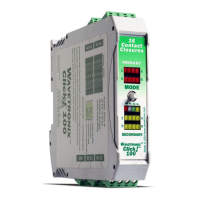
e faceplate of the Click 304 has the following three LEDs:
PWR (red) lights up when the device has power.
TD (yellow) lights up when the device is transmitting data.
RD (green) lights up when the device is receiving data.
e LEDs are also used to indicate operation modes, which will be discussed in the On-
device Conguration section of this chapter.
e front also has a push-button labeled Mode Switch, which is used to cycle the Click 304
through operation modes. is will be discussed in the On-device Conguration section
of this chapter.
On-device Configuration
e Click 304 can be congured using the push-button on the lower part of the faceplate.
Press and hold the push-button to cycle through the dierent operation modes; release the
button when the desired mode is reached. A quick press and release of the push-button will
exit out of any mode and return the unit back to normal operation. Table 24.1 and the fol-
lowing sections describe the dierent operating modes.
Mode LED Definition
Autobaud Green (solid) To autobaud the Click 304, press the push-button, then
release when the green LED turns on.
Reset Red (flashing) To reset the Click 304 to factory defaults, press the push-
button, then release when the red LED is blinking.
Table 24.1 – Click 304 Operation Mode Definitions
Autobaud (green solid)
e Autobaud mode is used to match baud rates with an external device. By default, the
device will attempt to match baud rates with a SmartSensor on the bus; however, the device
can be congured to autobaud with any device that supports a serial interface.
While the device is autobauding, the green LED will be on while the red LED blinks. e
autobaud was successful if the red LED stays on and the green LED turns o. If the auto-
baud is not successful aer a few minutes of trying, the red and green LEDs will stay on
indenitely. In the case of a failed autobaud, push the push-button once to return the device
to its normal state.



 To Next Page