64 CHAPTER 4 CLICK 104
bus 1 (data) or bus 2 (control).
Level 2 LEDs display conguration options for the menu items selected via the level 1 LEDs.
All level 2 LEDs are red. ese LEDs are dedicated to menu operation, and are extinguished
when the menu is not active.
Installation
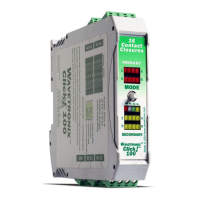
1 Mount the Click 104 on a DIN rail over a T-bus connector. is connects the device’s
control bus (bus 2) to the installation’s shared communication bus; you can connect
your computer to another device on this shared bus, such as the Click 305 USB con-
verter, to access the Click 104 to congure it using Click Supervisor. Mounting the
Click 104 on the T-bus also connects it to the power source.
2 Send detection data to the data bus (bus 1) in one of two ways. If you’re using a Smart-
Sensor Advance or Matrix, and therefore a Click 222 or 223, connect it to the Click 104
by connecting jumper cables from the RJ-11 jacks on the faceplate of the Click 222 or
223 to the RJ-11 jacks on the faceplate of the Click 104.
If you’re using a SmartSensor HD, rst set the sensor to push data on the RS-232 port.
en connect wires between the TD and RD screw terminals on the protected side of
the Click 200 to the TD and RD screw terminals on the Click 104.
3 If needed, daisy-chain multiple Click 104 devices together by utilizing both RJ-11 jacks
on each device’s faceplate.
Contact Closure Outputs
Part of installing the device is wiring its contact closure outputs to the trac controller
(or data logger or other device). It’s recommended, however, that you not do this until the
device is done being congured, to avoid sending any incorrect contact closures to the
controller
ere are four contact closure outputs, for the four channels the Click 104 can handle. Each
output has two screw terminals, one + and one –. e + terminals are for data, while the
– are ground, or common. Each – terminal is isolated from all the other grounds; if your
installation requires a common ground for each contact closure output, you’ll need to tie
together the wires from those four terminals yourself.
Fail-safe Mode
e Click 104 receives datagrams from the connected SmartSensor. ese datagrams must
be mapped to device outputs, as will be discussed later in this chapter. If the Click 104 does
not receive a datagram describing the device’s channels for ten seconds, the device will enter
fail-safe mode. In fail-safe mode, all outputs will assert a detection condition, and will con-
tinue to do so until the device receives a datagram that updates the state of its congured
channels. See the Click Supervisor section of this chapter for more information on how to



 To Next Page