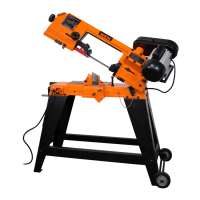
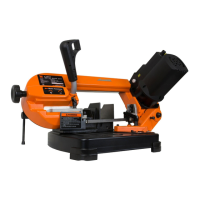
This document is an instruction manual for the WEN BA4555 5-Inch Variable Speed Metal-Cutting Band Saw. It provides detailed information regarding the tool's function, technical specifications, usage, and maintenance.
Function Description
The WEN BA4555 Metal Band Saw is designed for cutting flat and round pieces of metal. It is engineered to provide dependable, easy, and safe operation for years of rugged, trouble-free performance when properly cared for and used for its intended purpose. The manual emphasizes the importance of reading and understanding all safety rules, warnings, and cautions to prevent accidents and ensure safe, reliable service.
Important Technical Specifications
- Model Number: BA4555
- Motor: 120V, 60 Hz, 4.5A
- Saw Blade: 56-1/2 in. x 1/2 in. x 0.025 in, 8/12 TPI, Bimetal
- Cutting Capacity for Square Material:
- At 45°: 3-1/8 in. x 3-15/16 in.
- At 90°: 5 in. x 4-7/8 in.
- Cutting Capacity for Circular Material:
- At 45°: 3-1/8 in. Diameter
- At 90°: 5 in. Diameter
- Miter Cut Range: 0° - 60°
- Blade Speed: 125 to 260 FPM (Feet Per Minute)
- Product Weight: 45 Pounds
- Product Dimensions: 14 in. x 27 in. x 15.5 in.
Usage Features
The band saw incorporates several features to enhance usability and safety:
- Variable Speed Knob: Allows adjustment of the cutting speed from 125 to 260 FPM, depending on the material being cut. Lower speeds are recommended for ferrous metals or thicker workpieces, while higher speeds are for non-ferrous metals or thinner workpieces. Specific recommendations include 125-180 FPM for common steel (settings 1-3), 260 FPM for aluminum or alloy (setting 6), and 220-260 FPM for pipes (settings 4-6).
- Miter Angle Adjustment: The saw can cut miter angles from 0 to 60 degrees. Adjustments are made by loosening an angle lock handle, turning a swivel support to the desired angle on the scale, and then tightening the handle. The saw also features two positive stops for quick adjustments, which can be repositioned using a hex wrench.
- Stationary and Sliding Blade Guides: These guides ensure proper blade alignment and support. The stationary blade guide assembly should be adjusted to lay flush with the saw body, while the sliding blade guide must be positioned as close to the workpiece as possible without interference to ensure clean and accurate cuts.
- Work Stop: A supplied work stop can be used for making a series of cuts with uniform length. It is secured in place by a locking handle, which is spring-loaded and can be repositioned.
- Vise Handle: Used to secure the workpiece firmly in place before cutting, preventing blade binding and loss of control.
- Run Trigger and Power Switch: The saw is turned on by pushing a green button, which illuminates a power indicator light. The blade starts running when the run trigger is pulled.
- Locking Pin: Used to tilt the saw body to its upper position for setup and adjustments.
- Circuit Breaker: A safety feature to protect the machine in case of overload.
- Feet: Four feet are attached to the base for stability, and the machine can be further secured to a workbench using mounting hardware through provided holes.
Maintenance Features
The manual outlines essential maintenance procedures to ensure the longevity and performance of the band saw:
- Blade Changing: Requires relieving blade tension by turning the blade tension adjustment knob counterclockwise, carefully removing the old blade, inserting the new blade (ensuring teeth point in the direction of rotation), and then re-tensioning the blade. The blade cover needs to be removed and reinstalled.
- General Machine Care:
- Cord Inspection: Routinely check power supply cords for damage and replace if necessary.
- Cleaning: Use a brush to remove chips and debris. Wipe off cutting oil or processing residue from the blade, guide bearings, vise, and saw rest, especially before storage.
- Vise Maintenance: Apply a light coat of good-quality paste wax to the vise ways to protect against damage and rust, and to allow the movable jaw to slide easily. Keep vise ways clean to prevent damage.
- Hand Grip: Keep the hand grip clean to prevent accidental slippage.
- Storage: For periods longer than a week, clean the machine, store it in a cool, dry place out of reach of children, and relieve blade tension to prolong blade life and prevent warpage.
- Blade Condition: Daily check the blade for dullness, warpage, or other signs of damage and replace if needed.
- Troubleshooting Guide: Provides solutions for common issues such as the saw not turning on, the power indicator light not working, inaccurate cuts, the blade protruding or popping off, and noisy operation. This guide helps users diagnose problems and offers steps for resolution, including when to contact customer service.
The manual also includes important safety instructions, such as always wearing protective gloves when handling saw blades, using appropriate personal protective equipment (eye and hearing protection), and securing the workpiece properly. It warns against using damaged blades, operating the tool without guards in place, and using water-soluble cutting oils with magnesium to avoid fire hazards. Electrical safety guidelines, including grounding instructions and extension cord recommendations, are also provided to prevent electric shock.


 To Next Page
 General