CLOSED
CLOSED
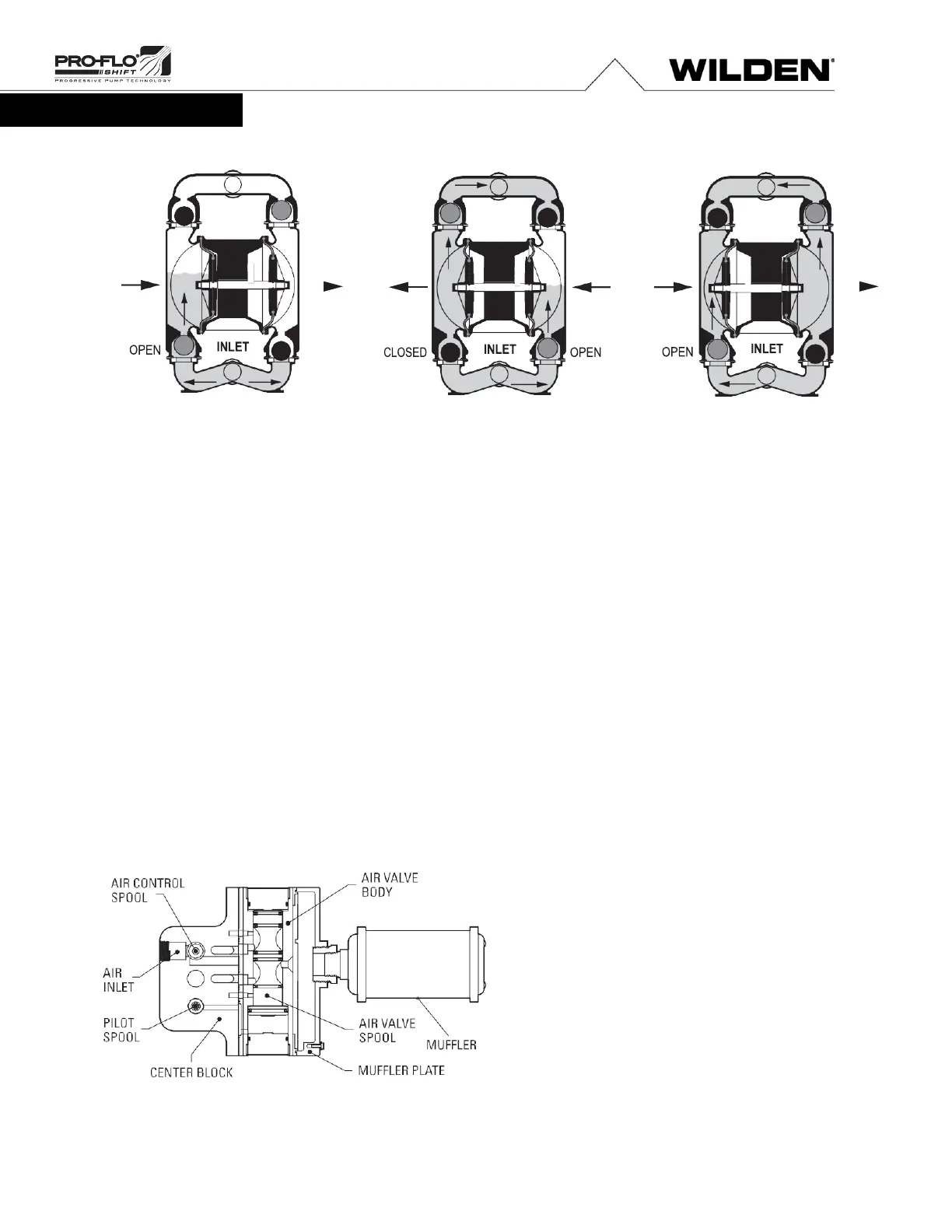
FIGURE 1
The air valve directs pressurized
air to the back side of diaphragm A. The
compressed air is applied directly to the
liquid column separated by elastomeric
diaphragms. The diaphragm acts as a
separation membrane between the
compressed air and liquid; a balanced
load removes mechanical stress from the
diaphragm. The compressed air moves
the diaphragm away from the center of
the pump. The opposite diaphragm is
pulled in by the shaft connected to the
pressurized diaphragm. Diaphragm B is
on its suction stroke; air behind the
diaphragm has been forced out to
atmosphere through the exhaust port of
the pump. The movement of diaphragm B
toward the center of the pump creates a
vacuum within chamber B. Atmospheric
pressure forces fluid into the inlet
manifold forcing the inlet valve ball off its
seat. Liquid is free to move past the inlet
valve ball and fill the liquid chamber (see
shaded area).
FIGURE 2
When the pressurized dia-
phragm, diaphragm A, reaches the limit of
its discharge stroke, the air valve redirects
pressurized air to the back side of
diaphragm B. The pressurized air forces
diaphragm B away from the center while
pulling diaphragm A to the center.
Diaphragm B is now on its discharge
stroke. Diaphragm B forces the inlet valve
ball onto its seat due to the hydraulic forces
developed in the liquid chamber and
manifold of the pump. These same
hydraulic forces lift the discharge valve ball
off its seat, while the opposite discharge
valve ball is forced onto its seat, forcing
fluid to flow through the pump discharge.
The movement of diaphragm A toward the
center of the pump creates a vacuum within
liquid chamber A. Atmospheric pressure
forces fluid into the inlet manifold of the
pump. The inlet valve ball is forced off its
seat allowing the fluid being pumped to fill
the liquid chamber.
FIGURE 3
At completion of the stroke, the
air valve again redirects air to the back
side of diaphragm A, which starts
diaphragm B on its exhaust stroke. As the
pump reaches its original starting point,
each diaphragm has gone through one
exhaust and one discharge stroke. This
constitutes one complete pumping cycle.
The pump may take several cycles to
completely prime depending on the
conditions of the application.
HOW IT WORKS — AIR DISTRIBUTION SYSTEM
The heart of the patented Pro-Flo
®
SHIFT Air Distribution
System (ADS) is the air valve assembly. The air valve design
incorporates an unbalanced spool with the small end of the
spool being pressurized continuously while the large end of the
spool is alternately pressurized, then exhausted to move the
spool. The air valve spool directs pressurized air to one
chamber while exhausting the other. The air forces the main
shaft/diaphragm assembly to move to one side – discharging
liquid on that side and pulling liquid in on the other side. When
the shaft reaches the end of the stroke, the inner piston actuates
the pilot spool, which controls the air to the large end of the air
valve spool. The repositioning of the air valve spool routes the
air to the other air chamber. The air control spool allows air to
flow freely into the air chamber for the majority of each pump
stroke, but it significantly restricts the flow of air into the air
chamber when activated by the inner piston near the end of the
each stroke.



 To Next Page