Page 28 Analyzer Q1 Witschi Electronic Ltd
16.2 Watches with Inhibition Compensation
In order to avoid faulty measurements, the watchmaker must know the particular characteristics of
watches with inhibition compensation. These characteristics are explained below.
The quartz frequency of watches with inhibition compensation is not compensated (no trimmer). The
oscillating circuit of the IC is designed in such a way that the quartz frequency is slightly too high
(0.5 to 10 s gain). The frequency divider suppresses a programmable number of pulses of the quartz
oscillation during an inhibition period, i.e. they are not forwarded to the next divider stage.
A watch with an inhibition period of 60 s is slightly fast during 59 s according to the quartz
frequency and, during the 1-second pulse inhibition, becomes markedly slow. (There are also other
correction systems able to correct the positive or negative deviations of the quartz frequency).
The programming of such watches is performed with a special pulse sequence sent through the
battery connections of the IC. In most cases, a readjustment by the watchmaker is not possible.
To obtain reliable measurement results, it is necessary to test such watches by means of the
stepping motor pulses and the measurement time must be an inhibition period or a multiple thereof.
The usual inhibition periods are 60 s or 10 s. The inhibition period of some precision watches is
120 s; special watches may have even longer inhibition periods, up to 960 s. If the measurement
time of such a watch is too short, the result shows large regular fluctuations. With a measurement
based on the quartz frequency, the result shows a constant deviation (a gain in most cases) of 0.5 to
10 s/d. When the
TIME
parameter is set to
Auto
, the Analyzer Q1 recognises watches with inhibition
periods up to 120s and selects itself the correct measurement time.
The instrument first measures with the shortest possible measurement time. If the rate deviation
exceeds ± 0.5 s/d, the instrument “assumes” it is dealing with an inhibition compensation watch.
The measurement time is automatically set to 60 s, a value that matches most of the watches with
inhibition compensation. If a shorter or longer inhibition period is detected during measurement (e.g.
10 s or 120 s), the measurement time is modified accordingly. The measured inhibition period is
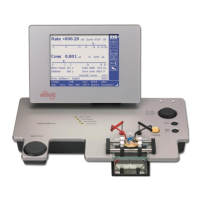
displayed in the result window.
Some precision watches have an inhibition period exceeding 120 s or several inhibition periods.
Their autonomous recognition as inhibition watches often fails. If a watch with a measurement time
of 60s alternatively provides positive and negative results at regular time intervals, it is an inhibition
watch. Select the measurement time according to the time intervals determined.
16.3 Influence of the Temperature
The rate deviation of quartz watches strongly depends on the watch temperature. Quartz watches
are optimised for a temperature of 27°. If the temperature is lower or higher, the ensuing loss
strongly increases with larger temperature deviations.
It is therefore important to carry out measurements with the watch at the normal ambient
temperature. Comparative measurements must be carried out at the same temperature.
For that reason, the instrument displays the current ambient temperature that will also appear in the
measurement log printout.
The measurement accuracy of the Analyzer Q1 is not influenced by fluctuations of the ambient
temperature.
16.4 Typical Values of the Rate Deviation
The compensation in inhibition-compensated watches is mostly performed in steps of 0.18 s/d (also
0.09 s/d or 0.36 s/d for some watches). The compensation is generally performed in such a way that
the rate deviation is as close to 0 as possible, but in the positive range.


 To Next Page