
 To Next Page

L
Lisa Rodriguez DDSSep 13, 2025
Why does my Yamaha PSR-E233 Electronic Keyboard make a popping sound when turned on or off?
- CcfritzSep 13, 2025
This is normal and indicates that the Yamaha Electronic Keyboard is receiving electrical power.

Why does my Yamaha PSR-E233 Electronic Keyboard make a popping sound when turned on or off?
This is normal and indicates that the Yamaha Electronic Keyboard is receiving electrical power.
Details the terms and conditions under which Yamaha will repair or replace a defective product.
Provides instructions on how to contact authorized dealers or Yamaha service for warranty claims.
Outlines limitations on implied warranties and exclusions of incidental or consequential damages.
Provides critical safety information regarding battery usage and proper disposal of electronic products.
Locates the product's name plate and outlines FCC compliance information for US users.
Lists essential safety precautions to prevent electrical shock, fire, and product damage.
Details safe practices for handling, installing, and disposing of batteries to prevent hazards.
Advises on actions to take if the instrument malfunctions and general cautions for safe usage.
Provides guidelines for proper handling and cleaning to prevent damage and ensure stable operation.
Explains copyright restrictions for musical data and notes about the manual's illustrations.
Lists the included Owner's Manual and downloadable online materials from the Yamaha website.
Details the items included with the instrument, such as the music rest and AC adaptor.
Specifies the instrument's power sources, recommending the AC adaptor for environmental friendliness.
Instructions for connecting and using the AC power adaptor safely and correctly.
Guidance on installing batteries, including polarity and type recommendations.
Explains how to connect headphones, external audio devices, and a sustain footswitch.
Details the procedure for turning the instrument on/off and the function of Auto Power Off.
Identifies and explains the functions of the buttons on the instrument's front panel.
Details the various input and output jacks located on the rear panel of the instrument.
Explains the meaning of the 'Press & Hold' symbol for accessing alternate button functions.
Guides on how to select basic functions like Voice, Style, and Song using dedicated buttons.
Explains how to use number buttons and +/- buttons to select items and set values.
Details how to start and stop playback for keyboard performance, songs, and styles.
Explains the various indicators and notation shown on the main display during operation.
Instructions on how to choose and play different instrument voices on the keyboard.
Lists and describes the different categories of preset voices available on the instrument.
Guides on playing the Grand Piano voice and utilizing special sound effect voices.
Explains how to use Ultra-Wide Stereo and add effects like Reverb and Chorus.
Instructions on how to select and listen to the various accompaniment style rhythms.
Details on how to enable auto accompaniment and play chords for accompaniment.
Explains how to use the Sync Start feature to begin style playback with a key press.
Describes how to use intros, endings, and switch between main A/B sections for style variation.
Reference charts showing common major, minor, and seventh chord fingerings.
Simple methods for playing chords using one, two, or three fingers.
Instructions on how to use the Chord Dictionary to look up and learn chord structures.
A practical example demonstrating how to play a song using styles and chords.
Guides on selecting specific songs and starting/stopping playback.
Explains the functions of Rewind, Fast-Forward, and Pause buttons for song playback.
How to change the melody voice of a song and listen to demo songs.
Details on setting up background music playback and random song order.
Introduces the three lesson modes: Listen & Learn, Timing, and Waiting.
Guides on selecting songs, practice parts, lesson modes, and starting/stopping lessons.
Explains how the instrument grades performance in timing and waiting lesson modes.
How to set start and end points for repeating a specific section of a song.
Instructions on how to mute left-hand (Track 2) or right-hand (Track 1) parts during playback.
Details on starting, stopping, and adjusting the metronome for practice.
How to change tempo and use the Tap Start feature for rhythmic practice.
Explains how to access and modify various instrument settings using the FUNCTION button.
Details settings for volume, reverb, chorus, MIDI, and metronome parameters.
Configuration options for lesson tempo, demo playback groups, and auto power off.
Explains MIDI as a standard interface for communication between electronic musical instruments.
Guidance on transferring performance data to and from other MIDI devices or computers.
Lists common problems and their possible causes and solutions for the instrument.
Explains the instrument's polyphony limit and how it affects note playback.
Introduces the list of panel voices, including MIDI program change numbers.
Provides detailed listings of instrument voices with their MIDI bank and program numbers.
Provides detailed listings of instrument voices with their MIDI bank and program numbers.
Provides detailed listings of instrument voices with their MIDI bank and program numbers.
Explains notes regarding drum kit usage, MIDI mapping, and alternate note numbers.
Details the specific drum sounds assigned to each MIDI note for various kits.
Continues the detailed listing of drum kit sound assignments for each MIDI note.
Lists demo songs and songs from the Orchestra category with their titles.
Song lists for Pianist-style pieces and practice songs.
Song categories for playing duets and learning chords.
Lists accompaniment styles categorized by genre, such as 8Beat, Latin, and Waltz.
Details the available reverb effects, including concert hall, room, and stage types.
Describes the available chorus and flanger effects for adding warmth to the sound.
Provides the physical dimensions and weight of the instrument.
Details the keyboard specifications and the type of display used.
Summarizes the number of voices, effect types, and preset styles available.
Outlines instrument functions, connectivity options, and included/optional accessories.
Information on the proper disposal of electronic equipment and used batteries according to regulations.
Provides specific guidance for disposal in the European Union and other countries.
 General
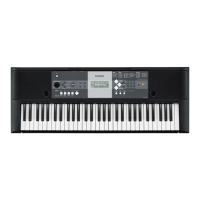
| MIDI-keyboard number of keys | 61 keys |
|---|---|
| Product color | Black |
| Compatible products | GM XGlite |
| Interface | - |
| DC-in jack | Yes |
| Dimensions (WxDxH) | 945 x 348 x 118 mm |
| Power requirements | 12V DC |
| Power consumption (typical) | 12 W |
 Weight and Dimensions
| Weight | 4500 g |
|---|