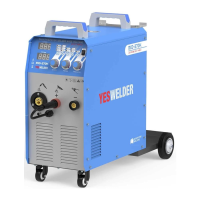
This document serves as the user's manual for the YESWELDER CUT-55DS Air Plasma Cutter, providing comprehensive information on its installation, operation, maintenance, and troubleshooting. It emphasizes safety precautions throughout, highlighting potential hazards such as electric shock, fire, explosion, arc radiation, magnetic fields, hot workpieces, excessive noise, and moving parts. The manual strongly advises professional support for complex issues and component replacement to ensure safety and proper functioning.
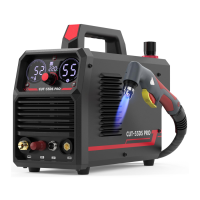
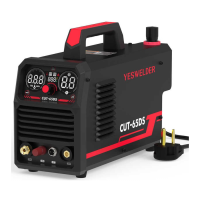
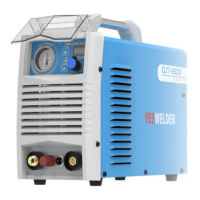
The CUT-55DS is described as a digital plasma cutting machine featuring perfect function, high performance, and advanced technology. It is an ultra-portable system suitable for various application requirements, including handheld and robot cutting. The machine is capable of cutting conductive metals such as low carbon steel, stainless steel, and aluminum, with a cutting thickness up to 20 mm and perforating thickness up to 12 mm. Its forward-looking design and the application of advanced and mature technologies are intended to protect user investment.
A key feature of the CUT-55DS is its advanced digital control mode, which utilizes international leading MCU intelligent digital control technology. All major parts are controlled through software, representing a significant improvement in function and performance compared to traditional plasma cutting machines. This digital control makes the machine less sensitive to parameter changes, contributing to better consistency and stability in performance, even if certain component parameters vary due to environmental factors like temperature and humidity.
The machine also incorporates advanced inverter technology, employing PWM technology and high-power IGBT components. It inverts the DC voltage rectified from a 50Hz/60Hz input AC voltage to a high AC voltage (30K~100KHz). This voltage is then dropped and rectified to output the high-power DC supply necessary for cutting. This switching power supply inverter technology significantly reduces the volume and weight of the plasma cutter while enhancing conversion efficiency. The switching frequency operates beyond the audible range, effectively eliminating noise pollution.
The CUT-55DS offers powerful cutting performance, making it an economic and practical choice. It uses compressed air as the plasma gas source, and its cutting speed is noted to be 1.8 times faster than oxyacetylene cutting. It can cut thick steel plates, stainless steel, copper, cast iron, and aluminum conveniently and quickly. The machine features HF arc ignition mode for easy arc initiation and includes a post-flow function. Users can expect smooth cutting surfaces, often eliminating the need for polishing, due to its simple operation and high cutting speed.
For operation, the manual details the functions of the front and back panels, including the 2T/4T key for welding mode conversion, a current control knob for adjusting output current, a quick socket for the earth cable, and a gas-electric connector for the cutting torch. The digital panel provides indicators for power, overheating, torch protection, 2T/4T status, gas-check, and metal mesh cutting. The operation method involves turning on the power, selecting the working mode (2T or 4T) and function (normal or metal mesh cutting), setting the cutting current based on workpiece thickness, and initiating the arc by bringing the copper nozzle into contact with the workpiece (or maintaining a 2mm distance for pilot arc models).
Important notes for cutting operation are provided to ensure optimal performance and longevity of consumables. Users are advised against igniting the arc in the air unnecessarily, as it shortens electrode and nozzle lifespan. It's recommended to start cutting from the edge of the workpiece unless penetration is required. Ensuring spatters fly from the bottom of the workpiece indicates proper cutting; spatters from the top suggest the torch is moving too fast or the current is too low. Maintaining a slight touch or short distance between the nozzle and workpiece is crucial for smooth cutting, as pressing the torch against the workpiece can cause sticking. For precise or round cuts, molding boards or other assistant tools are suggested. Pulling the cutting torch while cutting is recommended. Users should keep the nozzle upright, ensure the arc follows the cutting line, avoid bending or stepping on the cable to prevent gas flow obstruction, and regularly clean spatters and dust from the nozzle and torch head to maintain cooling efficiency.
Maintenance is crucial for the machine's high performance and safe operation. The manual outlines daily and periodic checks. Daily maintenance includes inspecting the front panel for damaged or loose components, tightened output quick sockets, and illuminated abnormity indicators. The back panel should be checked for input power cable condition and unobstructed air intake. Covers and chassis should be inspected for loose bolts and screws. Routine checks involve observing the machine enclosure for color fading or overheating, listening for normal fan sounds, and detecting any abnormal smell, vibration, or noise. Cables, including the earth cable and cutting cable, should be checked daily for breaks, worn insulation, external force damage, and secure connections.
Periodic checks, which should only be carried out by qualified professionals after the machine is powered off and capacitors have discharged (at least 5 minutes after power-off), involve a more thorough inspection. Safety is paramount, requiring the power plug to be disconnected before uncovering the machine and keeping hands, hair, and tools away from moving parts when the machine is on. Periodic checks include verifying inner circuit connections (especially plugs) for looseness or oxidization, and inspecting the insulating layer of all cables for damage. Precautions against static damage are advised for protecting semiconductor components and PCBs. Keeping the machine dry and avoiding water infiltration is important; if water ingress occurs, the machine must be dried and its insulation checked with an ohmmeter before reuse. Long-term storage requires the machine to be placed in its original packing in a dry location. General periodic checks should occur every 6 months, or every 3 months in dusty or oily environments, focusing on inspection and cleaning of the machine interior. Plastic parts should be cleaned with neutral detergent to prevent corrosion.
Troubleshooting guidance is provided for common issues, with the abnormity indicator on the front panel signaling internal failures. For instance, if the power indicator illuminates but control PCB keys don't function or the torch trigger gets no response, the machine may have crashed and needs to be shut down and restarted. If control PCB keys work but the torch trigger gets no response, the LED1 on the main board should be checked; if on, the control PCB is damaged; if off, the torch trigger and wire need inspection. If the power indicator and fan work, and the solenoid valve functions upon trigger push but there's no HF discharge rustling, the arc ignition part may be faulty due to excessive interelectrode distance, leakage in the HF capacitor, a damaged relay, or low input voltage. Finally, if the arc cannot be ignited, the air pressure might be overly high or low.


 To Next Page
 General