
 Need help?
Do you have a question about the ZKTeco SA32-E and is the answer not in the manual?
Lists key technical specifications such as operating voltage, current, dimensions, weight, temperature, humidity, storage, card type, and reading distance.
Details default configurations for programming password, relay unlock, W26 port, security mode, and open mode for factory reset.
Explains the meanings of different red and green light flashes and buzz sounds indicating system status and operations.
Details the pin assignments, colors, and functions for the JP1 terminal, crucial for connecting external devices and power.
Describes the JP2 terminal's pins, colors, functions, and remarks, including WG input/output and relay outputs for flexible integration.
Presents a visual representation of how to connect power, locks, buttons, doorbell, and other peripherals to the device terminals.
Provides a comprehensive guide to programming functions, covering adding/deleting users, setting passwords, and configuring modes.
Step-by-step instructions to reset the device's programming password back to the default factory setting of 123456.
Explains how to use Manager Add Card (MAC) and Manager Delete Card (MDC) for adding and removing card users efficiently.
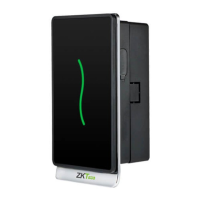
This document describes the SA32-E, a single-door RFID-based access control standalone device. It offers a robust solution for managing access in various environments, including residential housing, offices, and other public facilities.
The SA32-E is designed to provide secure and flexible access control through multiple verification methods. It supports contact-less smart card and password verifications, allowing for three distinct verification modes: Card only, PIN only, and a combination of Card & PIN. This multi-modal approach enhances both security and user convenience, adapting to different operational requirements.
The device features a single relay output, which can be configured as an optional output, and a PUSH (low) output. These outputs are crucial for controlling door locks and other access mechanisms. Additionally, it includes a dedicated door button port, enabling easy exit from the controlled area, and a doorbell port, which integrates with an existing doorbell system for visitor management.
The SA32-E operates as a standalone unit, meaning it does not require a constant connection to a central server or computer for its primary access control functions. This makes it a self-contained and reliable solution, particularly suitable for installations where network infrastructure might be limited or where a decentralized access control system is preferred.
The device's core function revolves around managing user access through a database of up to 1000 users. Each user can be assigned a unique card, a PIN, or both, depending on the chosen verification mode. The system distinguishes between private access passwords (PINs) and common access passwords, offering an additional layer of flexibility in managing access rights.
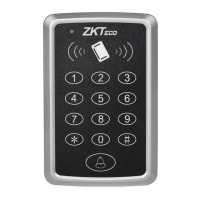
The SA32-E is designed for straightforward operation and management. Its user interface includes a keypad for PIN entry and programming, and an RFID reader for card authentication. Visual and auditory indicators provide immediate feedback on the device's status and user interactions.
Light indicators, specifically red and green LEDs, communicate the access control status. A slow red flash indicates a holding state, while a continuously lit red light signifies the programming state. A green light that stays on within the open time indicates an unlocking state, and a fast green flash signals that the device is pending further action. These visual cues help users and administrators understand the device's current operational mode at a glance.
Sound indicators, in the form of buzzes, provide auditory feedback. A single short buzz confirms a valid input, while three short buzzes indicate an invalid input. A long buzz signifies successful program execution, and a continuous long buzz indicates that the device is restoring factory programming passwords. These auditory signals complement the visual indicators, ensuring clear communication of the device's status.
Programming the SA32-E involves entering a programming password, which defaults to "123456" at the factory. This password allows administrators to access various settings and user management functions. The device supports adding and deleting users, setting access modes, and configuring relay unlock times.
User management is flexible, allowing for the addition of users by presenting a card, entering a card number, or assigning a PIN. The device supports different card types, typically EM (ID) cards, with IC card options available. When adding users, the system can read new cards or register existing card numbers. Deleting users can be done individually by card or PIN, or in bulk by deleting all users or all cards.
The open mode can be configured to accept either a card, an access password, or both. The access password can be a private access password (PIN) or a common access password, providing granular control over how access is granted.
The device also includes a W26 port, which can be configured as an input for options, and a security mode that can be turned on or off. These features offer additional customization and integration possibilities with other security systems.
Maintaining the SA32-E involves periodic checks and, if necessary, resetting the device to its factory defaults. The device is designed for durability and consistent performance in various ambient conditions.
One key maintenance feature is the ability to restore factory programming passwords. This is indicated by a continuous long buzz, which can be initiated through a specific procedure involving the RST (reset) pins. This feature is crucial for recovering the device if the programming password is lost or forgotten, allowing administrators to regain control and reconfigure the system.
The process for restoring factory programming passwords involves several steps:
This reset procedure ensures that the device can always be brought back to a known state, facilitating troubleshooting and system recovery.
The SA32-E's design, with its simple yet effective interface and robust functionality, minimizes the need for frequent maintenance. The visual and auditory feedback mechanisms aid in quick diagnosis of operational issues, allowing administrators to identify and address problems efficiently. The standalone nature of the device also simplifies maintenance, as there is no complex network infrastructure to manage for its core functions.
Overall, the SA32-E provides a reliable, user-friendly, and easily maintainable access control solution suitable for a wide range of applications.
 General
| Model | SA32-E |
|---|---|
| Access Control Mode | Standalone |
| RAM | 32 MB |
| Fingerprint Capacity | 3, 000 |
| Transaction Capacity | 100, 000 |
| Record Capacity | 100, 000 |
| Communication | TCP/IP, USB Host |
| Access Control Interface | 3rd party electric lock, door sensor, exit button, alarm |
| Operating Voltage | 12V DC |
| Operating Current | 500mA |
| Operating Temperature | -10°C to 50°C |
| Operating Humidity | 20% to 80% |
| Software | ZKAccess3.5 |
| CPU | 32-bit 400 MHz |
| Wiegand Signal | Wiegand Input/Output |





 To Next Page