26 CHAPTER 2: OPTIMIZING BANDWIDTH
Aggregated Links Aggregated links are connections that allow devices to communicate
using up to four member links in parallel. Aggregated links are supported
on the 10/100/1000BASE-T ports and GBIC or SFP ports
. These parallel
links provide two benefits:
■ They can potentially double, triple or quadruple the bandwidth of a
connection.
■ They can provide redundancy — if one link is broken, the traffic load
can be shared amongst the remaining link(s).
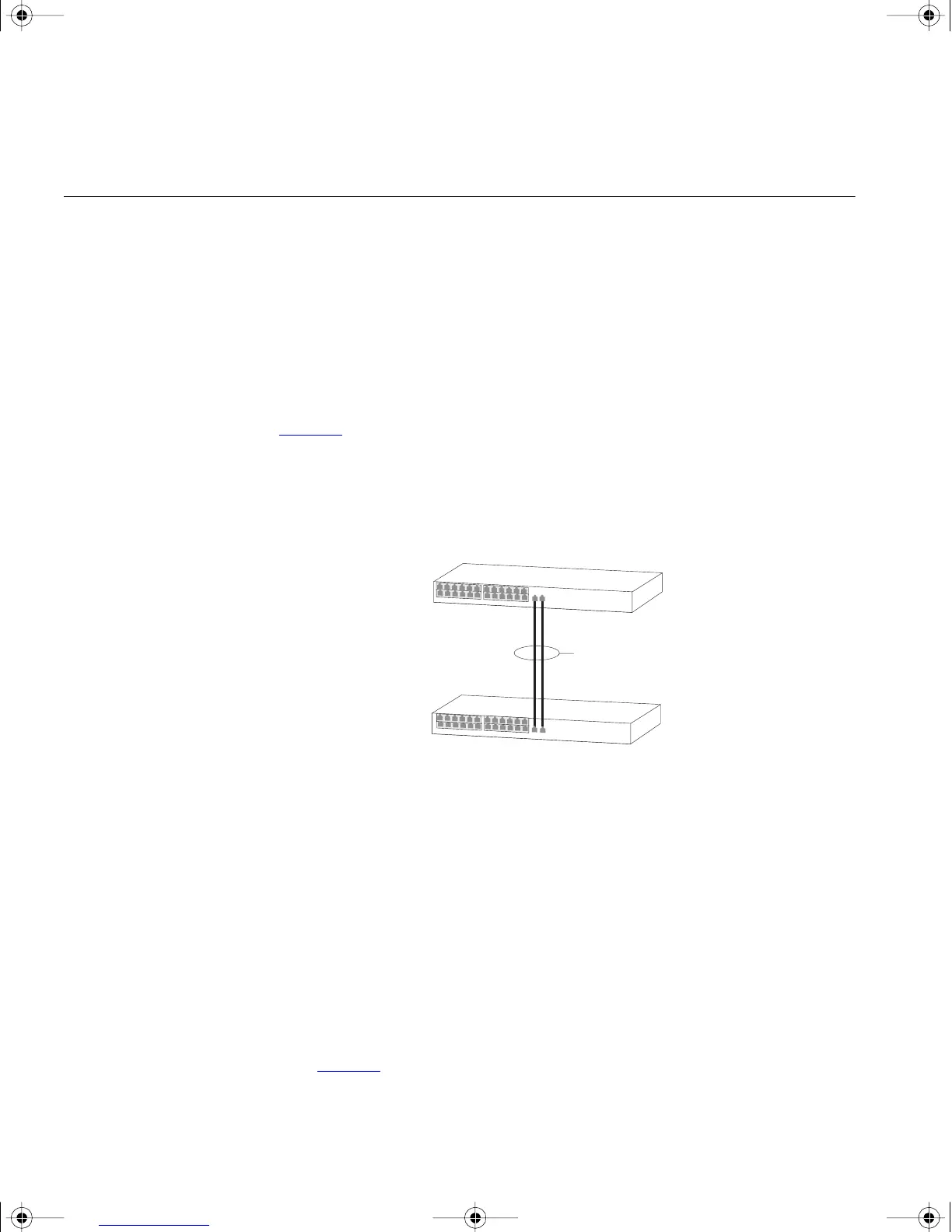
Figure 1
shows two Switches connected using an aggregated link
containing two member links. If all ports on both Switch units are
configured as 1000BASE-T and they are operating in full duplex, the
potential maximum bandwidth of the connection is 2 Gbps.
Figure 1 Switch units connected using an aggregated link
.
How 802.3ad Link
Aggregation
Operates
Your Switch supports IEEE 802.3ad standard aggregated links which uses
the Link Aggregation Control Protocol (LACP). LACP provides automatic,
point-to-point redundancy between two devices (switch-to-switch or
switch-to-server) that have full duplex connections operating at the same
speed.
By default, LACP is disabled on the 10/100/1000BASE-T and GBIC or SFP
ports. If you enable LACP your Switch will detect if there is more than one
connection to another device and will automatically create an aggregated
link consisting of those links.
If a member link in an aggregated link fails, the traffic using that link is
dynamically reassigned to the remaining member links in the aggregated
link. Figure 2
shows the simplest case: two member links, that is the
physical links, form an aggregated link. In this example, if link 1 fails, the
data flow between X and B is remapped to physical link 2. The
Switch
Switch
Aggregated Link
dua1730-0bAA03.book Page 26 Monday, July 11, 2005 11:14 AM



 To Next Page