
 Need help?
Do you have a question about the 3M NANO-LOK and is the answer not in the manual?
Highlights essential safety warnings and potential hazards.
Covers planning, sharp edges, and fall clearance definitions.
Outlines steps to determine required fall clearance using charts.
Covers pre-use verification, operation, and taglines.
Guidelines for using twin SRD systems for 100% tie-off.
Specifies inspection intervals and detailed procedures.
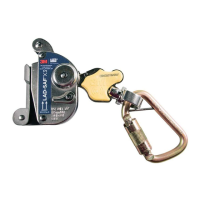
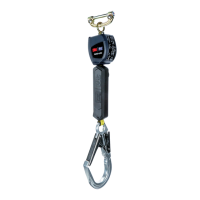
The 3M Nano-Lok Self-Retracting Device (SRD) is a crucial component of a comprehensive fall protection system, designed to enhance worker safety in various workplace applications. This device features a drum-wound lifeline that automatically extends and retracts into a robust housing, providing continuous fall protection as the worker moves. In the event of a fall, a sensing mechanism within the SRD activates, arresting the fall and limiting deceleration forces.
The Nano-Lok SRD is classified as a Class 1 Self-Retracting Device, making it suitable for applications where the lifeline remains generally vertical during use. It can be utilized for both fall arrest and restraint applications. The device's core function is to allow freedom of movement while ensuring immediate fall arrest if a fall occurs. The lifeline, typically made of Dyneema polyester, extends and retracts smoothly from the housing. A top connector secures the SRD to an anchorage point, while a bottom connector attaches to the user's full body harness. Energy absorbers are integrated into the system to dissipate kinetic energy during a fall, thereby limiting the forces exerted on the user.
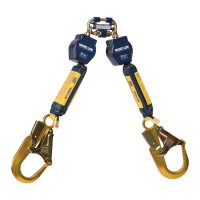
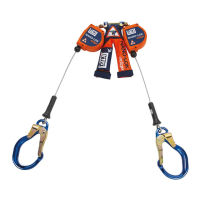
SRD models are available in both single-SRD and twin-SRD configurations. Twin-SRD models are particularly useful for maintaining 100-percent tie-off when workers need to transfer between anchorage points, ensuring continuous protection. Some models feature an alternate swivel for securing the top connector, designed for installation with the top connector attached to an overhead anchorage point.
The Nano-Lok SRD is intended for use by trained individuals in workplace applications as part of a complete fall protection system. Proper planning is essential before use, including accounting for all factors that may affect safety before, during, and after a fall. Users must be aware of fall clearance requirements, which include free fall, deceleration distance, harness stretch, and a safety factor, to prevent striking obstructions below. Minimizing fall potential and distance is achieved by working as directly below the anchorage point as possible. Anchorage height and user work radius (swing falls) are critical considerations that impact required fall clearance.
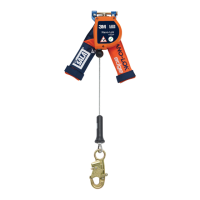
Connecting the SRD to an anchorage point requires careful attention to compatibility in size, shape, and strength. The anchorage should be directly overhead to minimize free fall and swing fall hazards and must be capable of sustaining the static loads defined in the product specifications. Single-SRD models can be mounted on anchorage points using appropriate connectors like carabiners, snap hooks, or rebar hooks. Harness-mounted SRDs, which secure directly to the full body harness via a harness interface, offer easier transportation and ensure the SRD is within reach when moving between anchorage points. Cab mount models are designed for overhead mounting in equipment like order pickers.
When using twin-SRD models, workers must always ensure at least one SRD is connected to an anchorage point when in the vicinity of a fall hazard. Both SRDs should never be connected to the same anchorage point, and each individual anchorage point must meet strength requirements. The lifelines must be kept free from obstructions and entanglement, and should not be passed under arms or between legs during use. Taglines can be used to raise or lower the bottom connector of the SRD to the worker's location, especially when the anchor point is out of reach.
Regular inspection and maintenance are crucial for ensuring the continued safety and reliability of the Nano-Lok SRD. The product must be inspected before each use by the user and, additionally, by a competent person at intervals of no longer than one year. Higher frequency inspections may be necessary depending on equipment use and environmental conditions.
Inspection procedures involve checking for loose bolts, bent or damaged parts, and any distortion, cracks, or other damage to the housing and swivel eye. The lifeline must pull out and retract fully without hesitation or slack, and the device should lock up positively when jerked sharply, with no slipping. All connectors must be inspected for damage, corrosion, and proper function of gates, swivel eyes, and locking mechanisms. The webbing lifeline should be examined for cuts, frays, broken fibers, tears, abrasion, heavy soiling, mold, burns, discoloration, and pulled or cut stitches, as these can indicate impact loading. The integral energy absorber must be verified as not activated, ensuring the lifeline cover is intact and no webbing is exposed. All labels must be present and legible.
If any inspection reveals an unsafe or defective condition, or if the product has been subjected to fall arrest or impact force, it must be immediately removed from service and clearly tagged "DO NOT USE." The product is not repairable, and any attempts to repair it should be avoided.
Cleaning involves periodically washing the lifeline and exterior of the product with water and a mild soap solution, followed by thorough rinsing and air drying. Labels should also be cleaned as necessary. For disposal, the lifeline should be cut or otherwise disabled, and the product disposed of appropriately. For extended storage, the product should be kept in a cool, dry, clean environment, away from direct sunlight and chemical vapors. After extended storage, a thorough inspection of all components is required before use. The product is equipped with an RFID Tag for recording inspection results, which should be removed and disposed of/recycled according to local regulations prior to product disposal.
 General
| Product Type | Self-Retracting Lifeline |
|---|---|
| Length | 6 ft |
| Weight Capacity | 310 lbs |
| Connector Type | Carabiner |
| Material | Polyester Web |
| Standards/Approvals | ANSI Z359.14 |
| Width | 1 inch |
| Snaphook Type | Steel |

 To Next Page