AR-B1579 User's Guide
3-11
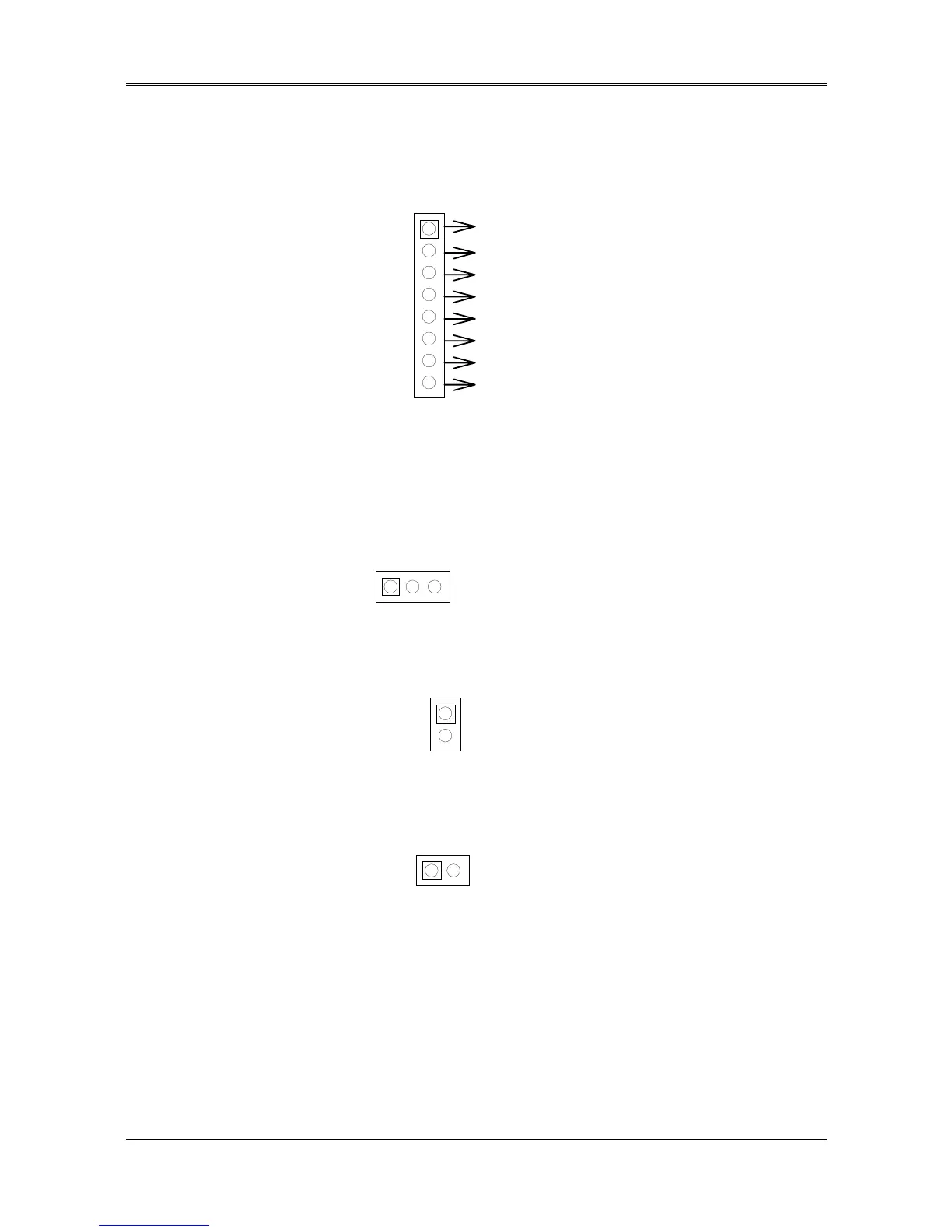
3.2.12 Power Connector (J9)
J9 is an 8-pin power connector. You can directly connect the power supply to the onboard power connector for
stand-alone applications.
1
2
3
4
+5 VDC
GND
GND
+12 VDC
5
6
7
8
GND
-12 VDC
+5 VDC
-5 VDC
Figure 3-22 J9: Power Connector
3.2.13 LED Header
(1) External Power LED Header (J3)
123
1 Power LED+
2 Not Used
3 Power LED-
Figure 3-23 J3: Power LED Header
(2) HDD LED Header for IDE0 (J5)
1
2
LED-
LED+
Figure 3-24 J5: HDD LED Header for IDE0
(3) Watchdog LED Header (J11)
1 LED+
2 LED-
12
Figure 3-25 J11: Watchdog LED Header
3.2.14 CPU Setting
The AR-B1579 accepts many types of 586 microprocessors such as Intel Pentium, AMD K5 & AMD K6, and Cyrix
6X86. All of these CPUs include an integer processing unit, floating-point processing unit, memory-management
unit, and cache. They can give a two to ten-fold performance improvement in speed over the 486 processor,
depending on the clock speeds used and specific application. Like the 486 processor, the 586 processor includes
both segment-based and page-based memory protection schemes. Instruction of processing time is reduced by
on-chip instruction pipelining. By performing quickly, on-chip memory management and caching, the 586
processor relaxes requirements for memory response for a given level of system performance.


 To Next Page