Page 76 of 84
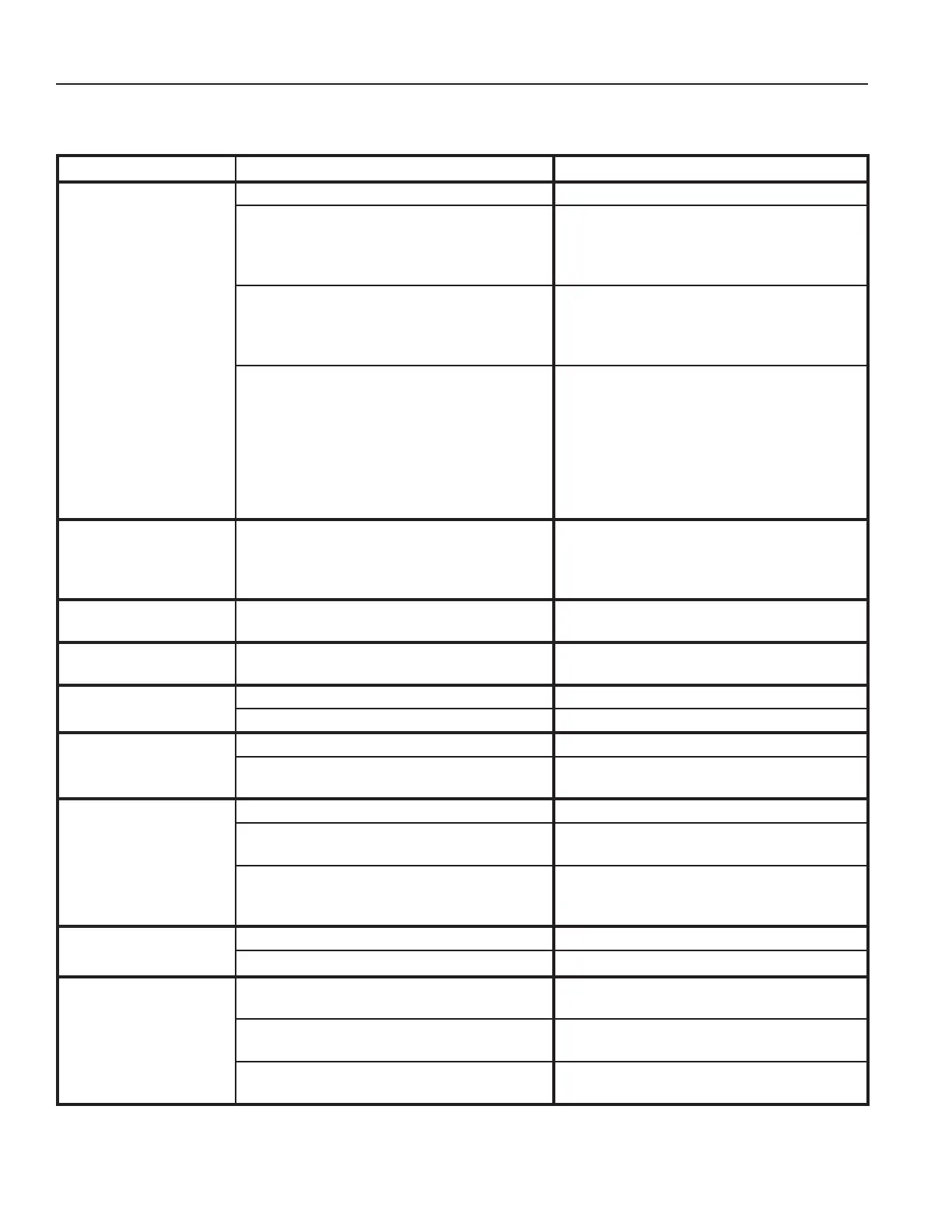
Problem Probable Cause Solution
No Fan Operation
No 24V control voltage Check for 24 VAC at control
No input pressure to control
Check alignment of capillary fitting
Schrader valve depressor must depress
Schrader valve enough to allow pressure
into capillary
Bad fan motor
Disconnect power, when P266 is used,
place a jumper from L1 to M1 and connect
power, if fan does not start, motor is bad
and should be replaced
Pressure transducer problem
Disconnect 6 pin connector from right side
of control, place a jumper wire between
third pin from the top and bottom pin on
the control (not the cable) If fan goes to
full speed, check for input pressure If it
has been determined there is adequate
pressure, the transducer is bad and the
control must be replaced
Fan Stops When
Pressure Reached
The High End Of The
Operating Range
Control is not wired correctly See wiring diagrams
No Fan Modulation
(On-O Operation)
Control is not wired correctly See wiring diagrams
Fan Starts At
Full Speed
Control is not wired correctly See wiring diagrams
Erratic Fan Operation
Control is not wired correctly See wiring diagrams
Dirty or blocked condenser coil Clean condenser coil
Fan Motor Is Cycling
On Thermal Overload
Dirty or blocked condenser coil Clean condenser coil
Wrong motor for fan speed
control application
Replace with motor approved for fan speed
control application
Erratic Pressure
Control
Defective regulator Replace defective part
Dirt causing regulator to bind
Disassemble regulator and clean internal
parts Install strainer
Power source to hot gas solenoid or
operation of the solenoid is intermittent
Determine if problem is caused by supply
voltage, solenoid or excessive MOPD, make
changes necessary to correct problem
Regulator Leakage
Dirt in regulator causing seat to remain open Clean regulator Install strainer
Worn or eroded seating surface on regulator Replace defective part
Regulator Hunting
(Chattering) With
Large Fluctuations
In Controlled Pressures
Regulator is oversized
Contact Addison for correctly
sized regulator
Regulator and liquid injection thermovalve
have control interaction
Increase superheat setting, dampen bulb
response by repositioning
Regulator and cylinder unloaders have
control interaction
Increase dierential between the controls
by lowering the regulator’s setpoint
Table 13.4: Variable Speed Head Pressure Control
PR Series Installation, Operation, and Maintenance Manual


 To Next Page