EasyManua.ls Logo

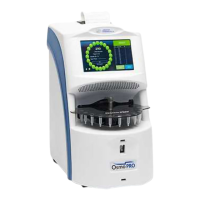
Advanced Instruments OsmoTECH PRO - User Manual

Advanced Instruments OsmoTECH PRO
5 pages
Print Icon
To Next Page IconTo Next Page
Loading...
Hot-Line Technical Service: Advanced Instruments and worldwide distributor network provides 24/7
comprehensive customer service and technical support.
©2019 Advanced Instruments. Alltrademarks are the property of their respective companies.
Two Technology Way / 781-320-9000
Norwood, Massachusetts 02062, USA
800-225-4034 Fax:781-320-8181
aicompanies.com
222123PM Rev 0
Replacement Procedure 222123PM
OsmoTECH
®
PRO Block Probe
Scope
This document describes how to replace the block
probe (p/n 222123R) on the OsmoTECH® PRO
Multi‑Sample Micro‑Osmometer. It is intended for use in
conjunction with service procedures that require access
to the OsmoTECH PRO interior.
Tools required
#1 and #2 Phillips screwdrivers
5/16” nut driver
7/64” and 9/64” Allen wrenches
30 µL sample tube
Static grounding wrist strap
Parts and materials required
Replacement part 222123R
Related documents
OsmoTECH PRO Disassembly and Reassembly
(p/n 222202PM)
OsmoTECH PRO Service Guide (p/n 222006EN)
Safety notices
WARNING: Hazardous Voltage. Power cord must
be disconnected to prevent electrical shock.
NOTICE: Internal components may be damaged
by static electricity. A static grounding wrist
strap must be worn during this procedure.
NOTICE: Improper connections may cause
damage to the instrument.
Disconnecting the control PCB
1. Remove the rear and side enclosure as explained in
OsmoTECH PRO Disassembly and Reassembly.
2. Remove the cable clamp [A] that secures the C10
sample probe cable and the C11 block probe cable
to the side of the power supply and controls
assembly.
A
3. Unplug the C10 and C11 connectors from the control
PCB.
4. Disconnect the B1, B2, B3, B4, B6, B7, B8, B9, and
B10 connectors on the motor/sensor cable harness
from their mating connectors.
5. Disconnect the A1, A2, A3, and A4 connectors on
the cooling system harness from their mating
connectors.

Other manuals for Advanced Instruments OsmoTECH PRO

Question and Answer IconNeed help?

Do you have a question about the Advanced Instruments OsmoTECH PRO and is the answer not in the manual?

Summary

Disconnecting the Control PCB

Remove Rear and Side Enclosure

Remove the rear and side enclosure as explained in OsmoTECH PRO Disassembly and Reassembly.

Remove Cable Clamp [A]

Remove the cable clamp [A] securing the C10 sample probe cable and C11 block probe cable.

Unplug C10 and C11 Connectors

Unplug the C10 and C11 connectors from the control PCB.

Disconnect Motor;Sensor Cable Harness

Disconnect B1-B4, B6-B10 connectors on the motor/sensor cable harness.

Disconnect Cooling System Harness

Disconnect A1-A4 connectors on the cooling system harness from mating connectors.

Removing the Power Supply and Controls Assembly

Rest Instrument on Back Side

Rest the instrument on its back side before proceeding.

Remove Screws [B]

Remove the two screws [B] securing the power supply and controls assembly to the chassis bottom.

Place Instrument Upright

Place the instrument in the upright position.

Remove Screws [C]

Remove the two screws [C] securing the power supply and controls assembly to the chassis rear.

Slide Assembly Out

Slide the power supply and controls assembly out of the base assembly.

Removing the Osmometer Module

Remove Screws and Washers [D]

Remove four socket head cap screws and washers [D] from the mounting bracket.

Slide Osmometer Module Out

Carefully slide the osmometer module out of the instrument.

Remove Hex Nut and Washer [E]

Remove hex nut and washer [E] securing SPG and BPG ring terminals.

Remove Screws and Washers [F]

Remove four socket head cap screws and washers [F] mounting the module bracket.

Lift Osmometer Module

Lift the osmometer module off of its mounting bracket.

Removing the Sample Cooling Assembly

Remove Screws and Washers [F]

Remove four screws [F] securing cooling fan, finger guard, and diverter to heatsink.

Disconnect Drain Tubing [G]

Disconnect the sample well drain tubing [G] from the drain tube [H].

Remove Screws and Washers [I]

Remove four socket head cap screws [I] securing cooling assembly to mounting block.

Remove Cables from Clamps [J]

Remove block probe, thermo-electric, and solenoid cables from cable clamps [J].

Detach Cable Clip [K]

Detach the cable clip [K] from the thermo-electric wire leads.

Lift Sample Cooling Assembly

Carefully lift the sample cooling assembly out of the osmometer module assembly.

Removing the Block Probe

Remember;Record Probe Details

Record block probe cable position and insertion depth before removal.

Fill Syringe with Thermal Grease

Fill the syringe with thermal grease.

Inject Grease into Hole [M]

Inject grease into the block probe hole [M] while withdrawing syringe tip.

Record Resistance Value [M]

Record the four-digit resistance value [M] listed on the block probe cable.

Replacing the Block Probe

Navigate to Probe Resistance Settings

From the main menu, press SETTINGS > PROBE RESISTANCE.

Log In to Account

Log in to your account to access settings.

Enter Resistance Value [M]

Enter the resistance value [M] previously recorded for the block probe cable.

Recalibrate Instrument

Recalibrate the instrument after replacing the block probe.

Replacing the Sample Cooling Assembly

Secure Assembly and Cable Clip

Secure the sample cooling assembly and cable clip using screws and washers [1].

Lift Sample Well Mounting Block

Lift up the sample well mounting block until the sample tube is below the stripper bracket.

Lower Movable Plate

Carefully lower the movable plate securing the sample probe until it enters the sample tube.

Replacing the Osmometer Module

Mount Replacement Module

Mount the replacement osmometer module using screws and washers [F].

Secure SPG;BPG Terminals

Secure SPG and BPG ring terminals using hex nut and washer [E].

Slide Osmometer Module In

Slide the osmometer module into the instrument.

Mount Module Mounting Bracket

Mount the osmometer module mounting bracket using screws and washers [D].

Reconnecting the Control PCB

Place Instrument Upright

Place the instrument in an upright position.

Plug Cooling System Harness Connectors

Plug A1-A4 connectors on the cooling system harness into their mating connectors.

Plug Motor;Sensor Cable Harness Connectors

Plug B1-B4, B6-B10 connectors on the motor/sensor cable harness.

Plug C10 and C11 Connectors

Plug the C10 and C11 connectors into the control PCB.

Secure Probe Cables with Clamp [A]

Secure C10 and C11 probe cables to the power supply assembly with clamp and screw [A].

Reassemble Instrument

Reassemble the instrument following disassembly instructions.

Access Probe Resistance Settings

When powered on, press SETTINGS > PROBE RESISTANCE.

Update Block Probe Resistance Value

Change the block probe resistance value to match the previously recorded value.

Calibrate Instrument

Calibrate the instrument as per the service guide.

Overview

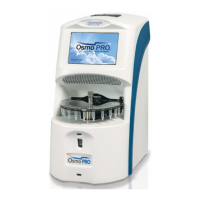
The OsmoTECH® PRO is a multi-sample micro-osmometer designed for precise measurement of osmolality in various samples. This document outlines a replacement procedure for the block probe (p/n 222123R), a critical component for the instrument's operation. The device is intended for use in conjunction with service procedures requiring access to its internal components, ensuring accurate and reliable performance.

Function Description

The OsmoTECH® PRO operates by measuring the freezing point depression of a solution, which is directly proportional to its osmolality. The block probe is a key sensor in this process, responsible for accurately detecting the temperature changes during the freezing point determination. The instrument is designed for multi-sample analysis, indicating its capability to process multiple samples efficiently, likely through an automated or semi-automated system. The replacement procedure detailed in the manual ensures the continued accuracy and functionality of this critical measurement.

Important Technical Specifications

While specific numerical specifications like measurement range or accuracy are not directly provided in this excerpt, the document implies several technical aspects:

  • Probe Type: The device utilizes a "block probe" (p/n 222123R), which is a specialized sensor for temperature measurement during osmolality determination.
  • Thermal Management: The presence of a "sample cooling assembly," "cooling fan," "heatsink," and "thermo-electric cable" indicates a sophisticated thermal management system. This is crucial for precise freezing point measurements, as stable and controlled cooling is essential for accurate osmolality readings.
  • Electrical Connections: The instrument features numerous electrical connectors (C10, C11, B1-B4, B6-B10, A1-A4) for various components like the sample probe, block probe, motors, sensors, and cooling system. This suggests a complex internal electrical architecture designed for integrated control and data acquisition.
  • Mechanical Assembly: The device involves multiple mechanical assemblies, including a "power supply and controls assembly," "osmometer module," and "sample cooling assembly," all secured with various screws, washers, and mounting brackets. This modular design likely facilitates maintenance and component replacement.
  • Probe Resistance: The block probe has a measurable "resistance value" (four-digit), which is a critical parameter for its calibration and proper functioning. This value needs to be recorded and entered into the instrument's settings after replacement, indicating that the probe's electrical characteristics are integral to its performance.

Usage Features

The manual primarily focuses on maintenance rather than daily operational usage. However, some usage features can be inferred:

  • Multi-Sample Capability: The "Multi-Sample Micro-Osmometer" designation highlights its ability to handle multiple samples, suggesting efficiency in laboratory settings.
  • User Interface: The mention of "main menu" and "SETTINGS > PROBE RESISTANCE" indicates a user interface that allows for configuration and calibration of the instrument.
  • Calibration: The instruction to "Calibrate the instrument" after block probe replacement confirms that regular calibration is a standard operational procedure to ensure measurement accuracy.
  • Sample Handling: The use of a "30 µL sample tube" and "sample well drain tubing" points to specific sample handling requirements and a system for waste management.

Maintenance Features

The document is a detailed guide for a specific maintenance procedure, highlighting several key maintenance features:

  • Modular Design: The instrument is designed with modular components (power supply, osmometer module, sample cooling assembly) that can be individually removed and replaced. This modularity simplifies troubleshooting and component-level repairs.
  • Detailed Step-by-Step Procedures: The manual provides clear, numbered steps with accompanying images and callouts (e.g., [A], [B], [C]) to guide technicians through the replacement process. This level of detail is crucial for accurate and safe maintenance.
  • Specialized Tools: The requirement for specific tools like Phillips screwdrivers, nut drivers, Allen wrenches, and a 30 µL sample tube indicates that maintenance requires specialized equipment.
  • Static Electricity Precautions: The "NOTICE: Internal components may be damaged by static electricity. A static grounding wrist strap must be worn during this procedure" emphasizes the importance of ESD (Electrostatic Discharge) precautions during maintenance, protecting sensitive electronic components.
  • Thermal Grease Application: The procedure for filling the block probe hole with "thermal grease" and slowly withdrawing the syringe tip to prevent air pockets is a critical step for ensuring proper thermal contact and accurate temperature sensing. This highlights the precision required in maintenance.
  • Cable Management: Instructions for removing and securing cable clamps (e.g., [A], [J], [K]) and ensuring a "service loop" [O] indicate careful attention to internal wiring organization, which is important for instrument reliability and future maintenance access.
  • Safety Warnings: The "WARNING: Hazardous Voltage. Power cord must be disconnected to prevent electrical shock" underscores the importance of safety protocols during maintenance, particularly when dealing with electrical components.
  • Probe Resistance Recording: The requirement to "Record the four-digit resistance value [M] listed on the block probe cable" and enter it into the instrument's settings is a crucial step for proper calibration and functionality after replacement.
  • Alignment Procedures: Instructions like "Make sure that the sample cooling assembly aligns with the sample probe" and "do not move either part more than necessary to avoid damaging the sample probe" highlight the need for careful alignment during reassembly to prevent damage and ensure correct operation.
  • Documentation: The reference to "Related documents" like "OsmoTECH PRO Disassembly and Reassembly (p/n 222202PM)" and "OsmoTECH PRO Service Guide (p/n 222006EN)" indicates a comprehensive suite of service documentation available for the instrument, supporting thorough maintenance.
  • Technical Support: The "Hot-Line Technical Service" information provided at the bottom of the page emphasizes the availability of professional support for maintenance and troubleshooting.

Advanced Instruments OsmoTECH PRO Specifications

General IconGeneral
BrandAdvanced Instruments
ModelOsmoTECH PRO
CategoryMeasuring Instruments
LanguageEnglish

Related product manuals