18
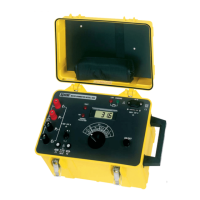
Digital Ground Resistance Tester Model 4500
NEC
®
2014250.52(A)(5)requiresaminimumof8ft(2.4m)oftheelec-
trode to be in contact with the soil. The most common of electrode is a
10ft(3m)cylindricalrodwhichmeetstheNEC
®
code, which requires a
minimumdiameterof5/8”(1.59cm).
4.1.2 Effects of Soil Resistivity on Ground Electrode
Resistance
Dwight’s formula, cited previously, shows that the resistance to earth of
grounding electrodes depends not only on the depth and surface area of
grounding electrodes but on soil resistivity as well. Soil resistivity is the key
factor that determines what the resistance of a grounding electrode will be,
and to what depth it must be driven to obtain low ground resistance. The
resistivity of the soil varies widely throughout the world and changes sea-
sonally. Soil resistivity is determined largely by its content of electrolytes,
consisting of moisture, minerals and dissolved salts. A dry soil has high
resistivity if it contains no soluble salts.
Soil
Ashes, cinders, brine, waste
Clay, shale, gumbo, loam
Same, with varying proportions
of sand and gravel
Gravel, sand, stones with
little clay or loam
590
340
1,020
59,000
2,370
4,060
15,800
94,000
7,000
16,300
135,000
458,000
Resistivity, Ω-cm
Minimum Average Maximum
Table 5
4.1.3 Factors Affecting Soil Resistivity
Two samples of soil, when thoroughly dried, may become in fact very good
insulators, having a resistivity in excess of 109 ohm-centimeters. The
resistivityofthesoilsampleisseentochangequiterapidlyuntilapproxi-
mately twenty percent or greater moisture content is reached.


 To Next Page