24
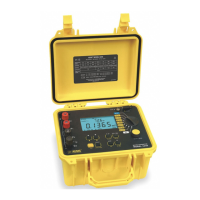
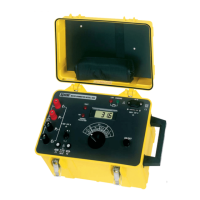
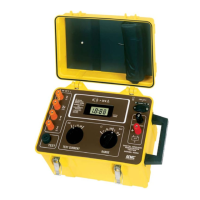
Digital Ground Resistance Tester Model 4500
The measurement of ground resistances may only be accomplished
with specially designed test equipment. Most instruments use the Fall
of Potential principle of alternating current (AC) circulating between an
auxiliaryelectrodeandthegroundelectrodeundertest;thereadingwill
be given in ohms and represents the resistance of the ground electrode to
the surrounding earth. AEMC
®
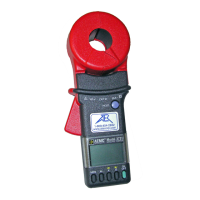
Instruments has also recently introduced a
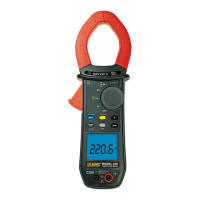
clamp-on ground resistance tester.
NOTE: The National Electrical Code
®
and NEC
®
are registered trademarks of the National
Fire Protection Association.
4.3 Ground Resistance Testing Principle
(Fall-of-Potential — 3-Point Measurement)
Three-point measurement is used to measure resistance to ground of
ground rods and grids. The potential difference between rods X and Y is
measuredbyavoltmeter,andthecurrentowbetweenrodsXandZis
measured by an ammeter.
By Ohm’sLawE=RIorR = E/I, we may obtain the ground electrode
resistance R.
IfE=20VandI=1A,then:
R===20Ω
E
I
20
1
It is not necessary to carry out all the measurements when using a ground
tester. The ground tester will measure directly by generating its own cur-
rent and displaying the resistance of the ground electrode.


 To Next Page