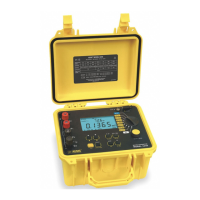
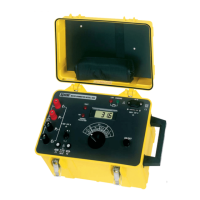
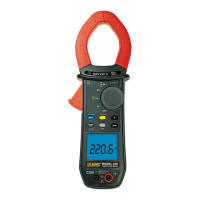
Digital Ground Resistance Tester Model 4500
23
FPN:Theparallelingefciencyofrodslongerthan8feetisimprovedby
spacing greater than 6 feet apart.
The National Electrical Code
®
(NEC
®
)statesthattheresistancetoground
shall not exceed25Ω. This is an upper limit and guideline, since much
lower resistance is required in many instances.
“How low in resistance should a ground be?”
Anarbitraryanswertothisinohmsisdifcult.Thelowerthegroundresis-
tance, the safer, and for positive protection of personnel and equipment, it
is worth the effort to aim for less than one ohm. It is generally impractical
to reach such a low resistance along a distribution system or a transmis-
sion line or in small substations. In some regions, resistances of 5Ω or less
maybeobtainedwithoutmuchtrouble.Inothers,itmaybedifculttobring
resistance of driven grounds below 100Ω.
Accepted industry standards stipulate that transmission substations
shouldbedesignednottoexceedoneohmresistance.Indistributionsub-
stations,themaximumrecommendedresistanceis5Ω. In most cases, the
buried grid system of any substation will provide the desired resistance.
Inlightindustrialorintelecommunicationscentralofces,5Ω is often the
accepted value. For lightning protection, the arresters should be coupled
withamaximumgroundresistanceof1Ω.
These parameters can usually be met with the proper application of basic
groundingtheory.Therewillalwaysexistcircumstanceswhichwillmake
it difcult to obtain the ground resistance required by the NEC
®
. When
these situations develop, several methods of lowering the ground resis-
tance can be employed. These include parallel rod systems, deep driven
rod systems utilizing sectional rods and chemical treatment of the soil.
Additional methods, discussed in other published data, are buried plates,
buried conductors (counterpoise), electrically connected building steel,
and electrically connected concrete reinforced steel.
Electricallyconnectingtoexistingwaterandgasdistributionsystemswas
often considered to yield low ground resistance; however, recent design
changesutilizingnon-metallicpipesandinsulatingjointshavemadethis
method of obtaining a low resistance ground questionable and in many
instances unreliable.
Ground rods, of course, will be required in high voltage transmission lines,
wheremaximumresistanceof15Ω is recommended; and in distribution
lines,where maximumresistance of25Ω is preferred. All electrical sys-
tems constructed in accordance with the National Electrical Code
®
, should
notexceed25Ω.


 To Next Page