32
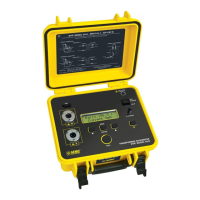
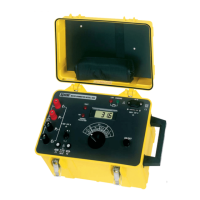
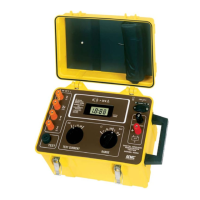
Digital Ground Resistance Tester Model 4500
Y
Z
X
X
v
TEST RANGETEST CURRENT
2
10
50
2
20
200
2
20
DIGITAL GROUND
RESISTANCE
TESTER
MODEL 4500
Figure 17
4.8 Soil Resistivity Measurements
Why make soil resistivity measurements?
Soil resistivity measurements have a threefold purpose. First, such data
are used to make sub-surface geophysical surveys as an aid in identifying
ore locations, depth to bed rock and other geological phenomena. Second,
resistivity has a direct impact on the degree of corrosion in underground
pipelines. A decrease in resistivity relates to in increase in corrosion activ-
ity and therefore dictates the protective treatment to be used. Third, soil
resistivity directly affects the design of a grounding system, and it is to that
taskthatthisdiscussionisdirected.Whendesigninganextensiveground-
ing system, it is advisable to locate the area of lowest soil resistivity in
order to achieve the most economical grounding installation.
Resistivity measurements are of two types, the 2-point and the 4-point
method. The 2-point method is simply the resistance measured between
two points. For most applications, the most accurate method is the 4-
point method, which is used in the Model 4500 Ground Tester. The 4-
point method, as the name implies, requires the insertion of four equally
spaced, and in-line, electrodes into the test area. A known current from a
constant current generator is passed between the outermost electrodes.
Thepotentialdrop(afunctionoftheresistance)isthenmeasuredacross
the two innermost electrodes. Model 4500 is calibrated to read directly in
ohms.


 To Next Page