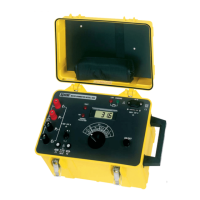
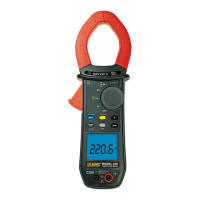
Digital Ground Resistance Tester Model 4500
21
Chemicallytreatedsoilisalsosubjecttoconsiderablevariationofresistiv-
itywithchangesintemperature,asshowninTable9onthenextpage.If
salt treatment is employed, it is, of course, necessary to use ground rods
which will resist chemical corrosion.
20
10
0
-5
-13
110
142
190
312
1440
The Effect of Temperature on the Resistivity of Soil Contining Salt*
(sandy loam, 20% moisture; salt 5% of weight of moisture)
Temperature ˚C Resistivity (Ohm-centimeters)
Table 9
*Such as copper sulfate, sodium carbonate and others. Salts must be EPA or local ordinance
approved prior to use.
4.1.4 Effect of Ground Electrode Depth on Resistance
Toassisttheengineerindeterminingtheapproximategroundroddepth
required to obtain a desired resistance, a device called the Grounding
Nomograph may be used. The Nomograph, shown on the following page,
indicates that to obtain a grounding resistance of 20 ohms in a soil with
a resistivity of 10,000 ohm-centimeters, a 5/8" OD rod must be driven 20
feet. NOTE that the values indicated on the Nomograph are based on
the assumption that the soil is homogeneous and, therefore, has uniform
resistivity(Figure8).TheNomographvalueisanapproximation.


 To Next Page