12
9. ELECTRICAL WIRINGS
• Before carrying out any work, switch off the
power supply to the air conditioner.
• All the parts and materials supplied on site
must comply with the local laws and regula-
tions.
• All the connection lines must comply with
the electrical wiring diagram. Incorrect con-
nection could cause the air conditioner to
malfunction or suffer damage. The wiring dia-
grams are subject to continuous updates, so
it is essential to use those on the machine as
your reference.
• The unit and its accessories must only be in-
stalled and wired by professionals with the
necessary technical qualifications in installa-
tion, conversion, extension and maintenance
of the systems and who are trained to per-
form operational and safety checks on these
systems. In this manual, these will generally be
referred to as “Personnel with specific techni-
cal skills”.
• In the specific case of electrical wirings, the
following must be checked:
− Measurement of the electrical system insula-
tion strength.
− Continuity of the protection wires.
• To protect the unit against short circuits,
mounted on the supply line of an thermo-
magnetic isolator switch (IG) with a minimum
contact separation of at least 3mm in all
poles. Respect the measurements given in
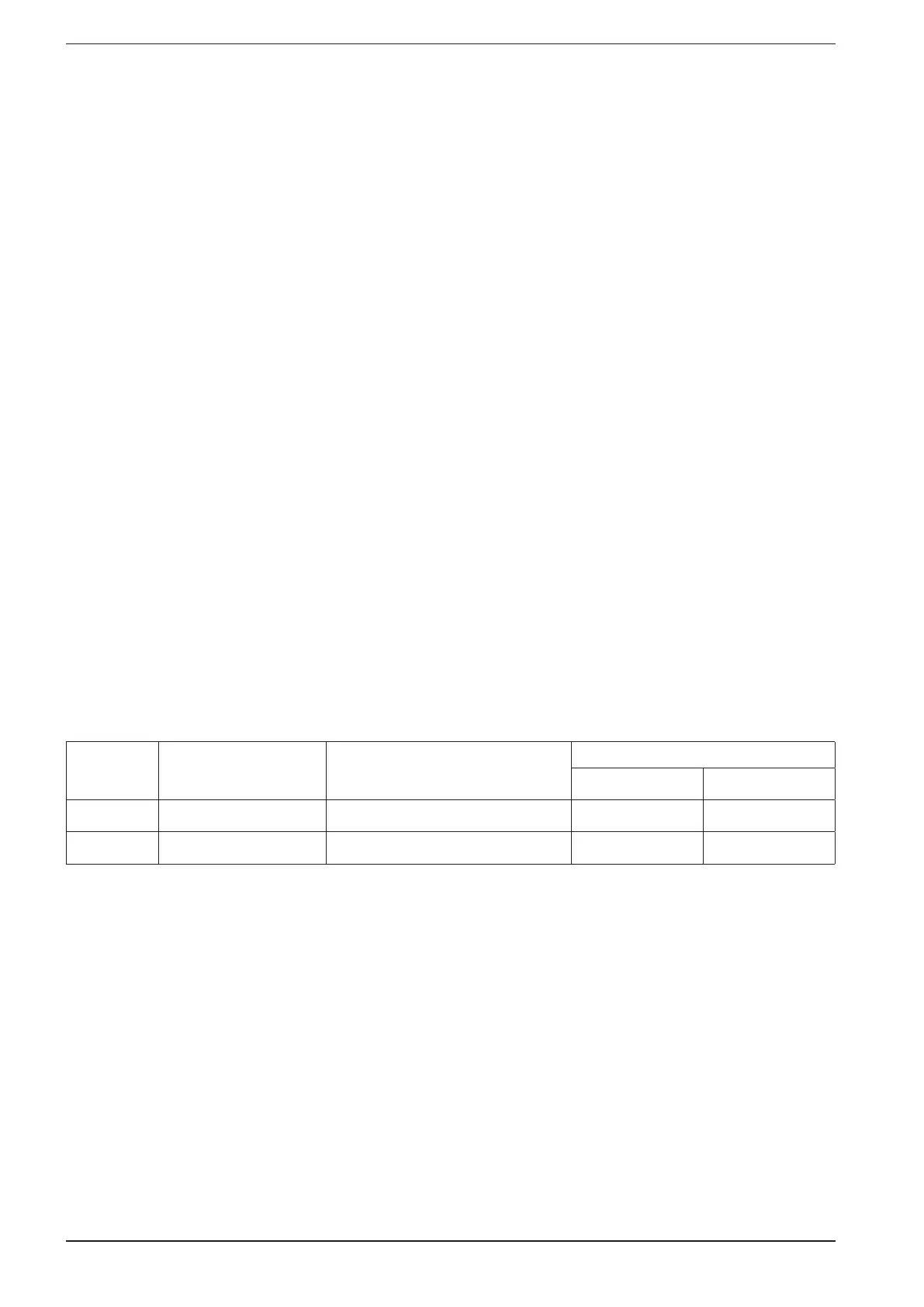
the table.
• Check the earth cable is connected to the
earthing system of the building itself.
• Ensure that the installation is wired in compli-
ance with the laws and standards in force,
and with the instructions in this manual.
• If the power supply cables, earth cables,
communication cables or wired panel ca-
bles are damaged, they must be replaced
with cables with the same specifications.
Have repairs carried out by “Personnel with
specific technical skills”.
• Ensure that the air conditioner is connected
to the power supply or to a power socket
with the correct voltage and frequency as in-
dicated on the data plate. Using power sup-
plies with the incorrect voltage and frequen-
cy could damage the unit and consequently
risk starting a fire. The voltage must be stable,
without major fluctuations.
• The available electric power should be suffi-
cient to supply the air conditioner.
• The power supply cable should be safe and
secure, in order to avoid damage caused by
pulling out the cable terminal.
• Do not make junctions on the power supply
cable: use a longer cable. Replacement
cables must have the same specifications.
Junctions can cause overheating and/or
fires. Have repairs carried out by “Personnel
with specific technical skills”.
• All the power supply lines must use terminals
with wire-end ferrules or single-wire terminals.
Stranded cables without wire-end ferrules
could cause electrical bridges.
• Do not leave any cables in contact with the
cooling pipe, the compressor or moving parts
such as the fans.
• Do not modify the circuits inside the air con-
ditioner. The manufacturer cannot be held
responsible for any damage or malfunction
due to incorrect line connections.
• Before accessing the terminals all of the pow-
er supply circuits need to be connected.
• The air conditioner is a Class I electrical ap-
pliance, so it is essential to provide a reliable
earthing connection.
• The yellow and green wire in the air condi-
tioner and the earth wire cannot be used
for other purposes. The cable cannot be se-
cured with a screw through the wire as this
could result in an electric shock.
• The user must provide a safe earthing con-
nection. Check the earth cable is connected
to the earthing system of the building itself.
• Check a suitable differential switch is installed
for earthing electrical discharge. Do not con-
nect the earth cable to the following com-
ponents:
− Water pipes
− Gas pipes
− Drain pipes
− Lightning conductor
− Telephone earth cable
− Other locations considered unsafe by “Per-
sonnel with specific technical skills”.
Indoor unit Power supply Breaker recommended
Section minimum recommended
Earth Line
(N° pole x mm
2
)
MVA1000V
220-240V~50Hz
208-230V~60HZ
6 1 2 x 1
MVA1400V
220-240V~50Hz
208-230V~60HZ
6 1 2 x 1
• Circuit Breaker and Power Cord Specifications are selected according
to the Rated Power Input ( Rated Current Input ) of the Unit. Rated Power
Input ( Rated Current Input ) is “Maximum” Power Input ( “Maximum”
Current Input ) of the Unit according to EN 60335-1 and EN 60335-2-40
• The Power Cord Specifications are Minimum Specifications based on
a Multi-Core Copper Cable in conduit on a wall with Ambient Tempe-
raure 40°C, Working Conductor Temperature 90°C and Max Lenght 15m
according IEC 60364-5-52 ( e.g. Multi-Core Copper Cable with XLPE in-
sulated and PVC sheath ) If Operationg Conditions are different please
calculate and adjust the Power Cord Specifications according to Na-
tional Standard
• The Circuit Breaker Specifications are based on Ambient Temperature
40°C If Opearting Conditions are different please calculate and adjust
Circuit Breaker Capacity according to the Circuit Breaker Specification
provide by manufacturer
• The Circuit Breaker must have magnet trip function and thermal trip
function so that the system can be protected from short circuit and
overload D-Type Thermal Magnetic Circuit Breaker is advice to be used.
• The Circuit Breaker must have a contact separation of at least 3mm
in all poles
NOTE:



 To Next Page