Electrical Installation
AGD301 Product Manual Rev.2.0 Page 22
Ground Domains
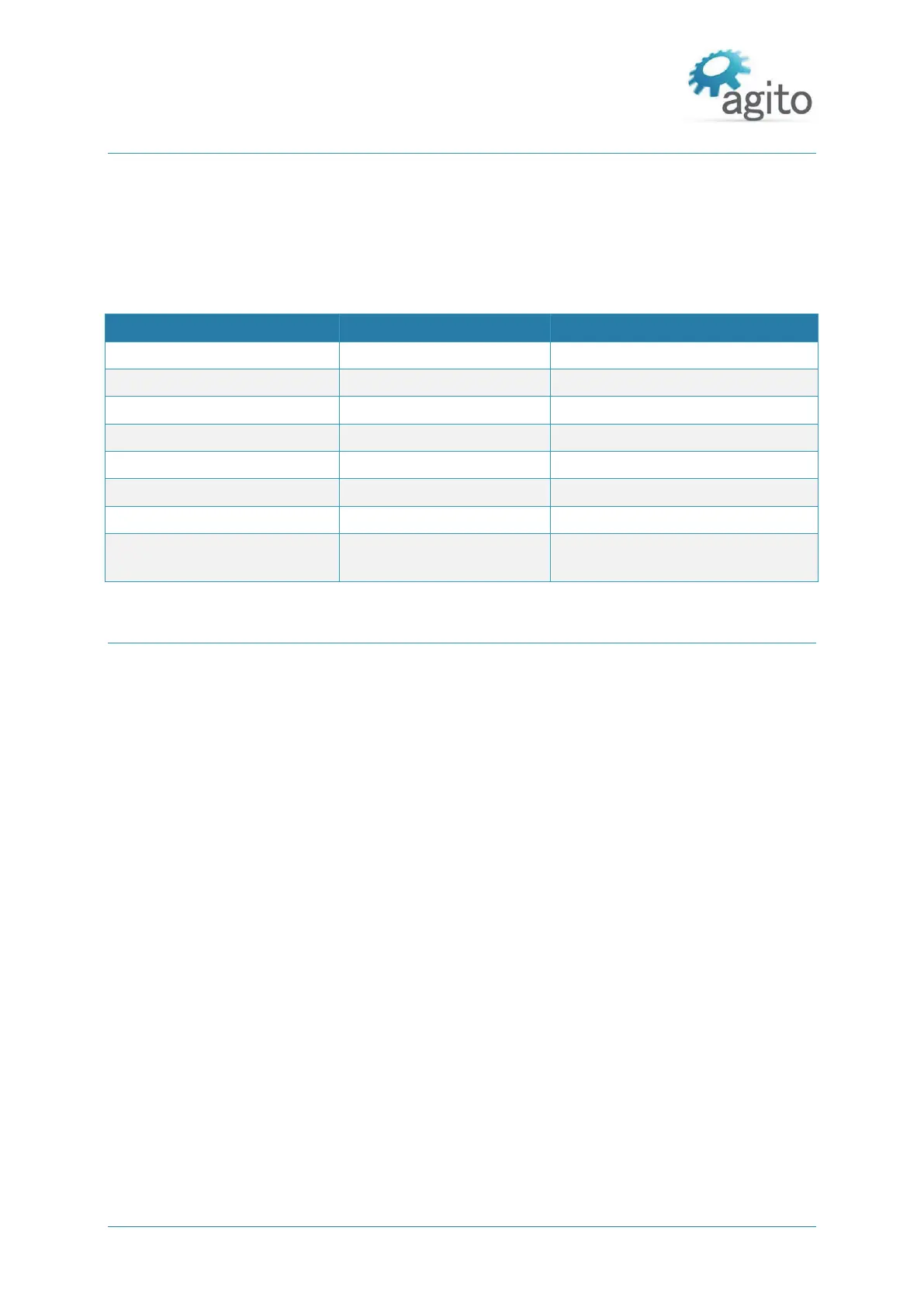
The following table shows the ground domains in the AGD301 system:
GND. Reference voltage for digital/analog circuits and signals.
PGND. High voltage ground domain (internal).
General. Usually at DC potential close to GND, but not connected internally.
Ground Domains
Name Ground Domain Notes
DC power input GND (digital ground) External DC power supply
Isolated digital inputs/outputs General Isolated
Differential inputs/outputs GND Not isolated. To controller/PLC.
Analog inputs/outputs GND Not isolated
Brake control output General Isolated. External DC power supply.
Regeneration output PGND
Ethernet communication General Isolated
Other communication GND Not isolated (unless otherwise stated
in manual).
Grounding Policy
Grounding of the product must comply with the following guidelines:
The enclosures and other external parts that may be touched by the user must be in the safe
domain.
The AGD301 must be connected to protective earth (PE) and connected to the building’s ground.
PE is protected with an earth-leakage circuit breaker (ELCB); hence it is safe to touch. Refer to
Figure 6.
PGND is connected directly to mains wires, hence it is just as dangerous as mains to the user.
All shielded cables, including but not limited to motor, encoders, and power input, have their
shield connected to PE as part of the external metal enclosure.
It is critical to avoid ground loops in the system. A ground loop allows currents to return by two
or more different paths, causing electromagnetic interference or even damage to wires.
The system designer must carefully examine all GND connections in the system to ensure that no
loops are created, and that all GND-referenced signals have a GND wire nearby (for both return
currents and common mode voltage).


 To Next Page