AIRMAR
®
TECHNOLOGY CORPORATION
35 Meadowbrook Drive, Milford, New Hampshire 03055-4613, USA
■
www.airmar.com
4
Copyright 1999. All rights reserved.
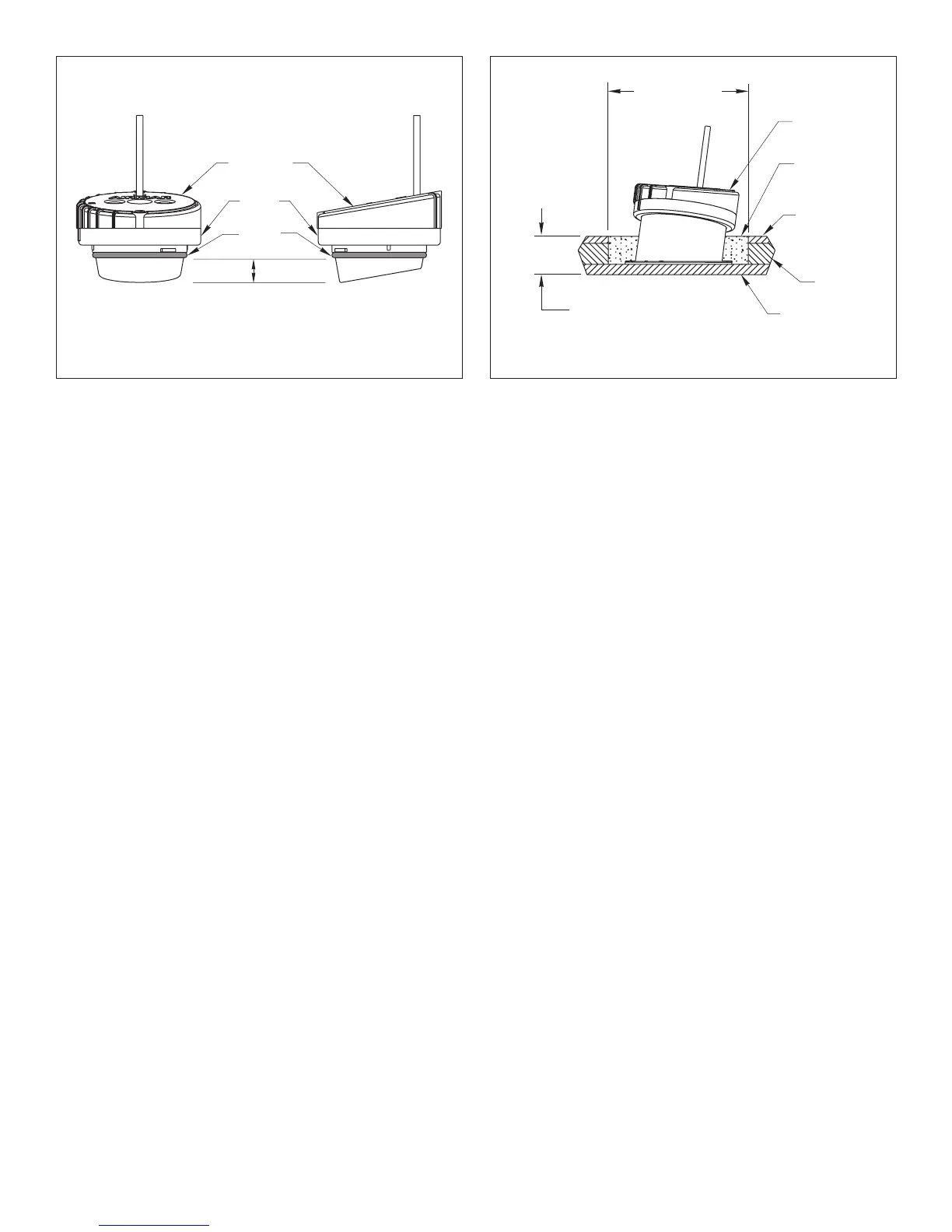
8. Lubricate the O-ring with mineral oil. This will help to seal the
assembly and prevent the mineral oil from leaking. Slide the
O-ring onto the transducer assembly (see Figure 7).
9. After the sealant on the base has cured, pour 71ml (2.4 fl. oz.)
of mineral oil into the base.
10.Lock the transducer assembly into the base by inserting the
keys on the locking ring in the notches in the base. Press down
and rotate clockwise until seated (see Figure 6).
11.Route the cable to the echosounder
being careful
not to tear
the cable jacket when passing it through the bulkhead and other
parts of the boat. To reduce electrical interference, separate the
sensor cable from other electrical wiring and sources of
electrical noise.
Note
: Some transducers are equipped with a short cable, about
1m (3'), and an extension cable. Be sure to locate the mated 3
pin connectors
well above the bilge waterline
. To facilitate
this, use one of the two cable clamps supplied on either side of
the connection.
Installation in a Cored Fiberglass Hull
Installation in a cored hull is difficult. The objective is to bond the
sensor to the
inside surface of the hull’s outer skin
while
preventing any moisture from penetrating the core.
Caution
: There is no way to determine if the outer skin is solid (no
trapped air bubbles in the fiberglass) at the selected location
before cutting the inner skin.
Warning
: Always wear safety goggles and a dust mask.
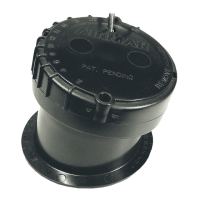
1. Using a 100mm
or
4" hole saw, cut through the
inner
skin and
the core at the selected location (see Figure 8). The core
material can be very soft. Apply only light pressure to the hole
saw after cutting through the inner skin to avoid accidentally
cutting the outer hull.
2. Remove the plug of core material, so the inner core of the hull is
fully exposed. Sand the
inside surface of the outer skin
using
a miniature disk sander. Slightly undercut the surrounding
coring if possible.
3. Clean and dry both the
inside surface of the outer skin
and
the housing with a weak solvent, such as alcohol, to remove
any dust, grease, or oil.
4. Place the base in the cavity. Fill the gap between the base and
the hull with casting epoxy or resin following the manufacturer’s
directions for its use.
5. After the casting epoxy or resin has cured, proceed with
“Installation”, on page 3.
Replacement Parts
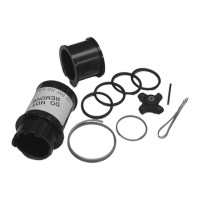
To obtain a replacement base and O-ring, order part number
33-268-01 from your marine dealer or instrument manufacturer.
Transducer Replacement
The information needed to order a replacement sensor is printed
on the cable tag.
Do not
remove this tag. When ordering, specify
the part number, date, and frequency in kHz. For convenient
reference, record this information on the top of page one.
Figure 8. Installation in a cored fiberglass hull
transducer
i
nner skin
core
outer skin
fill with
casting epoxy
or resin
hull thickness
assembly
Figure 7. Installing the O-ring
O-ring
transducer
100mm (4")
front view
side view
locking
ring
Note: lubricate the O-ring with
mineral oil before sliding it onto
the transducer assembly
AIRMAR
®
AIRMAR
®


 To Previous Page