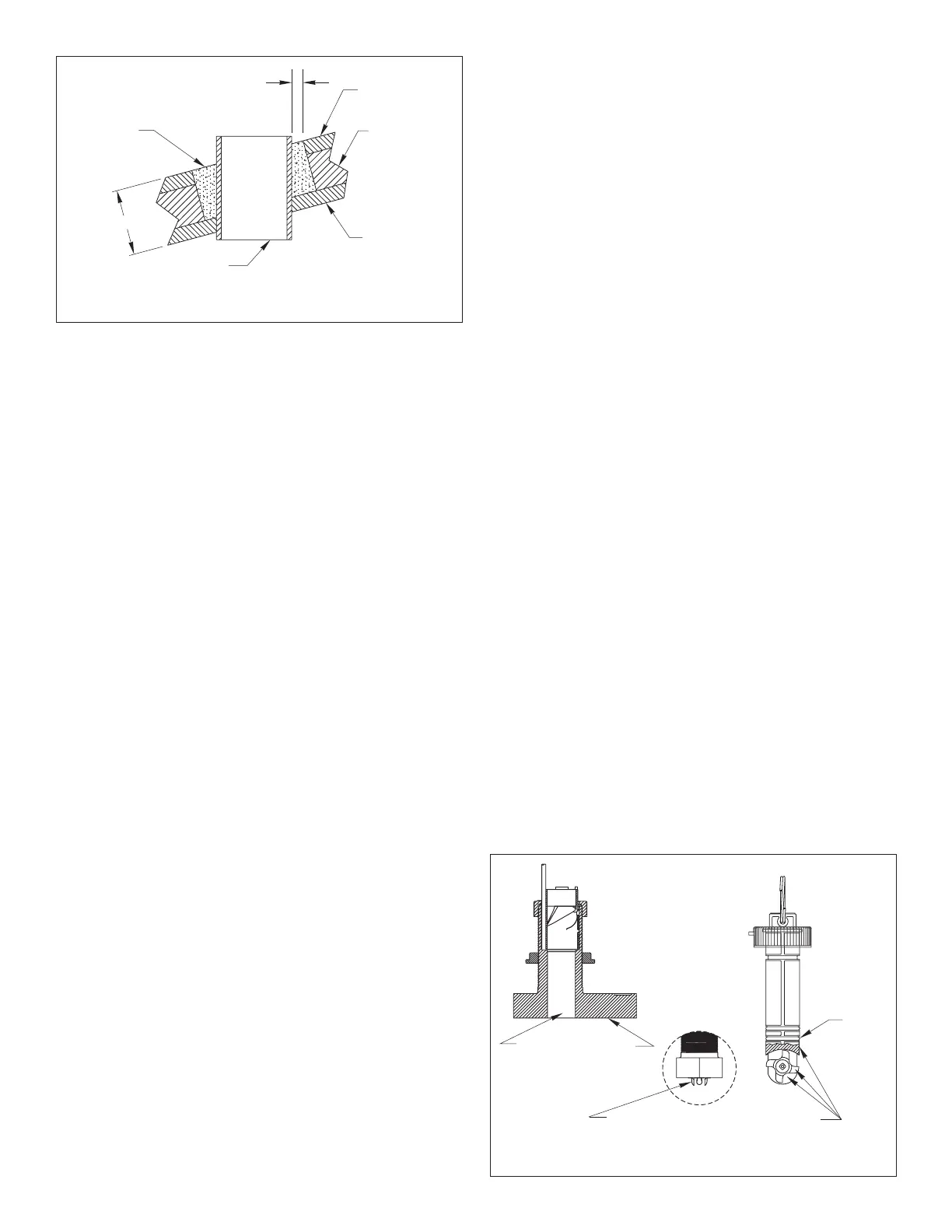
hull’s outer skin to
hull
outer skin
solid or hollow
cylinder
pour in
casting
epoxy
core
inner skin
Figure 8. Preparing a cored fiberglass hull
Dimension equal to
the thickness of the
ensure adequate
clearance
Figure 9. Antifouling paint
(B744V shown)
Paint outside wall below the lower O-ring
including exposed end, paddlewheel cavity and paddlewheel
Paint exposed housing
lower
O-ring
and bore up 30mm (1-1/4")
paddlewheel
insert
housing
detail
Installation in a Cored Fiberglass Hull
The core (wood or foam)
must
be cut and sealed carefully. The
core
must
be protected from water seepage, and the hull
must
be
reinforced to prevent it from crushing under the hull nut allowing
the housing to become loose.
Warning: Always wear safety goggles and a dust mask.
1. Drill a 3mm or 1/8" pilot hole perpendicular to the waterline from
inside the hull (see Figure 8). If there is a rib, strut, or other hull
irregularity near the selected mounting location, drill from the
outside. (If the hole is drilled in the wrong location, drill a second
hole in a better location. Apply masking tape to the outside of the
hull over the incorrect hole and fill it with epoxy.)
2. Using the 51mm or 2" hole saw, cut a hole from outside the hull
through the
outer
skin only.
Be sure
to hold the drill plumb, so
the hole will be perpendicular to the water surface.
3. The optimal interior hole diameter is affected by the hull’s
thickness and deadrise angle. It
must
be large enough in
diameter to allow the core to be completely sealed.Using the
60mm or 2-3/8" hole saw, cut through the
inner
skin and most
of the core from inside the hull keeping the drill perpendicular to
the hull. The core material can be very soft. Apply only light
pressure to the hole saw after cutting through the
inner
skin to
avoid accidentally cutting the
outer
skin.
4. Remove the plug of core material so the
inside
of the outer skin
and inner core of the hull is fully exposed. Sand and clean the
inner skin, core, and the outer skin around the hole.
Caution: Completely seal the hull to prevent water seepage into
the core.
5. Coat a hollow or solid cylinder of the correct diameter with wax
and tape it in place. Fill the gap between the cylinder and hull
with casting epoxy. After the epoxy has set, remove the cylinder.
6. Sand and clean the area around the hole, inside and outside, to
ensure that the sealant will adhere properly to the hull. If there is
any petroleum residue inside the hull, remove it with either mild
household detergent or a weak solvent (alcohol) before sanding.
7. Proceed with “Bedding the Housing” on page 3.
Antifouling Paint
Aquatic growth can accumulate rapidly on the multisensor’s surface
reducing performance within weeks. Surfaces exposed to salt water
must
be coated with antifouling paint. Use
WATER-BASED
antifouling paint only.
Never
use ketone-based paint since ketones
can attack many plastics possibly damaging the transducer.
Reapply paint every 6 months or at the beginning of each boating
season.
Paint the following surfaces (see Figure 9):
• Exposed areas of the housing including the acoustic window
• Bore of the housing up 30mm (1-1/4")
• Outside wall of the paddlewheel insert below the lower O-ring
•Paddlewheel cavity
•Paddlewheel
• Blanking plug below the lower O-ring including the exposed end
Operation & Maintenance
Winterizing
After the boat has been hauled for winter storage, remove the
blanking plug to let the water drain away before reinserting it. This
will prevent any water from freezing around the blanking plug and
possibly cracking it.
How the Valve Works
WARNING: THE VALVE IS NOT A WATERTIGHT SEAL!
Always install the paddlewheel insert or the blanking plug secured
with the insert nut and safety wire for a watertight seal.
The multisensor incorporates a self-closing valve which minimizes
the flow of water into the vessel when the paddlewheel insert is
removed. The curved flap valve is activated by both a spring and
water pressure. Water pushes the flap valve upward to block the
opening, so there is no gush of water into the boat (see Figure 6).
Using the Blanking Plug
To protect the paddlewheel, use the blanking plug:
• When the boat will be kept in salt water for more than a week.
• When the boat will be removed from the water.
• When aquatic growth buildup on the paddlewheel is suspected
due to inaccurate readings from the instrument.
WARNING: The O-rings must be intact and well lubricated to
make a watertight seal.
1. On the blanking plug, inspect the O-rings (replace if necessary)
and lubricate them with silicone lubricant or petroleum jelly
(Vaseline®) (see Figure 6).
Warning: Do not remove the CAP nut. The valve assembly will
come out.
2. Remove the paddlewheel insert from the housing by removing
the safety wire from the pull ring and the
insert
nut. Unscrew the
insert
nut (see Figure 7).
Do not remove the CAP nut.
5
Copyright © 2005 Airmar Technology Corp.
Copyright © 2005 Airmar Technology Corp.


 To Next Page
 Loading...