Residential HRV/ERV
32
Door-Port Balancing – Measuring Airow
1. Finish sealing the ductwork system.
2. Make sure all the HRV/ERV components are in place and functioning properly.
3. Prepare the pressure gauge by mounting it according to manufacturer’s instructions
and zeroing the gauge.
4. Prepare the HRV/ERV and select the operating speed. For most installations, measuring
at high speed permits a more accurate reading, and the system will normally remain in
balance at lower speeds.
a. If there are dynamic elements in the duct that react to changing pressures, the
HRV/ERV should be balanced at the speed it is expected to operate at most of
the time. Example: If the ducting system includes zone dampers or Zoned Register
Terminals (ZRT®), it must be balanced at a speed lower than normal operation. If
balanced at high speed, the HRV/ERV will not be in balance at the lower speeds due
to the operation of the constant airow regulators incorporated in the ZRTs.
5. If the HRV/ERV is ducted to the forced-air HVAC system, turn that blower on high speed
as well.
6. Airows in branch lines to specic areas of the house should be adjusted rst prior to
balancing the unit. A smoke pencil used at the grilles is a good indicator of each branch
line’s relative airow.
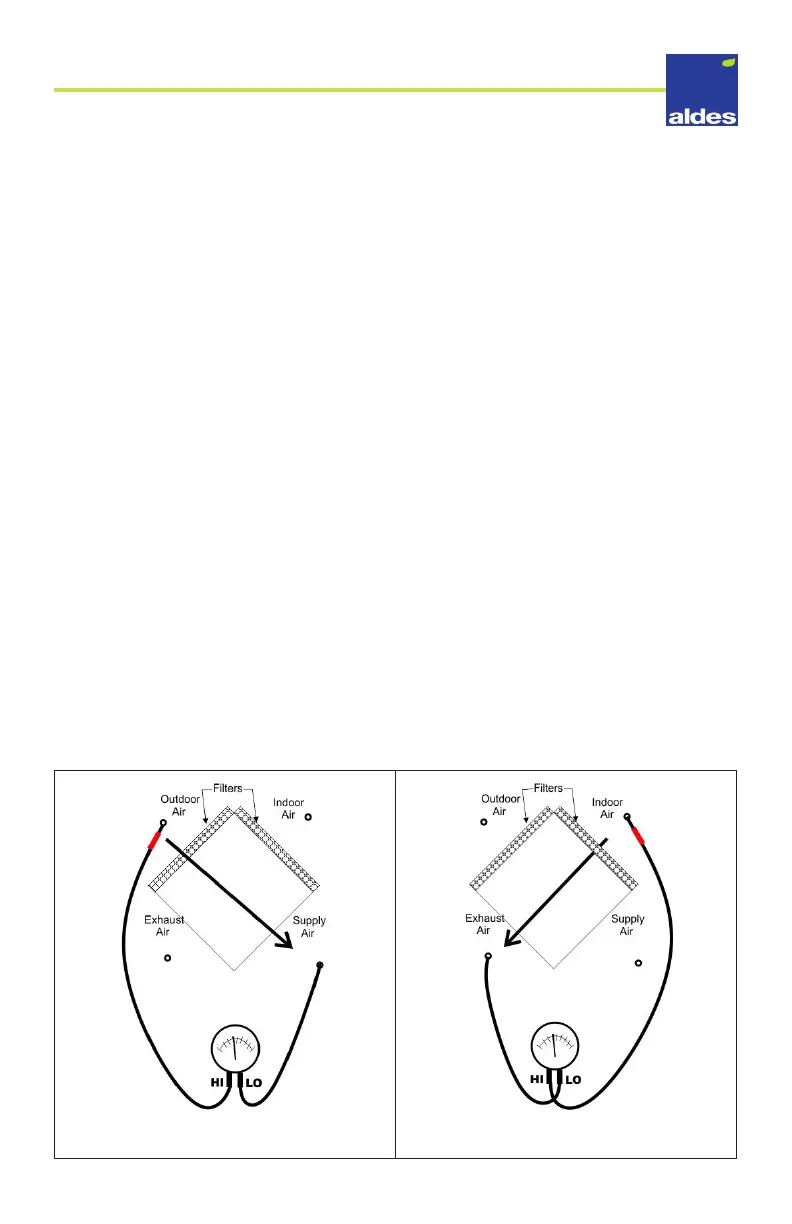
7. Locate the 4 ports on the door of the HRV/ERV and remove the plugs.
8. Refer to the drawings below and connect the tubing from the pressure gauge to the
respective door ports to the outdoor air and supply air ports.
Note: The geometry may differ from one model to another.
Measuring Supply Airow Measuring Exhaust Airow



 To Next Page