MIDI Applications – Chapter 6
Wedge Reference Manual 67
If the [D] slider is moved to the bottom half of its range so that the value goes below
User 000, the upper display will change to Pset indicating you are selecting a Program
in the Preset bank.
Sysex Storage
In order to send and receive Program information via Sysex (System Exclusive)
dumps using a computer, or some other Sysex storage device, or another Wedge:
Ê Connect the other device’s MIDI OUT to the Wedge’s [MIDI IN]. Connect the
Wedge’s [MIDI OUT] to the other device’s MIDI IN.
This provides two-way communication between the devices.
Ë Press the [UTIL]button repeatedly until page 5 is selected.
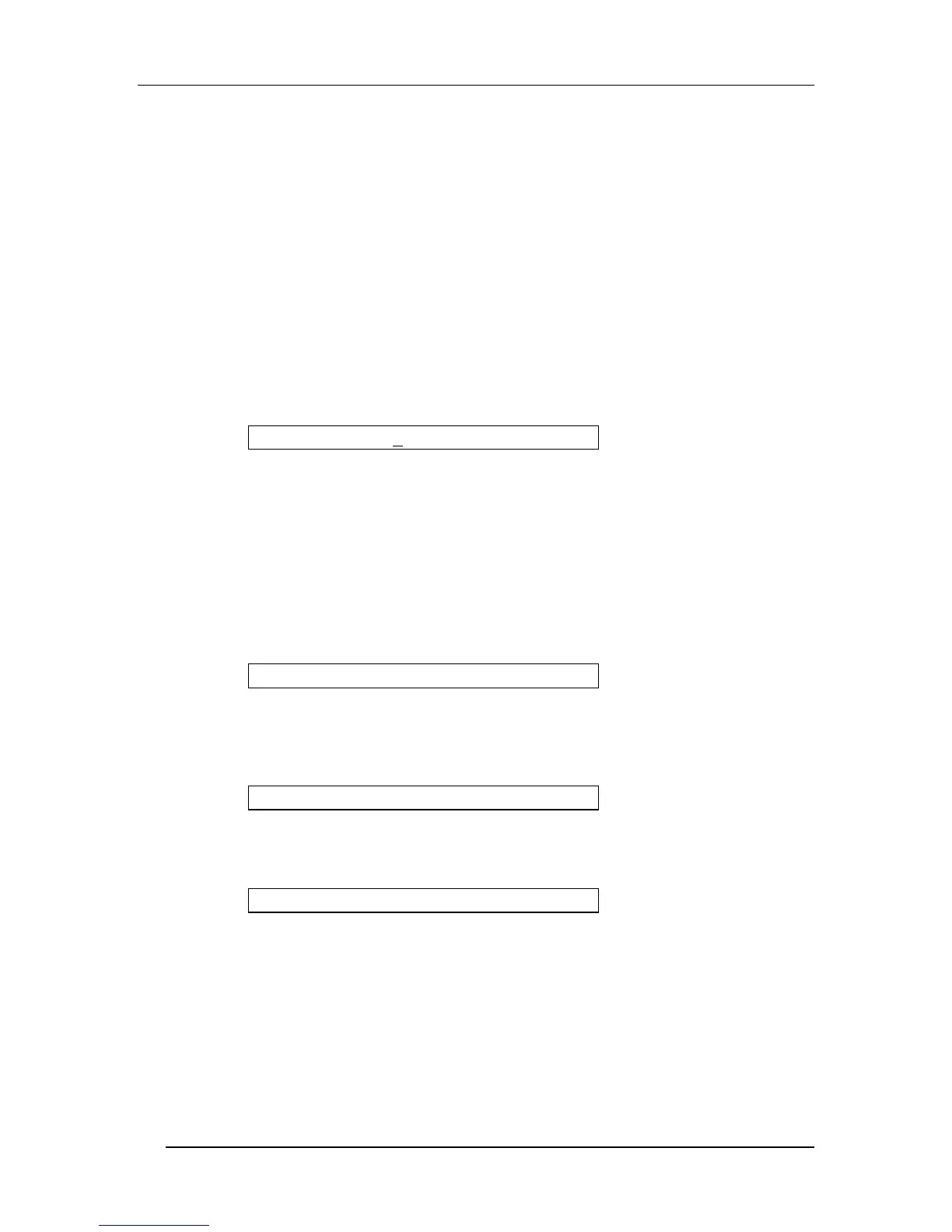
The [UTIL] button will now be flashing, and the display will read:
Send MIDI Sysex: All
Ì Use the [VALUE] knob to select All User Programs, the Edit Buffer, the Program
Table and the Utility menu settings (All), or the currently selected Program
(Buffer), or the Program Change Table (Table).
Í Set the receiving MIDI device to receive or record the MIDI information about
to be sent from the Wedge.
Î Press the flashing [STORE] button to transmit.
The [STORE] button will flash rapidly and the display will read:
Transmitting Sysex...
Ï When you send a Sysex dump back to the Wedge, it will automatically go into
receive mode (you do not have to do anything special). When this occurs, the
display will momentarily read:
RECEIVING MIDI DATA...
Note: If an error occurs while receiving Sysex data back into the Wedge, the display
will briefly indicate:
!!! SYSEX DATA ERROR !!!
If this occurs, try sending the data again. If the problem persists, it may indicate a
bad MIDI cable connection or a problem with the data itself.
Realtime Modulation Functions
You can use various MIDI messages (such as note number, velocity, aftertouch, or
pitch-bend, etc.) to simultaneously control up to two parameters in the Wedge, such
as delay time, room size, etc. Modulation functions are “hard-wired” in each
Configuration, and therefore cannot be changed. However, you can select which


 To Next Page