43Alvium USB Cameras User Guide V3.6.4
Compliance, safety, and intended use
Alvium USB cameras and USB 2.0
If Alvium USB cameras are connected to USB 2.0 ports, they are recognized. They
can be operated with reduced performance only if
DeviceLinkThroughputLimit
is set to a value supported by USB 2.0. See Host setup and bandwidth on page 221.
Some pixel formats may not be supported.
Handling bare board cameras
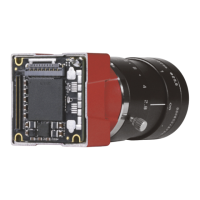
Bare board cameras are an electronic assembly without a protective housing. To
avoid damage:
• Handle bare board cameras with extreme care.
• Avoid any mechanical stress to the sensor area.
• Avoid short circuits by keeping away from electronics components.
Observe for mounting bare board cameras:
• Allow mechanical contact only at the mounting area. (This does not apply to
the cooling areas.)
• Enable proper cooling at the cooling areas, see Mounting bare board cameras
on page 187.
• Give 2 mm minimum clearance above board components.
• Tighten screws at 0.1 Nm maximum torque.
• Follow the instructions in Mounting bare board cameras on page 187.
Optical components
Provide the following conditions to keep dirt and droplets out of the optical system
of camera and lens:
• Dust-free environment
• Low relative humidity
• No condensation.
When camera or lens are stored:
• Cover the lens mount with a protection foil or cap.
• Cover front and back lens with caps.
No image transfer at high bandwidths
USB 2.0 supports maximum 50 MBps. If cameras require a higher bandwidth than
50 MBps for streaming, no image is transferred on a USB 2.0 bus. The bandwidth
used by a camera results from
DeviceLinkThroughputLimit, the image
resolution, sensor characteristics, and pixel format (Mono8 has 8 bits per pixel,
while RGB8 has 3 × 8 bits per pixel).
Damage to optical components by conductive media for heat sinks
See Conductive media for heat sinks on page 45 for details.


 To Next Page
 Loading...