103448-07 - 1/16 127
CAUTION / ATTENTION
Electrical Shock Hazard. Label all wires prior to
disconnection when servicing controls. Wiring
errors can cause improper and dangerous
operation. Verify proper operation after
servicing.
Au moment de l´entretien des commandes,
étiquetez tous les ls avant de les débrancher.
Les erreurs de câblage peuvent nuire au bon
fonctionnement et être dangereuses.
S´assurer que l´appareil fonctionne
adéquatement une fois k´entretien terminé.
acid or alkali products is prohibited. Do not use any
cleaning agents or solvents. If insulation disc has signs
of damage, it must be replaced.
8. Inspect the condensate trap to verify it is open
and free from debris. Inspect condensate line integrity
between boiler and condensate neutralizer (if used),
condensate neutralizer and the drain. Clean/repair if
needed.
If the condensate neutralizer is used, check pH before
and after the neutralizer to determine neutralizing
effectiveness. Replace limestone chips and clean out
the neutralizer if needed.
9. Inspect the ue temperature sensor cap to verify
that it is free from leakage and deterioration. Replace
if needed.
10. Inspect vent connections and vent connector to
heat exchanger seals to verify that they are free from
leakage and deterioration. Repair as needed. Follow all
instructions in Section IV “Venting” when reassembling
vent system.
11. Check for vent and air intake terminal for
obstructions and clean as necessary. Check rodent
screens in vent and air intake terminations to verify
they are clean and free of debris.
WARNING
Failure to properly secure the burner/blower/gas
valve assembly to the heat exchanger could lead
to property damage, personal injury or loss of
life.
12. Reinstall the burner/blower/gas valve assembly
and secure with M6X1 hex ange nuts. Tighten the
hex nuts in star pattern with wrench to 5Nm (44 lbf.
In) torque.
13. Reconnect any wiring which has been disconnected.
14. Verify that the system pH is between 7.5 and 9.5.
15. Inspect the heating system and correct any other
deciencies prior to restarting the boiler.
16. Follow Section IX “System Start-up” before leaving
installation.
17. Perform the combustion test outlined in Section
IX “System Start-up”.
D. Recommended Heating System Water
Treatment Products:
1. System Cleaning and Conditioning:
a. The following heating system water treatment
products are recommended for an initial existing
heating system sludge removal, initial boiler
cleaning from copper dust, ux residue and any
boiler debris and for preventive treatment as
corrosion/scale inhibitors:
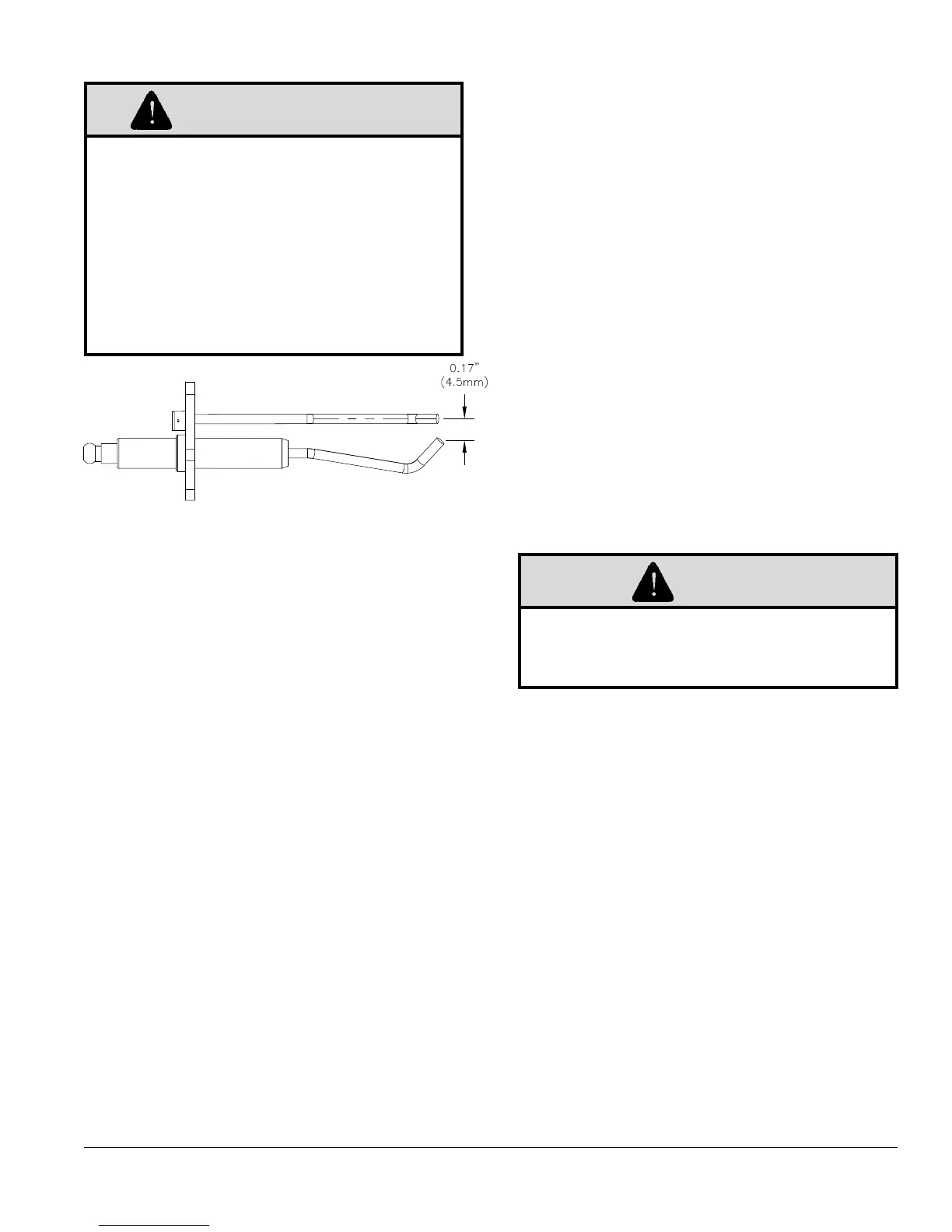
Figure 46: Igniter Electrode Gap
3. Remove the igniter assembly and ame sensor
and inspect them for oxide deposits. Clean the oxide
deposits from the igniter electrodes and ame sensor
rod with steel wool. Do not use sandpaper for the
cleaning. Inspect the ceramic insulators for cracks
and replace the igniter assembly and/or ame sensor
if necessary. Check the igniter electrode spacing gap.
Refer to Figure 46 “Igniter Electrode Gap” for details.
4. To gain access to boiler burner and combustion
chamber, rst disconnect and remove gas inlet piping
from gas valve. Then, remove six M6X1 hex ange
nuts and take out the burner/blower/gas valve assembly
from the boiler. To prevent stud breakage, apply a
generous amount of good quality penetrating oil to
nuts and let it soak in prior to attempting nut removal.
5. Inspect the assembly for lint and dust presence.
If signicant lint and dust accumulations are found,
disassemble the blower/gas valve assembly to expose
the swirl plate and blower inlet. For parts identication,
refer to Section XIII “Repair Parts”. Vacuum these
parts as required, being careful not to damage the vanes
on the swirl plate.
6. Vacuum any dust or lint from the burner if present.
If the burner shows any visual deterioration or corrosion
signs, replace it immediately. Inspect the burner gasket
and replace if necessary.
7. Inspect the heat exchanger combustion
chamber, clean and vacuum any debris found on
the surfaces. If required, brush the coils of the heat
exchanger using a non-abrasive, non-metal bristle
brush. Any cleaning of the combustion chamber with
XI. Service and Maintenance (continued)


 To Next Page