Troubleshooting
23
Section 3: Troubleshooting
WARNING
If ThePoint instrument is located in a hazardous environment,
do not open enclosure cover or make/break any electrical
connections without rst disconnecting electrical power at
the source. Ensure that wiring, electrical ttings and conduit
connections conform to electrical codes for the specic location
and hazard level.
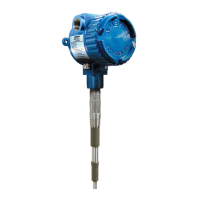
3.1 Testing Sensing Element
To test the sensing element, disconnect the integral cable as
discussed in Section 2.9. See Figure 3-1.
CAP & ELECTRONIC UNIT
REMOVED FOR ACCESS
TO
REMOVE CABLE TO EXPOSE
TOP OF SENSING ELEMENT
Center Wire
Shield
Ground
For Three-terminal Probes:
under sensor side
of integral cable...
Measured Resistance (Sensor dr
y and clean):
Center Wire - Ground
Center Wire - Shield
Ohms
Shield - Ground
ust be taken
using an analog ohmeter set to Rx1000 scale
.
Ohms
Ohms
When tank level is known to be below the sensor
minimum acceptable values are:
Center Wire - Ground 1000 Ohms.
Center Wire - Shield 600 Ohms.
Shield - Ground 300 Ohms.
If the readings are less than the minimum
acceptable values:
1. Check to see if tank is full, or if a severe
coating is present.
2. Clean sensor and re-measure the sensor
resistances.
Note:
Low resistance readings are acceptable if the
sensor is covered with a conductive liquid. Also,
low resistance readings can be the result of
material lodging in a long mounting nozzle. Refer
to Figure 2-2.
Note:
A reading of zero (0) Ohms usually indicates a
metal-to-metal short circuit. Check for contact
with tank wall, mounting nozzle, or other tank
structure.
Figure 3-1
Testing Sensing Element
Expect the following measurements:


 To Next Page
 Loading...