7.0.4 External charging
•
Read and follow manual of the charger manufacturer.
•
Check electrolyte level before charging and balance it where
necessary (see point 7.0.5 – maintenance)
•
Only charge the battery with suitable, voltage regulated charg
-
ers with the same nominal voltage, otherwise the battery has
to be disconnected/removed. Recommendation:
Charging current: 1/10 Ampere of the battery capacity Ah
Charging voltage: 14,4 V
•
Never charge frozen batteries or batteries with a temperature
higher than 45°C.
•
Connect the positive terminal (+) of the battery with the posi
-
tive terminal (+) of the charger and the negative terminal (-) of
the battery with the negative terminal (-) of the charger.
•
Only switch on the charger after connecting it to the battery.
•
Only switch off the charger after charging has been com
-
pleted.
•
Interrupt charging if the acid temperature exceeds 55°C.
•
In case the battery becomes hot or acid leaks, the charging
must be interrupted!
•
The battery is fully charged if:
•
Current and voltage remain constant with voltage regulated
chargers.
•
The charging voltage does not rise anymore within two
hours with a current regulated charger. The automatic
charger switches off or switches over to maintain charge.
• Ensure good ventilation during charging.
7.0.5 Maintenance
• Keep the battery surface clean and dry, only clean with damp
or antistatic cloth.
• Protect terminals/connection clamps against corrosion (as
described under point 7.0.3).
• Control electrolyte level (regard inner or outer marking on the
box or optical acid level indicator in the lid).
•
If necessary, refill demineralised or distilled water according to
DIN IEC 60933-3… up to the maximum acid level (never refill
acid, foreign matters or so-called optimizers).
•
In case of high electrolyte loss, consult a garage.
•
In case of insufficient starting performance, check battery and
possibly recharge it (see point 7.0.4).
7.0.6 Jump Starting
•
Only use standardized jump start cables (e.g. according to
DIN 72 553).
•
Regard instructions of the jump start cable manufacturer.
•
Only use batteries of the same nominal voltage.
•
Switch off the engine of the giving vehicle (1).
•
Connect jump start cable to the positive terminal (+) of the do
-
nator battery
and to the positive terminal (+) of the receiving
battery
or to the positive (+) vehicle connection terminal.
•
Only then connect the jump start cable to the negative termi
-
nal (-) of the donating battery
and to a sturdy, blank mass in
the receiving vehicle or to the negative (-) jump start point
(Do not use the negative terminal of the receiving battery as a
point of connection).
• Start receiving vehicle (2).
• In case the first attempt to jump start the vehicle fails, the do-
nating vehicle can be started BEFORE the second jump start
try.
• Disconnect the jump start cables in opposite order.
7. Batery
50
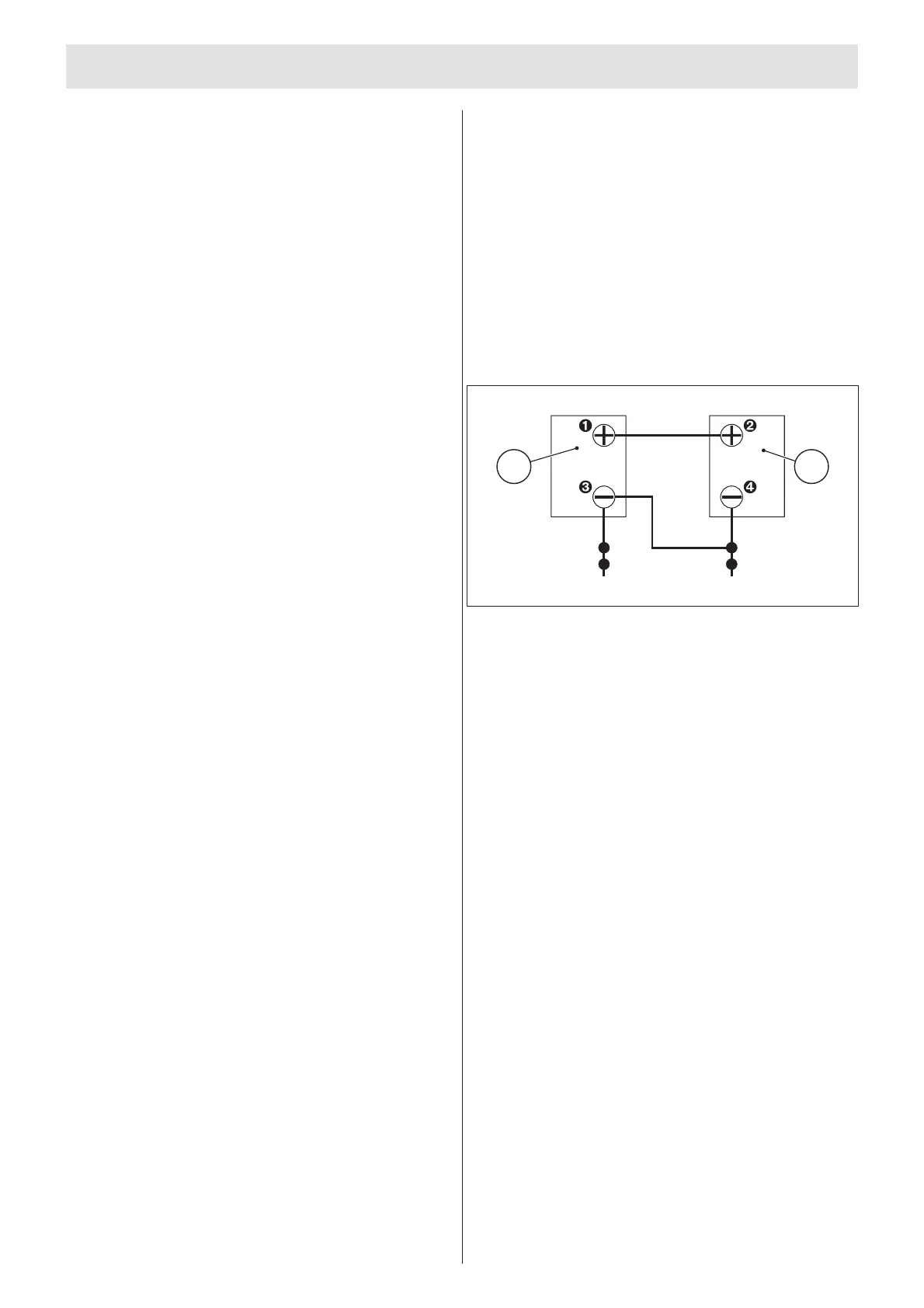
12 V 12 V
1 2
B0001002.cdr



 To Next Page