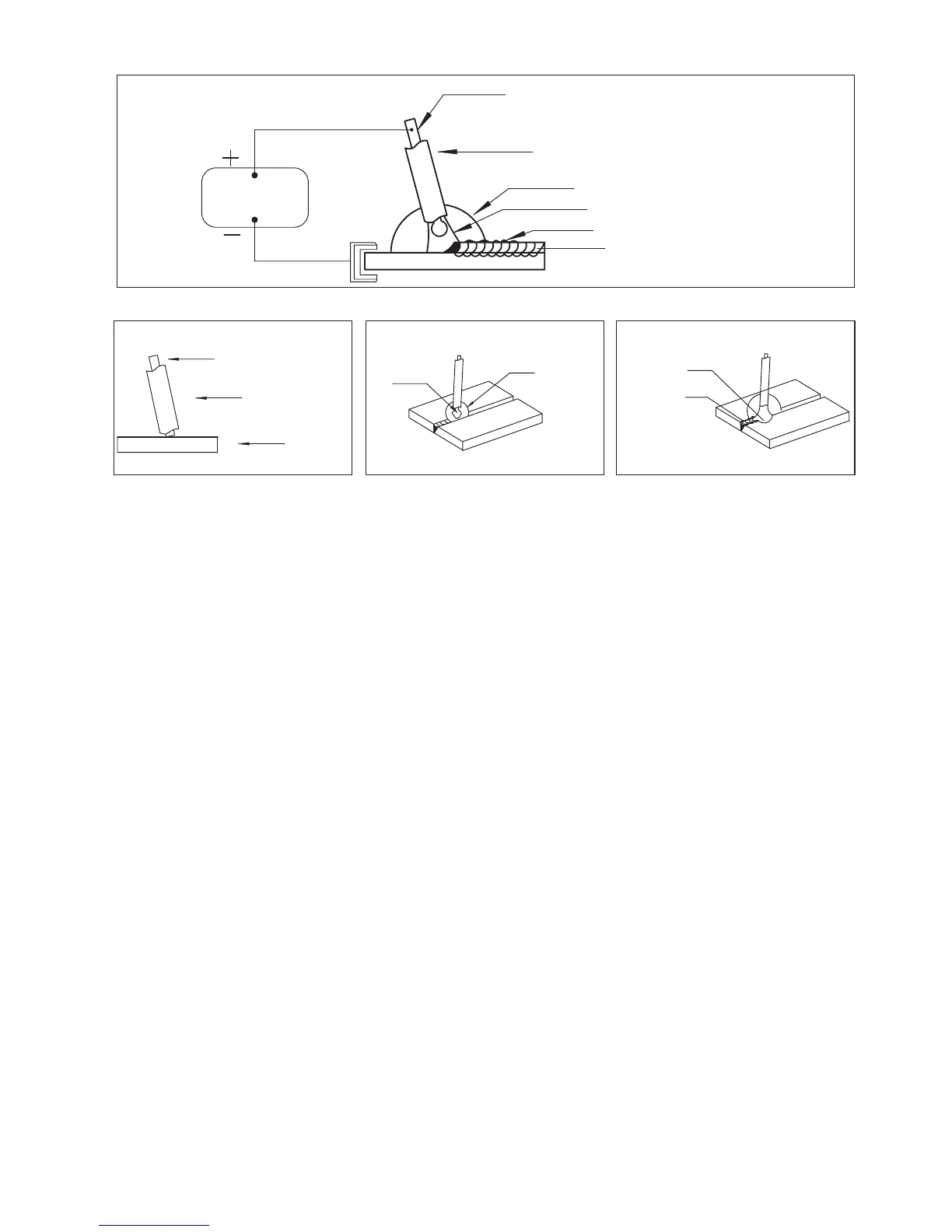
Molten pool
Slag
Protective gas
Arc
Core wire
Flux coating
Base metal
Power source
Flux coating
Gas shield from flux melt
Core wire
Arc with core wire melt
Weld metal
Flux residue forms slag cover
Fig. 14-2-1: Stick arc
Fig. 14-2-2: ARC ignition Fig. 14-2-3: Weld pool protection Fig. 14-2-4: Slag
• The arc is initiated by momentarily touching the electrode to the base metal.
• The heat of the arc melts the surface of the base metal to form a molten pool at the end of the electrode.
• The melted electrode metal is transferred across the arc into the molten pool and becomes the deposited weld metal.
• The deposit is covered and protected by a slag which comes from the electrode coating.
• The arc and the immediate area are enveloped by an atmosphere of protective gas.
Manual metal arc (stick) electrodes have a solid metal wire core and a flux coating. These electrodes are identified by the
wire diameter and by a series of letters and numbers. The letters and numbers identify the metal alloy and the intended use
of the electrode.
The Metal Wire Core works as conductor of the current that maintains the arc.
The core wire melts and is deposited into the welding pool.
The covering on a shielded metal arc welding electrode is called Flux.
The flux on the electrode performs many different functions.
These include:
• producing a protective gas around the weld area
• providing fluxing elements and deoxidizers
• creating a protective slag coating over the weld as it cools
• establishing arc characteristics
• adding alloying elements
Covered electrodes serve many purposes in addition to adding filler metal to the molten pool. These additional functions are
provided mainly by the covering on the electrode.
MMA (Stick) Welding Fundamentals
Electrode Selection
As a general rule, the selection of an electrode is straight forward, in that it is only a matter of selecting an electrode of
similar composition to the parent metal. However, for some metals there is a choice of several electrodes, each of which has
particular properties to suit specific classes of work. It is recommend to consult your welding supplier for the correct
selection of electrode.
83



 To Next Page