Need help?
Do you have a question about the Apeks Flight and is the answer not in the manual?
Instructions for removing all hoses from the first stage regulator, exercising caution to avoid scratching.
Procedure to remove MP and HP Blanking Plugs and associated O-rings using a 5mm Allen key.
Steps to remove the DIN connection from the first stage body using specific tools and care.
Detailed steps for dismantling the YOKE connection, including the knob, axle, and clip.
Procedure to separate HP Valve, Spring, and disc filter from the Yoke Connector.
Instructions for removing the composite diaphragm clamp using a specialized tool.
Visual inspection of the spring adjuster for cracks, scratches, wear, and thread condition.
Visual inspection of the diaphragm clamp for cracks, scratches, wear, and thread condition.
Checking for excess movement or wear between diaphragm clamp and spring adjuster threads.
Steps for refitting the jacket, valve lifter, splitter, diaphragm, and diaphragm clamp assembly.
Instructions for assembling the YOKE connection, including HP valve, spring, and yoke connector.
Procedure for attaching the first stage to a cylinder, installing blanking plugs, and connecting a test gauge.
Steps for pressurizing the first stage, submerging it in water, and checking for leaks.
Instructions for stretching the hood over the assembled first stage and ensuring proper fit.
Steps for cleaning metal and plastic components using an ultrasonic bath and soapy water.
Guidance on lubricating 'O' Rings with Christo-Lube MCG-111 and avoiding excess application.
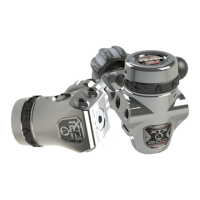
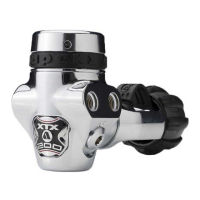
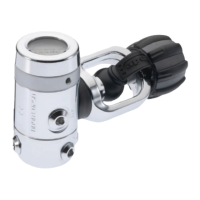
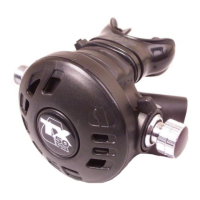
The Apeks Flight First Stage Regulator is a critical component in a diving system, designed to reduce the high pressure from a scuba tank to a more manageable intermediate pressure for the second stage regulator. This manual provides comprehensive instructions for its maintenance and repair, specifically for authorized technicians.
The Flight First Stage Regulator serves as the primary pressure reduction unit in a scuba diving system. It takes the high-pressure air directly from the scuba tank, typically ranging from 150 to 300 bar (232 to 300 psi), and precisely lowers it to an intermediate pressure, usually between 9 and 10 bar (130 to 145 psi). This intermediate pressure is then supplied to the second stage regulator, which further reduces it to ambient pressure for the diver to breathe. The regulator is designed to maintain a stable medium pressure, ensuring consistent and reliable air delivery to the diver. It incorporates various components, including an HP valve, springs, diaphragms, and O-rings, all working in concert to achieve this pressure regulation. The design allows for both Yoke and DIN connection types, accommodating different tank valve standards.
The Apeks Flight First Stage Regulator is engineered for robust performance and ease of use within its operational context. It is designed to be securely attached to a scuba tank valve, either via a Yoke clamp or a DIN connector. The regulator's internal mechanisms are built to withstand the demanding environment of underwater diving, providing a reliable air supply. While the manual focuses on maintenance, it implicitly highlights the regulator's operational characteristics, such as its ability to maintain a stable medium pressure and its compatibility with both standard breathing air and enriched air nitrox (EAN) mixtures up to 40% oxygen. For nitrox use, specific cleanliness standards and compatible components are emphasized to ensure safety. The regulator's design also considers the need for easy connection and disconnection from the tank, with features like the Yoke knob or DIN handwheel facilitating this process. The overall construction aims for durability and consistent performance during dives.
The Apeks Flight First Stage Regulator is designed with comprehensive maintenance in mind, ensuring its longevity and safe operation. The manual outlines a detailed maintenance schedule, recommending an annual examination regardless of usage and a full service every two years. This service includes a thorough inspection for air leakage, stable medium pressure, secure fastenings, and visual integrity of critical components like the Large Spring Adjuster and Composite Diaphragm Clamp. Filters are also inspected for debris or discoloration.
The maintenance process involves a complete disassembly of the regulator, with specific procedures for removing hoses, blanking plugs, DIN connections, and various internal components such as the HP valve, springs, diaphragms, and O-rings. Technicians are instructed to use specialized tools, such as O-ring removal picks, diaphragm clamp tools, and work handles, to prevent damage during disassembly. A crucial aspect of maintenance is the mandatory replacement of all O-rings and other specified parts with genuine Apeks service kit components, regardless of their apparent condition or previous use. This ensures optimal sealing and performance.
Cleaning procedures are meticulously detailed, recommending ultrasonic cleaning for metallic components and soapy water for plastic and composite parts. The use of specific cleaning agents like Biox or white distilled vinegar is suggested, with strict warnings against muriatic acid due to its potential to harm chrome plating and O-ring seals. After cleaning, components are to be thoroughly rinsed and dried.
Lubrication is another key maintenance feature, with Christo-Lube MCG-111 specified for all O-rings. Technicians are instructed to apply a light film of grease, removing any visible excess to prevent the attraction of particulate matter. Silicone rubber parts, such as diaphragms and exhaust valves, are explicitly not to be lubricated with grease or spray to avoid chemical breakdown.
Reassembly procedures are provided in a step-by-step manner, emphasizing correct component placement and the use of a calibrated torque wrench for all threaded parts. Specific torque specifications are given for components like the DIN Connector, Yoke Connector, DIN Bolt, and Composite Diaphragm Clamp, highlighting the importance of precise tightening to prevent damage and ensure proper sealing. Warnings are included to prevent cross-threading and to ensure components are correctly aligned during reassembly.
Post-assembly, the regulator undergoes rigorous testing, including an immersion test to check for leaks and an adjustment procedure for the first stage medium pressure. This involves pressurizing the regulator, adjusting the Large Spring Adjuster to achieve a stable medium pressure between 9 and 10 bar, and cycling the relief valve multiple times. The manual provides a troubleshooting guide to address common issues like high-pressure creep, external air leakage, and restricted airflow, offering possible causes and corrective actions.
For regulators used with enriched air nitrox, the manual outlines additional considerations regarding cleanliness and compatibility, emphasizing the need for oxygen-compatible breathing air and specific cleaning procedures if the regulator has been used with standard breathing air. The overall maintenance framework is designed to ensure the regulator's safety, reliability, and compliance with performance standards.
 General
| Environmental Sealing | Yes |
|---|---|
| Maximum Working Pressure | 232 bar |
| Inlet Connection | DIN |
| Material | Brass, reinforced composite |
| Intermediate Pressure | 9-10 bar |

 To Next Page