8
Safety Instructions
001.08075.EN rev. 22
Shock Prevention
• Do not touch or use a lift with bare conductors
or a damaged power cord. If this is the case,
contact your local Arjo agent immediately.
• Do not splash or expose the device to water or
moisture.
• Check nameplate for input voltage and
frequency requirements. These differ by country.
Do not attempt to use the lift in an area that has
a different voltage and frequency requirement.
• Read batteries and charger instructions carefully
before using or storing them.
Fire and Explosion Prevention
• Do not place or store the battery under direct
sunlight or near a heat source.
• 'R QRW H[SRVH WKH EDWWHULHV WR ÀDPHV 7KH\
might open, causing a chemical leak.
• Do not use the charger in the presence of
ÀDPPDEOH DQDHVWKHWLF JDVHV 7KH FKDUJHU
might generate a spark, which could cause an
implosion.
• Do not short circuit the battery terminals.
Human and Environmental Safety
Practices
• Should the battery casing crack and cause
contents to come in contact with skin or clothing,
rinse immediately with plenty of water.
• If contents come in contact with the eyes, rinse
immediately with plenty of water and seek
medical attention.
• Inhalation of the contents can cause respiratory
irritation. Provide fresh air and medical attention.
• For recycling and disposal of the batteries, the
rules according to the WEEE directive (Waste of
Electronic and Electrical Equipment) as well as
local laws and regulations must be followed. If
not they may explode, leak and cause personal
injury. When returning batteries, insulate their
terminals with adhesive tape. Otherwise, the
residual electricity in used batteries may cause
¿UHRUH[SORVLRQ
Environmental Advice
When disposing of any items associated with
the equipment, contact the appropriate local
authorities for information. Fig. 2 shows the
symbols for disposal and recycling.
Fig. 2
Battery and Battery Charger Safety
Practices
NOTE: Following the instructions is
important to prolong the battery life.
Only use batteries designed for use with the
device. If unsure, do not use the battery. Make sure
it belongs to the device by comparing the battery
ODEHO ZLWK WKH WHFKQLFDO VSHFL¿FDWLRQV VHFWLRQ RI
this Instructions for Use. If battery type cannot be
FRQ¿UPHGFDOO\RXU$UMRDJHQW
• 'RQRWH[SRVHWKHEDWWHU\RUFKDUJHUVWRÀDPHV
• To avoid bodily injury, do not crush, puncture,
open, dismantle or otherwise mechanically
interfere with the battery.
• Stop using the battery if any damage or
deformation is noted.
• Be careful not to drop the battery.
• Only use the charger that has been supplied
with the product.
• Do not charge the battery in an unventilated
area.
• The charger must not be covered or exposed
to dust.
• The charger is designed for dry areas only and
for normal air humidity conditions.
Homecare Environment
Considerations
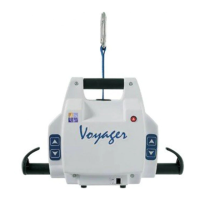
WARNING: The Voyager is not intended to
be operated by children. Serious injuries
could occur.
NOTE: Rigorous cleaning actions should
be done when the Voyager is exposed to an
animal. Pet hair trapped inside the device
(through the strap opening) can reduce the
product performance.


 To Next Page