Application
1590 99 002_1 - 21. February 2011 63
6.6 Treatment of acne
Acne vulgaris is one of the most frequent diseases treated in dermatological practices. Mostly, the
treatment takes a long time and is partly connected with considerable side-effects.
Most of the young patients concerned suffer much from it.
In most of the cases it is a disease of the pilosebaceous follicles that are mainly located in the face,
on the back and on the chest. First, they generate non-inflammatory blackheads but in the later
stages a number of inflammatory efflorescences such as papules, pustules and nodules can also be
developed. Acne vulgaris or usual acne is caused by an increased androgen influence in the puberty
and fades away until the beginning of the third life decade at the latest.
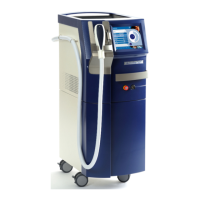
The infrared radiation of the MeDioStar device penetrates like necessary for hair removal
sufficiently deep into the skin to reach the pilosebaceous follicles.
The treatment as well as contraindications, side effects and treatment procedure are identical to
epilation (see the corresponding chapters).
But unlike the epilation treatment, the acne treatment consists of 3-4 passes in direct succession and
then it is the best to continuously cool the skin with a cooling mask. Due to the inflammation the
treatment is painful.
3 to 5 treatments at one-week-intervals are required.
Acne inversa
1
is a disease of the skin appendage. It starts from the sebaceous glands and secondarily
affects the apocrine perspiratory glands. Men and women are equally affected. This disease often
starts during puberty but can also occur at any time later.
Predilection areas are especially axillas and the groin-pubic region, also spreading to the gluteal. The
back and belly are less frequently affected and seldom the zones typical for acne like the face.
At the areas affected, first nodular, solitary foci of inflammation develop and in the course of the
disease, they show recidivism and confluence to formations similar to carbuncles. Often, flat scar
plates with a thickness of centimeters are caused. They have cutaneous/subcutaneous fistulas that
can only be removed by an operation. The stress for the patient is not only caused by the
inflammatory pains, the motoric restrictions by scar formation, but also by the repeated fetid
infections.
The reasons for this disease may be a genetic disposition, its development in combination with other
diseases (M. Dowling-Degos), keatinization defects of the follicular ducts, seborrhea, a special
bacterial colonization by propioni bacteria and staph. Aureusin, smoking and adiposity are also
responsible for the development of this disease.
According to the medical history, in some patients the development of the disease can be possibly
explained by an intensive hormone fluctuation (temporary secondary amenorrhea due to a
considerable loss in weight), but the disease does not stop at the end of this possible cause.
The therapeutic measures taken so far are the repeated antibiotic and antiseptic treatment, abscess
splitting as well as scar excision and defect coverage by means of split-skin graft. The disadvantages
of this procedure are the repeated development of recurrences, the repeated small- or large-area
surgical procedures, pain, the required bandage changes, the work time losses due to sick notes as
well as the psychological stress with possible subsequently limited social contacts.
An alternative therapy option is the laser treatment by using a diode laser such as the MeDioStar.
The laser primary designed for epilation purposes penetrates deep under the skin surface and its
effect is due to the absorption of light most of all by pigments or similar light-sensitive structures.
The hair follicles are affected first. They are brought to involution due to the produced thermal
damage after several treatment sessions. Porpyrhin-forming bacteria and fungi that are considered
1
by courtesy of Dr. med. C. Passos Pereira, Dermatologe, Hürth-Hermühlheim
published in DERMAforum, September 2003


 To Next Page