Tires and wheels 251
Cold tire inflation pressure
Tire pressure affects the overall handling , performance and safety of a vehicle .
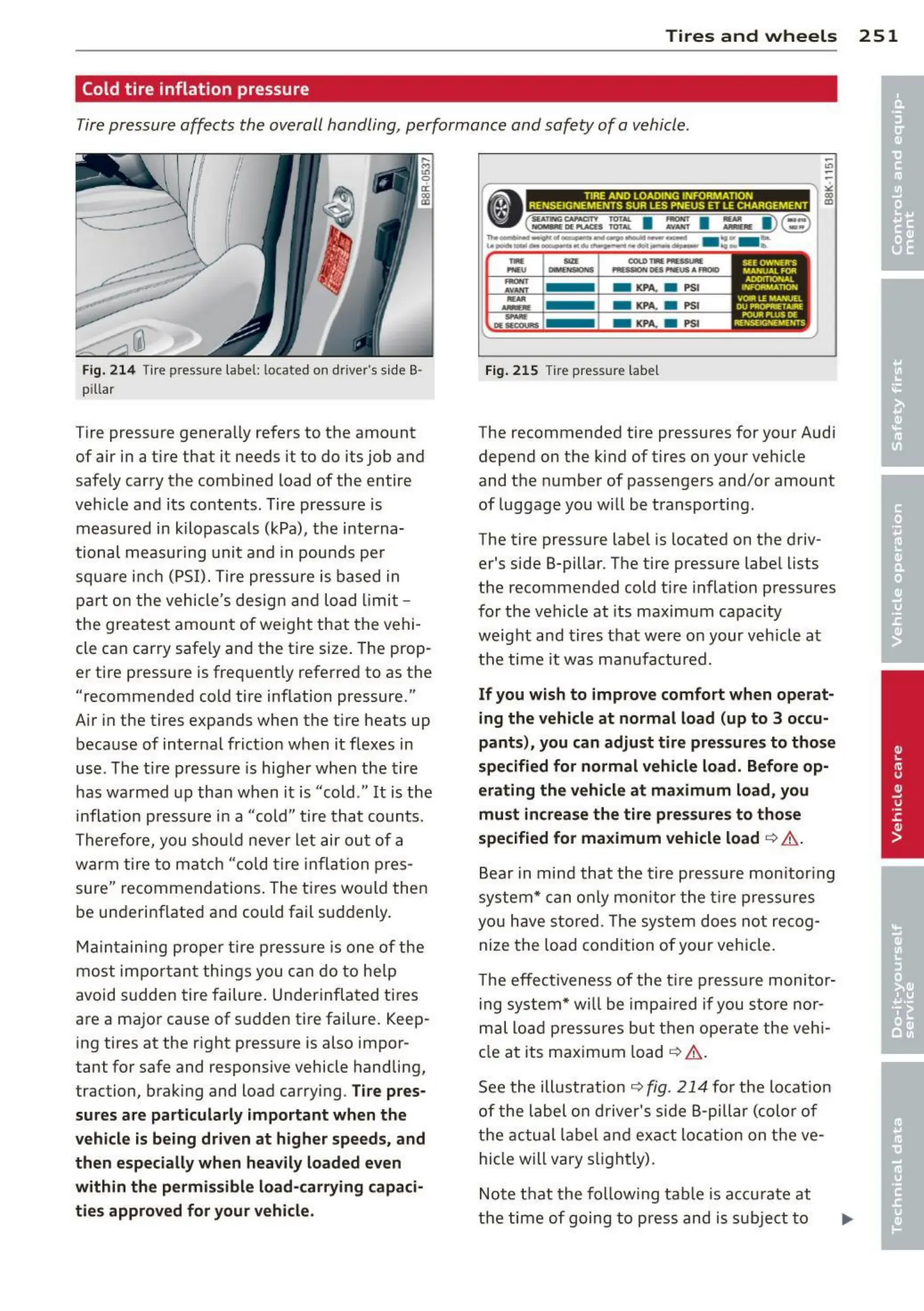
Fig. 214 Tire pressur e labe l: located on driver's side B·
pillar
Tire pressure genera lly refers to the amount
of air in a t ire that it needs it to do its job and
safely carry the combined load of the entire
vehicle and its contents . Tire pressure is
measured in kilopasca ls (kPa), the interna-
tional measuring unit and in pounds pe r
square inch (PSI). Tire pressure is based in
pa rt o n the vehicle's desig n an d load limit-
the greatest amount of weight that t he vehi-
cle can carry safe ly and the tire size . The prop -
er tire pressure is freq uent ly referred to as the
"recommended cold tire inf lation pressure ."
Air in the tires expands when the tire heats up
because of interna l frict ion when it flexes in
use . The ti re pressu re is higher when the tire
has warmed up than when it is "cold ." It is the
inflat io n pressure in a "cold" tire that counts.
Therefo re, you s ho uld never let air ou t of a
warm tire t o match "cold tir e infla ti on pres-
sure" recommendations . The ti res wo uld then
be underinf lated a nd could fail suddenly.
Main t aining proper t ire press ure is one of the
most impor t an t thi ngs you ca n do t o he lp
avoid sudden tire failure. Underinfla t ed tires
are a major cause of sudden tire failure . Keep-
ing tires at the right pressure is also impor-
tant for safe and responsive vehicle handling,
traction, braking and load carrying .
Tire pres-
sures are part icularly important when th e
vehicle is being driven at higher speeds, and
then especially when heavily loaded even
within the permi ssible load-carrying capaci-
ties approved for your vehicle.
~
"'
~
,.------------------- ~
• (=~: I := I
~
I )§ :ll
,.,,. ........................ ...., .... ~----.... _ ...
t.._.. .... _..,.. .... ......,... .. ~--......... · - ..
- KPA. . PSI
- KPA. . PSI
- KPA.. PSI
Fig. 215 Tire pressu re labe l
The recommended tire pressures for your Audi
depend on the kind of tires on your ve hicle
and t he number of passe ngers and/or amount
of luggage you will be t ransporting .
The tire pressure label is located on the driv-
er's side 8-pillar . The tire pressure labe l lists
the recommended cold t ire inflat ion pressures
for the veh icle at its maximum capac ity
weight and tires that we re o n your veh icle at
t he time it was manufactu red.
If you wish to improve comfort when operat-
ing the vehicle at normal load (up to 3 occu-
pant s), you can adju st tire pressures to those
specified for normal vehicle load. Before op-
erating the vehicle at maximum load, you
must increase the tire pressures to those
specified for maximum vehicle load c::> A .
Bear in mind that the tire pressure mon itor ing
system* can on ly mon itor t he tir e press ures
you have sto red. The syst em does not recog -
nize the load condition of your vehicle.
The effectiveness of the t ire press ure monitor-
ing system * w ill be impa ired if you sto re no r-
ma l load pressures but t hen opera t e the veh i-
cle at its ma ximum load
c::> A .
See the illustration ,:;, fig . 214 fo r the locat ion
of the label o n driver's s ide B-pillar (color of
the act ual label a nd exact locat ion on the ve-
hicle will vary slight ly).
Note t hat the follow ing table is accu rate at
the time of going t o press and is subject to


 To Next Page
 Loading...