252 Tires and wheels
change. In the event of discrepancies, the tire
pressure labe l located on the driver's side B-
pillar a lways takes precedence.
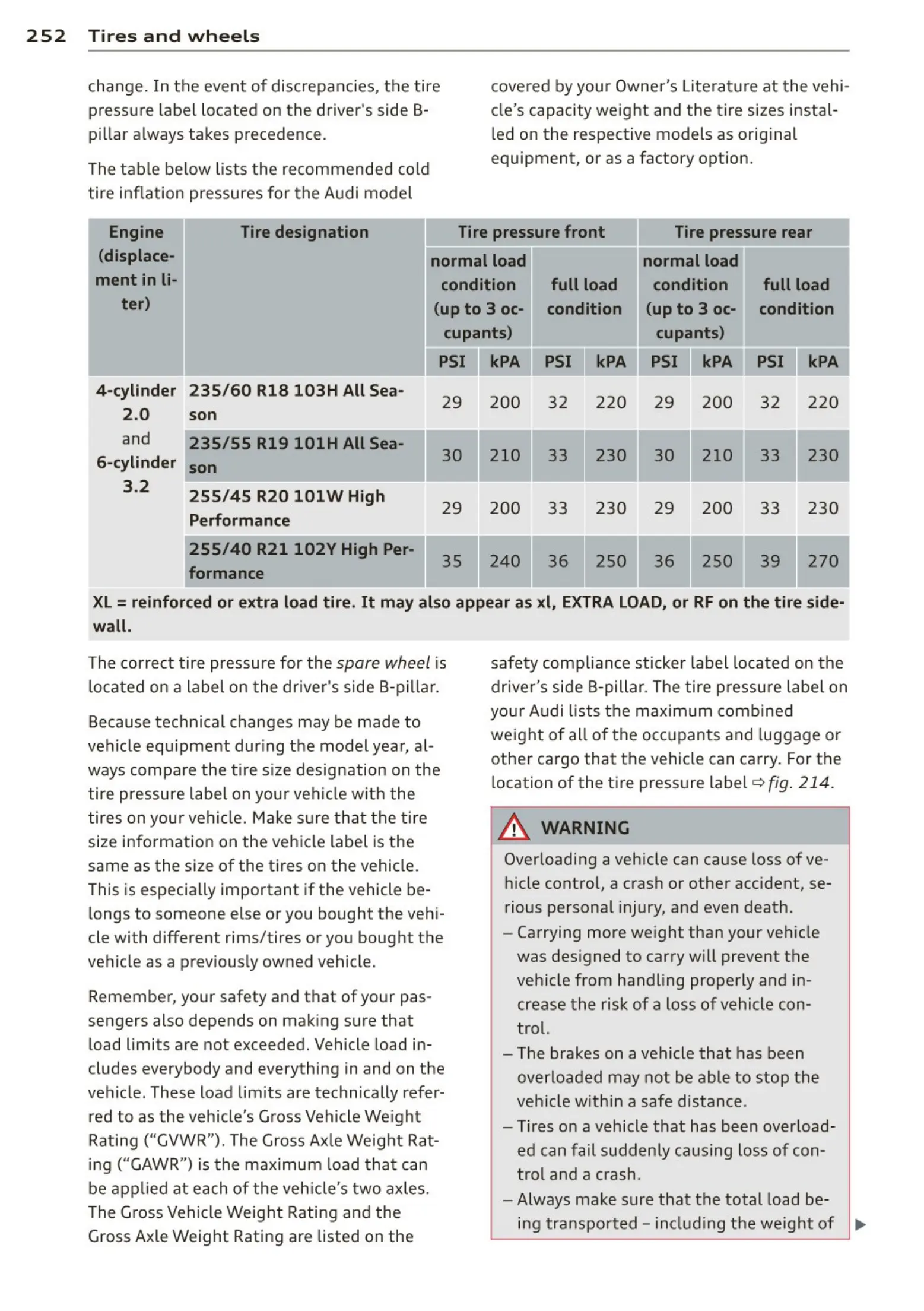
The table be low lists the recommended cold
tire inflation pressures for the Audi model
covered by your Owner's Literature at the vehi -
cle's capacity weight and the tire sizes instal-
led on the respective models as orig inal
equipment, or as a factory option.
I Engine II
Tire designation Tire pressure front
JI
Tire pressure rear
I
(displace-
normal load normal load
ment in li-
condition full load condition full load
ter)
(up to 3 oc-
condition
(up to 3 oc-
condition
cupants) cupants)
PSI II kPA
PSI
II kPA 1r PSI II kPA
PSI
II kPA '
4-cylinder 235/60 Rl8 103H All 5ea-
29 200 32 220 29 200 32 220
2.0 son
and
235/55 Rl9 101H All Sea-
6-cylinder
30 210 33 230 30 210 33 230
son
3.2
255/45 R20 101W High
29 200 33 230 29 200 33 230
Performance
255/40 R21 102V High Per-
35
240
36
250 36 250
39
270
formance
XL= reinforced or extra load tire. It may also appear as xl, EXTRA LOAD, or RF on the tire side-
wall .
The correct tire pressure for the spare wheel is
located on a label on the driver's side 8-pillar.
Because technical changes may be made to
vehicle equ ipment dur ing the model year, al-
ways compare the tire size designation on the
tire pressure labe l on your vehicle w it h the
tires on your vehicle. Make sure that the tire
size information on the vehicle label is the
same as the size of the tires on the vehicle.
This is especially important if the vehicle be-
longs to someone else or you bought the vehi-
cle with different rims/tires or you bought the
vehicle as a previously owned vehicle.
Remember, your safety and that of your pas-
sengers also depends on making sure that
load limits are not exceeded. Vehicle load in-
cludes everybody and everything in and on the
vehicle . These load lim its are technically refer-
red to as the vehicle's Gross Vehicle Weight
Rating ("GVWR"). The Gross Axle Weight Rat-
ing ("GAWR") is the maximum load that can
be applied at each of the veh icle's two axles.
The Gross Vehicle Weight Rating and the
Gross Axle Weight Rating are listed on the
safety compliance sticker label located on the
driver 's side B-pillar . The tire pressure labe l on
you r Audi lists the max imum combined
weight of all of the occupants and luggage or
other cargo that the vehicle can carry. For the
location of the tire pressure label ¢
fig . 214.
A WARNING
Overloading a vehicle can cause loss of ve-
hicle control, a crash or other accident, se-
rious personal injury, and even death.
- Carrying more weight than your vehicle
was designed to carry will prevent the
vehicle from handling properly and in-
crease the risk of a loss of vehicle con-
trol.
- The brakes on a vehicle that has been
overloaded may not be able to stop the
veh icle w ith in a safe distance .
- Tires on a vehicle that has been overload-
ed can fail suddenly caus ing loss of con-
trol and a crash.
- Always make sure that the total load be-
ing transported - including the weight of
~


 To Next Page
 Loading...