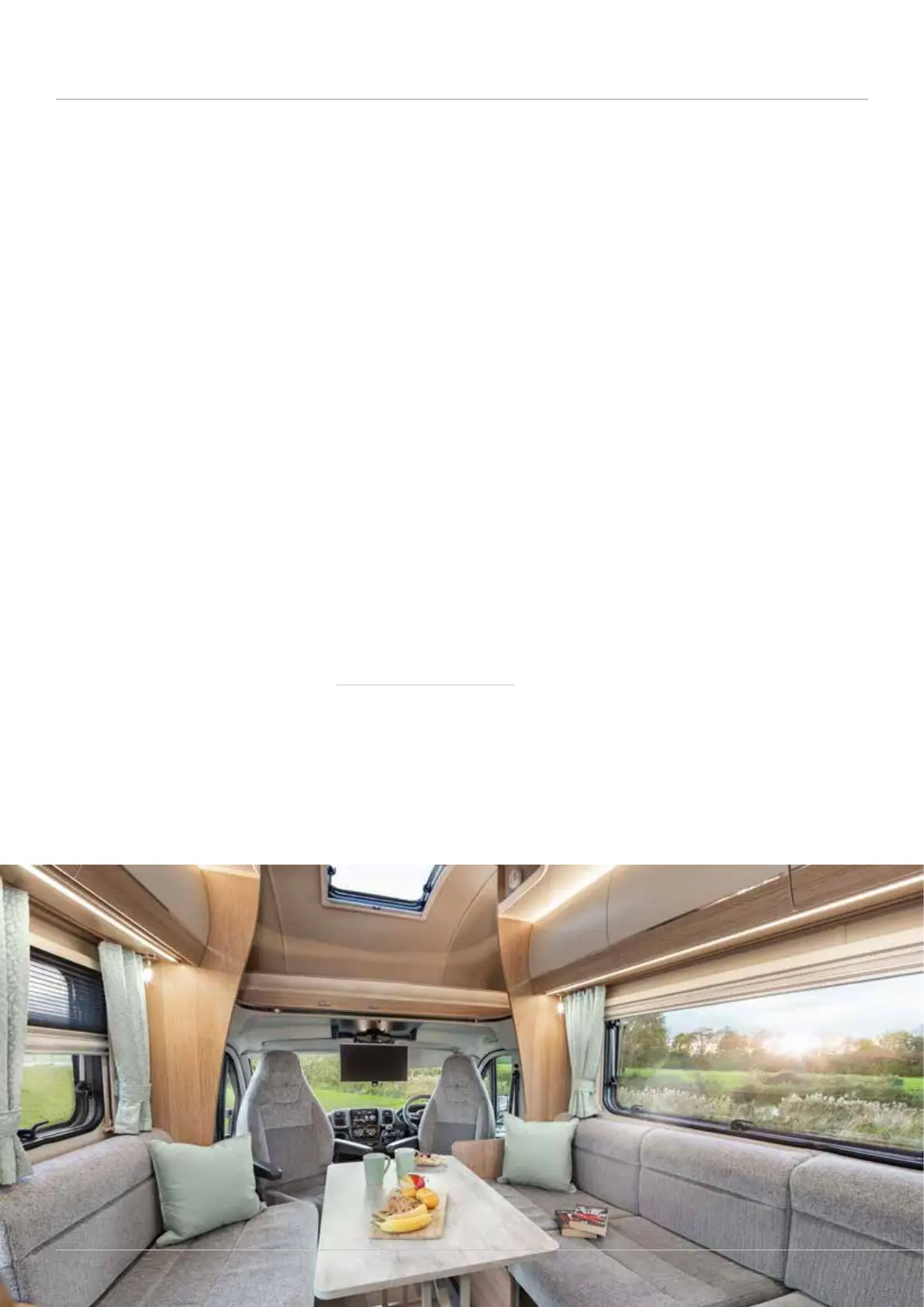
Low level ventilation is provided via
cut-out in the furniture. High level
ventilation is provided by skylights
located in the roof of your vehicle.
On pop top models, the high-level
ventilation is provided by a ventilation
slots in the pop-top material.
All ventilation complies with
European Standards and vents
should not be obstructed in any way
as this could lead to insucient fresh
air in the vehicle. If this occurs, the
confined atmosphere can become
deficient in oxygen, which can lead
to a build-up of the highly dangerous
gas carbon monoxide (Co).
The use of gas cooking appliances
results in the production of
heat, moisture and products of
combustion in the space in which
they are installed. Ensure the room
has sucient ventilation when the
appliance is un use. During prolonged
use, additional ventilation may be
needed by opening a window.
There is no danger, providing all
ventilation is not blocked in any way
and all meshes are regularly cleaned
using a vacuum cleaner.
Condensation
Condensation occurs when warm
moist air meets a cold surface.
The risk of condensation therefore
depends upon how moist the air is
and how cold the internal surfaces
of the vehicle are. Condensation
is normally more noticeable
during the winter months as the
Motorhome is cold and because
skylights, windows and doors are
opened less meaning that the
moist internal air cannot escape.
To try to minimise the risk of
condensation occurring, it is
important to try to maintain some
level of ventilation. Your vehicle
complies with EN721, which states
the minimum requirements for
high and low level ventilation. It is
very important that these are not
blocked or reduced in any way.
Heating
If possible, use the electric element
of the space heater when washing,
cooking or drying damp clothes,
particularly if the windows show
signs of misting up. Try to make
sure all areas are at least partially
heated; condensation most often
occurs in unheated areas. To
prevent condensation, the heat
has to keep the room surfaces
reasonably warm.
It can take a long time for a cold
motorhome to warm up, so it is
better to have a small amount of
heat for a long period, rather than
a lot of heat for a short time. A
motorhome that has been left
unoccupied for a long period
of time can become very cold.
Whenever possible, it is best to put
the heating on at a low level before
setting o on a journey in the
winter to pre heat the vehicle.
Even in a well-insulated
motorhome with correct ventilation
it is likely during cold weather, if
the temperature is less than 10°C,
that condensation will occur. Ideally
the temperature should be kept
at about 20°C although this is not
always possible.
VENTILATION
31 TOGETHER WE’RE GOING PLACES



 To Next Page